Fridays with Franklin – The Adventure of the Little Poser, Part One

fwf-logo-v11The Adventure of the Little Poser, Part One

For an introduction to what goes on in this column, click here.

I live in a rather up-and-coming part of Chicago’s North Side, in the sort of neighborhood where we already have three coffee shops on three successive blocks, but so far only one of them is a Starbucks.

I do a fair amount of knitting in one of those coffee shops. As the neighborhood has grown trendier the profile of the patrons has shifted from mostly punk rockers too young to have heard Joey Ramone live, to mostly pampered college students who never set foot in a library, to mostly Angry Yoga Moms taking a break after an hour of Vinyasa Flow.

This newest crowd has two topics of conversation: how doing yoga gives you inner peace, and how having children takes it away again. Therefore: Angry, Yoga, Moms.

They drink a lot of very strong coffee very quickly.

They’re also pretty much the worst advertisement for the benefits of yoga in the history of people bending over. The big yoga magazines always put somebody on the cover who looks like this.

Poser 1.1
The Angry Yoga Moms always look like this.

Poser 1.2

Of course it’s not really fair to blame that face on the yoga, but it was always easier to do that than to try doing yoga. I already have one of those faces that–on a happy day–inspires total strangers to hand me pamphlets bearing the word DESPERATE? in large type with a toll free number underneath.

Poser 1.3

What finally got me onto a mat was the sudden onset of not being able to reach things any more.

I don’t mean things on high shelves. I am a short man; I have never been able to reach things on high shelves. I mean that I began to have problems picking up things from the floor, and frankly even when I’m standing up no part of me is all that far from the floor.

Something had to give. Turns out it was my hamstrings, which hadn’t stretched since Carter was in the White House and I was sitting on a carpet square with nineteen other kindergarteners, already complaining about the lack of lumbar support.

Breathe In

Turns out yoga is pretty easy to get into. No great outlay of cash is required, nor must you invest heavily in supplies.

Your classes will likely cost you something, of course. You’ll also need a mat. Probably you’ll want a towel, and maybe a bottle for your water. Some people buy special yoga clothes, though few of the guys in my all-male class do. That’s about it. These things can get pricey–the alpha Angry Yoga Mom at the coffee shop has a $200 mat–but they don’t have to be.

In fact, compared to what I spend on yarn and yarn-related goodies in a month, starting yoga was practically free. Which is nice, because hobbies that interfere with my ability to purchase yarn and yarn-related goodies quickly become ex-hobbies. (Priorities, people. Priorities.)

Stretch Out

After two weeks with a great teacher, surrounded by nice men who didn’t complain when I accidentally farted during pigeon pose, I was hooked.

So far as I was concerned, the only thing that could improve yoga would be somehow to mix it with yarn. Walking home with my mat rolled under my arm, I flashed back to the early 1970s and my first encounter with yoga.

The yogini was a woman named Linda. She lived across the street from us in Tucson and she was into all kinds of things that my mother and her friends considered alluringly exotic if possibly dangerous: office work, platform shoes, wine with dinner, belly dancing, divorce, and yoga.

She also crocheted. And she kept her yoga mat, I now remembered, in a special crocheted floral bag that exactly matched the crocheted floral poncho she threw over her leotard on the way to and from class.

Carrying a rolled yoga mat under your arm is uncomfortable and inconvenient. I’d seen a short strap on sale for tying it up–for twenty bucks. Twenty bucks? For a strap? Nope.

I’d make myself a bag. In fact, by way of a tribute to Linda, I’d crochet one.

And I did. I used a whole huge pile of lovely multi-colored worsted wool kindly sent along from Australia, and the bag (worked from a free pattern recommended by a friend) was handsome and serviceable, if extremely basic in its construction.

But as I got deeper into yoga, I felt the urge to make a new bag that would be really mine–my own design. After The Adventure of the Fallen Flowers, I wasn’t scared of crochet any more. Not much. I wasn’t an expert, no; but I felt I could branch out beyond double crochet repeated ad nauseam.

I started sketching.

Poser 1.4

Poser 1.5

And of course I started swatching, too. I had my eye on a pretty unusual yarn: Schoppel Leinen Los from Skacel.

Poser 1.6

What you’re looking at here is a singles (the final s is not a typographical error–the word is “singles”) yarn. Rather than multiple strands being twisted (plied) together to make the finished strand, there’s only one strand held together by felting. And that single strand is made from 70% virgin wool and 30% linen.

Poser 1.7

Yes, linen. I’ve been teaching a lot in the south lately, and it has reminded me what a fantastic fiber linen is–something easy to forget when you live in the Land of Horizontal Snow and are always thinking warm, warm, warm.

Warm is wonderful, but what I wanted for my bag was strength and resilience. Thirty percent is enough linen that the fiber has an appreciable effect on the look, feel, and performance of the yarn. Linen begins rough to the touch but softens with wear, and wears like iron. In fact, unlike many fibers, the more it wears, the better it looks. It’s supple, but doesn’t stretch–very desirable in a bag.

Knitters and crocheters tend to touch a skein of linen, wince, and put it back down again. That’s a shame, because once you get the feel for the stuff you realize there’s nothing else quite like it.

Performance aside, I just loved the look. A little rustic. Certainly natural. But absolutely modern. It made me think of Linda, pony tail blowing in the desert wind, striding down the driveway to her green Volkswagen Beetle and trailing a cloud of patchouli, or maybe it was Wind Song.

Poser 1.8

As long as I was trying out a new fiber, I decided to also try a new (to me) hook: the addi® Swing.

Poser 1.9

After the chaste natural beauty of the addi® Olive Wood hooks I’d used before, these looked distinctly unnatural. The handles reminded me of the weirdly curvy, brightly-colored Scandinavian furniture in Linda’s living room. Surely that must be a sign?

Time, and two weeks, will tell.

In the meantime…swatches!

Poser 1.10

Tools and Materials Appearing in This Issue

Schoppel Leinen Los (70% Virgin Wool, 30% Linen • 328 yards per 100 gram ball). Colors: 0908 (White) and 8495 (Gray-Brown).

Addi® Olive Wood Crochet Hooks

Addi® Swing Crochet Hooks

About Franklin

Designer, teacher, author and illustrator Franklin Habit is the author of It Itches: A Stash of Knitting Cartoons (Interweave Press, 2008). His new book, I Dream of Yarn: A Knit and Crochet Coloring Book has was brought out by Soho Publishing in May, 2016 and is in its second printing.

He travels constantly to teach knitters
at shops and guilds across the country and internationally; and has
been a popular member of the faculties of such festivals as Vogue
Knitting Live!, STITCHES Events, Squam Arts Workshops, Sock Summit, and
the Madrona Fiber Arts Winter Retreat.

Franklin’s varied experience in the fiber world includes contributions of writing and design to Vogue Knitting, Yarn Market News, Interweave Knits, Interweave Crochet, PieceWork, Twist Collective; and a regular columns and cartoons for Mason-Dixon Knitting, PLY Magazine, Lion Brand Yarns, and Skacel Collection. Many of his independently published designs are available via Ravelry.com.

He is the longtime proprietor of The Panopticon,
one of the most popular knitting blogs on the Internet (presently on hiatus).

Franklin lives in Chicago, Illinois, cohabiting shamelessly with
15,000 books, a Schacht spinning wheel, four looms, and a colony of
yarn that multiplies whenever his back is turned.


Fridays with Franklin – The Adventure of the Transparent Excuse to Show You More Pictures of My Adorable Dog, Part Six

fwf-logo-v11

The Adventure of the Transparent Excuse to Show You More Pictures of My Adorable Dog, Part Six

For an introduction to what goes on in this column, click here.

For the first part of this adventure, click here.

So, at last, the moment of truth.

Snip, snip, snip, went the steeks. Like a beautifully de-boned chicken, Rosamund’s new sweater lay open on the table.

Transparent 6.1

In this shot, the live stitches along the underside of the tummy, which had been held on scrap yarn, have been transferred to a short (8-inch) Addi Turbo circular needle.

After turning under and whip stitching the halves of the bridges…

Transparent 6.2

…it was time for the first try-on. The moment of truth.

It fit.

Transparent 6.3

Transparent 6.4
Celebratory cookies all around.

While I was doing my victory dance, Rosamund wandered off to chew on Mr. Happy Fuzzy Pumpkin (now the late Mr. Happy Fuzzy Pumpkin), still wearing the sweater. As she is recently turned two years old and therefore officially a dog teenager, that is her way of saying, “Oh, my dear Papa! Your loving generosity thrills me through and through! To think that I, a dog of humble origins, am now favored with made-to-measure handknits! I adore you and am so grateful.”

At length, a discreet bribe of two more peanut butter cookies allowed me to retrieve the work-in-progress so that I might apply the finishing touches.

First, the forelegs each got about two inches of simple knit 2, purl 2 rib worked on stitches picked up and knit on four double-pointed needles. I could have done them on an eight-inch addi Turbo circular needle, but the double-pointed needles were close to hand and the circular needle was All The Way Over There. You know how it is.

Next, the turtleneck. I love how Rosamund looks in a turtleneck, and she seems to appreciate the warmth.

Transparent 6.5

This was done on a short circular needle after picking up and knitting stitches through the cast-on edge, in more knit 2, purl 2 rib.* Of course, I could have done the turtleneck first as part of the body. So why do it afterwards? Because I am still new at fitting Rosamund, and wanted to hedge my bets. Had the body once again come out low at the shoulders, I could have camouflaged it with an even taller turtleneck.

I’ve learned by watching Rosamund live in her first sweater that I needed to stitch that turtleneck edge down after folding or it would be forever unrolling. I took a few stitches at each of six points spaced evenly around the neckline. I think this will hold the collar nicely without sacrificing stretch. If not, I’ll try something else.

The last step was a bit of edging all around the lower edge of the tummy (those stitches shown above, waiting on the short circular needle) and the three sides of the rear flap.

The flap was particularly in need of further attention as the two final ridges of garter did nothing to stop it from curling up.

Transparent 6.6

I ought to have foreseen this, I know, and worked more garter stitch at the tush end to begin with; but I’ll know better next time.

Also from a purely aesthetic perspective, the edges of the flap where the bridge halves had been turned under still looked naked . It’s rare to leave any steek untrimmed, because no matter how neatly you work that newly-created selvedge is always a bit wonky.

The tummy stitches didn’t need more than four rows (so, two ridges) of garter stitch to finish them off.

The flap I decided to handle this way: pick up and knit stitches along this path on a circular needle…

Transparent 6.7

…and work in flat garter stitch for about four ridges (that’s eight rows).

And at the tush end, I thought it would be nice to curve the trim by throwing in some short rows.

Short rows have a reputation for being complex, but I can never quite understand why. A short row is–as the name suggests–no more than a row in which you stop and turn your work before all the stitches have been knit. There are many (many) ways of dealing with the holes that develop at the turning points, but those methods aren’t complicated once you understand what is to be done.

Garter stitch short rows are even simpler, because you don’t do anything at the turning point but turn. I kid you not. You get holes, yes. But the tendency of garter stitch ridges to pull together in the finished fabric means the holes won’t show up unless you’re working at quite a loose gauge.

So this was the path of the knitting at the end of the flap.

Transparent 6.8

That’s just one short ridge, but it was enough to give the end of the flap a gentler, curved shape; and the additional garter stitch eliminated the curl.

With all complete, we put the sweater back on and stepped outside on an unseasonably pleasant day for the official test drive.

Transparent 6.9

The sun was brilliant, the wind was sharp. I was elated to find that the high relief of the garter borders–the fabric that you, dear readers, told me to use–caught the shadows beautifully.

Transparent 6.10

Transparent 6.11

The HiKoo® Simpliworsted was warm and comfortable enough that we were able to enjoy the garden–even in its drab winter disarray–long enough for a much-needed frolic and breath of air before returning indoors for a celebratory cookie.

Transparent 6.12

It’s tough to express how much I’ve come to love this yarn–a pleasure to work with, lovely to look at, and durable enough to survive on a dog who expresses her love of nature by rolling around in it.

So, I’m calling this adventure a success. If you’ll please join me in two weeks, there will be something entirely new to play with.

Meanwhile, Rosamund says thank you very much to all of you for helping with her sweater.

Transparent 6.13


*Is there a stitch in all of knitting more interminable than knit 2, purl 2 rib? Working those five inches of turtleneck felt like climbing Everest on a pogo stick.

Tools and Materials Appearing in This Issue

Simpliworsted by HiKoo® (55% Merino Superwash, 28% Acrylic, 17% Nylon; 140 yds per 100g skein). Colors: 033, Red Hat Purple; and 013, Violette.


addi® Turbo circular needle

About Franklin


Designer, teacher, author and illustrator Franklin Habit is the author of It Itches: A Stash of Knitting Cartoons (Interweave Press, 2008). His new book, I Dream of Yarn: A Knit and Crochet Coloring Book has was brought out by Soho Publishing in May, 2016 and is in its second printing.

He travels constantly to teach knitters
at shops and guilds across the country and internationally; and has
been a popular member of the faculties of such festivals as Vogue
Knitting Live!, STITCHES Events, Squam Arts Workshops, Sock Summit, and
the Madrona Fiber Arts Winter Retreat.

Franklin’s varied experience in the fiber world includes contributions of writing and design to Vogue Knitting, Yarn Market News, Interweave Knits, Interweave Crochet, PieceWork, Twist Collective; and a regular columns and cartoons for Mason-Dixon Knitting, PLY Magazine, Lion Brand Yarns, and Skacel Collection. Many of his independently published designs are available via Ravelry.com.

He is the longtime proprietor of The Panopticon,
one of the most popular knitting blogs on the Internet (presently on hiatus).

Franklin lives in Chicago, Illinois, cohabiting shamelessly with
15,000 books, a Schacht spinning wheel, four looms, and a colony of
yarn that multiplies whenever his back is turned.


Fridays with Franklin – The Adventure of the Transparent Excuse to Show You More Pictures of My Adorable Dog, Part Five

fwf-logo-v11

The Adventure of the Transparent Excuse to Show You More Pictures of My Adorable Dog, Part Five

For an introduction to what goes on in this column, click here.

For the first part of this adventure, click here.

We now resume the knitting of a new sweater for Rosamund–this is Rosamund–

Transparent 5.1

Transparent 5.2

which has been by far the longest-running “Fridays with Franklin” adventure to date.

We’re nearing the end, though. Take a look at what finally popped offa my needles.

Transparent 5.3

Is it a dog sweater? Or did some demented worm from outer space shed a cocoon on my work table?

I know. It’s a lousy photo. But it was so late, y’all. So late. You should see what I looked like at that hour. No, you shouldn’t.

Transparent 5.4

Anyway.

You may remember I was so dubious about this stitch pattern that I didn’t bother to measure my first swatch before ripping it out. Just my luck that most of you voted to make it the basis of the sweater.

I had to grit my teeth to get past the ugly duckling stage. Most knitting projects have one, have you noticed? It’s a point at which you are well begun, with a several inches complete, and you suddenly feel with sick certainty that the finished project won’t be worth the bother.

I mean, look at this. Bleah.

Transparent 5.6

Now, I teach motif design to knitters. I stand in front of every class and say the same thing: don’t judge your fabric until there’s enough there to judge it fairly. A repeating motif will almost never show itself to advantage until you let it repeat, and repeat, and repeat. That’s where you find the power, the beauty, and the interest. Maybe I should listen to myself.

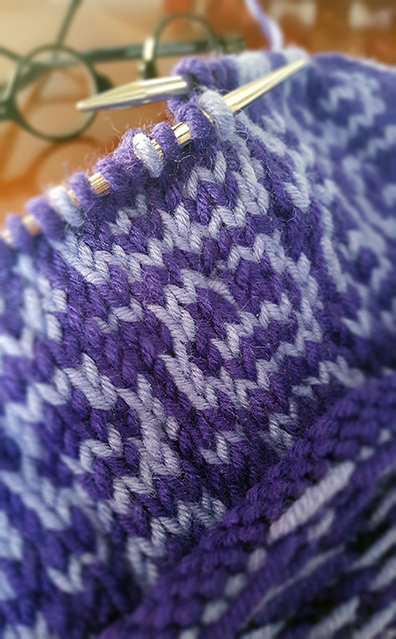
That simple square, multiplied

Transparent 5.7

becomes something greater. I need to put the sweater on Rosamund to make the final call, but I can say with certainty that I’m happy to have worked with the more unusual motif. It doesn’t look like something I’ve seen a million times before. It sure doesn’t look like something I’ve made a million times before–and that alone is worth the time spent.

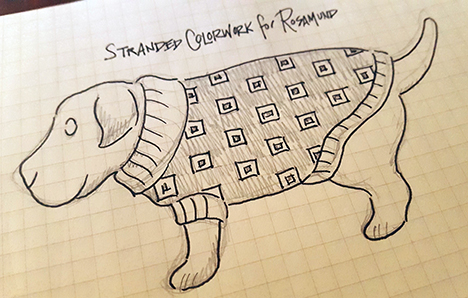
Rosamund’s last sweater had only a tiny bit of short-rowing to make the top longer than the bottom. This time, I wanted to be sure to give her back more coverage with a much extended tail, as in the sketch.

Transparent 5.8

Tail End

I could have done that by working in the round to the back flap, then working the flap itself (including the shaping) flat. Many patterns for the “shirt-tail” sweaters that become popular now and again do just that.

The potential problem is that most knitters (myself included) will find that even with the same needles and yarn, their flat gauge differs significantly from their circular gauge. More than likely, the fabric of the tail wouldn’t have matched the body unless I took the time to mess around with different needle sizes, and that’s annoying.

Also annoying? Purling wrong side rows in stranded color work. Can I do it? Yes I can. Do I enjoy it? No I do not. Is life too short to spend it knitting stuff you don’t want to knit? Yes it is.

So, seeing as I already had two steeks in this thing–one for each leg hole–why not add a third? When I reached the beginning of the tail, I put the live stitches for the lower (tummy) half of the sweater on a piece of scrap yarn,

Transparent 5.9

and then used a simple backward loop to cast on a bridge of seven stitches

Transparent 5.10

to form the basis of the steek that, when cut open, would allow the tail to lie flat.

(For more on steeks and how they’re constructed, click back to The Adventure of the Warm Puppy, Part Three.)

With the bridge in place, I could keep knitting in the round, decreasing as desired on either side of the bridge to shape the flap.

Transparent 5.11

Of course, the knitting itself starts to look bizarre. This, however, is temporary. It’s also an asset if you’re the sort of show-off knitter who likes confused strangers to come over and ask what the hell you’re making.

What’s left now is the cutting, the fitting, and the finishing.

The fitting, of course, can’t happen until after the cutting–and there, I must admit, lies the rub in working with steeks. Because you can measure and measure and measure again–and I did–but you can’t really try the thing on before you cut. And while cutting isn’t difficult, un-cutting rather is.

So I’m off to get the scissors. I invite you please to stop by again in two weeks. And then, oh then, I do hope we will have sewn this puppy up. So to speak.

Tools and Materials Appearing in This Issue

Simpliworsted by Hikoo® (55% Merino Superwash, 28% Acrylic, 17% Nylon; 140 yds per 100g skein). Colors: 033, Red Hat Purple; and 013, Violette.

addi® Turbo 16-inch circular needle
About Franklin

Designer, teacher, author and illustrator Franklin Habit is the author of It Itches: A Stash of Knitting Cartoons (Interweave Press, 2008). His new book, I Dream of Yarn: A Knit and Crochet Coloring Book has was brought out by Soho Publishing in May, 2016 and is in its second printing.

He travels constantly to teach knitters
at shops and guilds across the country and internationally; and has
been a popular member of the faculties of such festivals as Vogue
Knitting Live!, STITCHES Events, Squam Arts Workshops, Sock Summit, and
the Madrona Fiber Arts Winter Retreat.

Franklin’s varied experience in the fiber world includes contributions of writing and design to Vogue Knitting, Yarn Market News,Interweave Knits, Interweave Crochet, PieceWork, Twist Collective; and a regular columns and cartoons for Mason-Dixon Knitting, PLY Magazine, Lion Brand Yarns, and Skacel Collection. Many of his independently published designs are available via Ravelry.com.

He is the longtime proprietor of The Panopticon,
one of the most popular knitting blogs on the Internet. On an average
day, upwards of 2,500 readers worldwide drop in for a mix of essays,
cartoons, and the continuing adventures of Dolores the Sheep.

Franklin lives in Chicago, Illinois, cohabiting shamelessly with
15,000 books, a Schacht spinning wheel, four looms, and a colony of
yarn that multiplies whenever his back is turned.


Fridays with Franklin – Interlude: Into the Hoods

fwf-logo-v11

Interlude: Into the Hoods

For an introduction to what goes on in this column, click here.


Twice a year I turn over the accumulated samples in my chest of drawers and make tough choices.

There are months when I feel like all I do is swatch. Yet the finished objects pile up. And up. And up. On one hand, it’s good to have evidence of productivity. On the other, it’s nice to not die trapped under a avalanche of small woolens.

At the bottom of a chest I found one end of Scarf That Ate the World, and after five minutes of pulling had got the whole thing out into the light.

Interlude 1

It wound up buried because I couldn’t stand to look at it, or to have it sitting around staring at me.

Interlude 2

It was ridiculously long: twelve feet. And so very candy-colored. Not a bad piece of weaving, sure. But unless I were to make the acquaintance of a six-foot-tall toddler with a chilly neck, what was it for? It took up a lot of precious storage space to be so useless.

The fabric itself–that wasn’t bad. Made from three colors of HiKoo® Rylie, it had drape, drape, and more drape; and felt deluxe in the hand.

Now, a nice thing about weaving is if there’s too much of it here or there, you can chop it to size. There wasn’t quite enough to make two good scarves, but I thought about trimming it to make one scarf of less monstrous proportions.

Then I’d have a length of handwoven to throw away, which seemed a shame. Why not do a little trimming and a little sewing, and transform almost every bit into something useful?

Stage One: Cut and Sew

After taking some measurements…

Interlude 3

I found I had the right amount of fabric to turn the scarf into a hood.

The first stage was staystitching (simple sewing to prevent unraveling) followed by cutting, as shown below:

Interlude 4

A sewing machine would have made quick work of the staystitching, but as my sewing machine needs to be hauled out and set up for every new project I elected to just backstitch by hand. Backstitch is quick–each seam took about seven minutes. Setting up the machine takes thirty.

The cutting was fun. There is something intrinsically thrilling about this sight.

Interlude 5

Next, I turned and sewed quarter-inch hems that hid the staystitching on both pieces of fabric, using a matching pink thread.

Interlude 6

Stage Two: Sew and Sew

Now I had two pieces–one long, one short–and turning them into a hood was ridiculously simple.

First, match the center of the long piece to the center of the short piece like this.

Interlude 7

Pin them together.

Interlude 8

And sew the seam, which will become the top of the hood. I used Color 088 (Guava) and whip stitch, figuring this piece was rustic enough that visible seams would be an asset. (For more on whip stitch, see Adventure of the Stealth Blanket, Part Two).

Then, sew first one side of the hood back, then the other. Same yarn, same whip stitch.

Interlude 9

That could have been the end, but I’d also found in my stash a ball of HiKoo® Rylie in Color 124, a deep purple that didn’t appear in the weaving.

Interlude 10

I used it to make a blanket stitch edge all around the hood opening,

Interlude 11

where I was tickled to find it tempered the cutesy-wutesy effect of all those Necco wafer colors. (You know the party is a little too WOOOOOOOOOO when purple comes in and settles everyone down.)

I liked the purple so much in the hood that I decided to use more of it…

Interlude 12

….to make four tassels…

Interlude 13

And these I attached firmly to the bottom corners with a bit more sewing. Tassels aren’t just decorative here–the added weight should help keep the tails in place if they’re worn thrown back over the shoulders.

Interlude 14

The Scarf That Ate the World is gone, and in its place is a hood that I hope will bring a big smile to dear girl who lives in the snow and wind of coastal Maine. I don’t know, because she hasn’t seen it yet. I’ll keep you posted.

Tools and Materials Appearing in This Issue

Hikoo® Rylie (50% Baby Alpaca, 25% Mulberry Silk, 25% Linen), 274 yd/100g skein. Colors: 086 Periwinkle, 087 Freesia, 088 Guava, 124 Purple

About Franklin

Designer, teacher, author and illustrator Franklin Habit is the author of It Itches: A Stash of Knitting Cartoons (Interweave Press, 2008). His new book, I Dream of Yarn: A Knit and Crochet Coloring Book has was brought out by Soho Publishing in May, 2016 and is in its second printing.

He travels constantly to teach knitters at shops and guilds across the country and internationally; and has been a popular member of the faculties of such festivals as Vogue Knitting Live!, STITCHES Events, Squam Arts Workshops, Sock Summit, and the Madrona Fiber Arts Winter Retreat.

Franklin’s varied experience in the fiber world includes contributions of writing and design to Vogue Knitting, Yarn Market News,Interweave Knits, Interweave Crochet, PieceWork, Twist Collective; and a regular columns and cartoons for Mason-Dixon Knitting, PLY Magazine, Lion Brand Yarns, and Skacel Collection. Many of his independently published designs are available via Ravelry.com.

He is the longtime proprietor of The Panopticon, one of the most popular knitting blogs on the Internet. On an average day, upwards of 2,500 readers worldwide drop in for a mix of essays, cartoons, and the continuing adventures of Dolores the Sheep.


Franklin lives in Chicago, Illinois, cohabiting shamelessly with 15,000 books, a Schacht spinning wheel, four looms, and a colony of yarn that multiplies whenever his back is turned.

Fridays with Franklin – The Adventure of the Transparent Excuse to Show You More Pictures of My Adorable Dog, Part Four

fwf-logo-v11

The Adventure of the Transparent Excuse to Show You More Pictures of My Adorable Dog, Part Four

For an introduction to what goes on in this column, click here.

For the first part of this adventure, click here.


The votes are in!

Last time, I asked you to decide whether I ought to move forward with Option A or Option B…

Transparent 4.1

…as the fabric for a new sweater for Rosamund..

(This is Rosamund.)

Transparent 4.2

More than 500 of you voted (thank you!) and it was a landslide for Option B, 73 percent to 27 percent.*

Which meant–shall I tell you what that meant? I’ll tell you what that meant.

That meant I had to re-knit the swatch for Option B all over again, because I didn’t take gauge measurements from it the first time.

Transparent 4.3

I think it was then that I realized if I could stitch together all the false starts and swatches associated with this sweater, I’d have enough fabric to make Rosamund a set of billowy Auntie Mame hostess pajamas with a matching capelet.

As a seasoned professional, I try not to let such thoughts become obstructive. When they bubble to the surface, I find it’s best to shove them down, down, down into the deepest recesses of the most remote crevasses of the outskirts of my soul. There they remain until, years later, they re-emerge under medically supervised hypnosis as a series of harrowing, apocalyptic shrieks.

It works for me.

Planning for Growth

Knitting a shaped, patterned fabric means planning the shaping so it plays well with the patterning.

You don’t necessarily have to hide your shaping stitches; but if they’re going to show, I find it’s wise to consider what effect they’ll have on areas around them. Otherwise you’re almost certain to find the areas of transition are a muddle, and it’s those areas that often draw the eye.

In the first sweater, which was plain, I put the increases at the shoulders. That made the increase stitches themselves something of a feature.

I could have done the same again. Why not, though, try to find a way to keep that grid of garter stitch flowing with as little interruption as possible?

It seemed to me I could begin the increases right under Rosamund’s chin, on either side of a center stitch, gradually forming a triangular panel across her chest.

Transparent 4.4

According to my calculations I needed an increase of 44 stitches from the neck to the shoulder, over a distance of seven inches–or, at my gauge, 42 rounds. Very convenient: I could simply increase two stitches in every other round. Sure, it wasn’t a perfect fit–but it was well within the fudging limits that knitting allows us.

Some designers can keep all this stuff in their heads and rush into the knitting. Me, I have to make myself charts and drawings to figure out what I want to do. In chart form, the triangular panel (here abbreviated so it will fit the page) looked like this.

Transparent 4.5

The question remained of how exactly to treat each of those stitches.

It would have been possible to work out a completely different stranded pattern for this area, but frankly time and logistics were against me. This is the busy season for a traveling teacher, and I will be at retreats or festivals almost every week throughout January and February. This would therefore be an on-the-road knit, and for the sake of my sanity I decided to do this.

Transparent 4.6

The chart’s been turned point-down now, of course, so it’s oriented in the fashion it would be knit–beginning at the neck.

What you see above is a series of stockinette panels which are, as in the original swatch, bordered by garter stitch. Within the garter borders, the light and dark yarns alternate stitch by stitch and round by round.The horizontal garter bands occur in the same rounds in the chest panel as they do in the rest of the fabric. In theory, it should all flow together.

It’s not revolutionary, but it’s something I can work without a chart on a bumpy airplane. In fact, that’s exactly where I knit most of what you see in this hasty progress shot.

Transparent 4.7

The chest panel is emerging pretty much as I hoped.

Transparent 4.8

However, this is the awkward adolescent phase of the project, when it’s bunched up on the needle and nearly
impossible to photograph without it looking more like a dog’s dinner
than a dog’s sweater. So I choose to reserve judgment until I have knit quite a bit more, and can perhaps get it home and have a preliminary fitting on the model.

In the meantime, I’ll be doing something we haven’t done before–revisiting and remaking an old project from one of the first series of Fridays with Franklin. Drop by in two weeks to see what I’ve been up to.

*Fans of Option A, don’t despair. I still like the chart and have filed it away. Today’s rejected idea is tomorrow’s…well, something. It’ll become something, some day.

Tools and Materials Appearing in This Issue

Simpliworsted by Hikoo® (55% Merino Superwash, 28% Acrylic, 17% Nylon; 140 yds per 100g skein). Colors: 033, Red Hat Purple; and 013, Violette.

addi® Turbo 16-inch circular needle
About Franklin

Designer, teacher, author and illustrator Franklin Habit is the author of It Itches: A Stash of Knitting Cartoons (Interweave Press, 2008). His new book, I Dream of Yarn: A Knit and Crochet Coloring Book has was brought out by Soho Publishing in May, 2016 and is in its second printing.

He travels constantly to teach knitters
at shops and guilds across the country and internationally; and has
been a popular member of the faculties of such festivals as Vogue
Knitting Live!, STITCHES Events, Squam Arts Workshops, Sock Summit, and
the Madrona Fiber Arts Winter Retreat.

Franklin’s varied experience in the fiber world includes contributions of writing and design to Vogue Knitting, Yarn Market News,Interweave Knits, Interweave Crochet, PieceWork, Twist Collective; and a regular columns and cartoons for Mason-Dixon Knitting, PLY Magazine, Lion Brand Yarns, and Skacel Collection. Many of his independently published designs are available via Ravelry.com.

He is the longtime proprietor of The Panopticon,
one of the most popular knitting blogs on the Internet. On an average
day, upwards of 2,500 readers worldwide drop in for a mix of essays,
cartoons, and the continuing adventures of Dolores the Sheep.

Franklin lives in Chicago, Illinois, cohabiting shamelessly with
15,000 books, a Schacht spinning wheel, four looms, and a colony of
yarn that multiplies whenever his back is turned.

Fridays with Franklin – The Adventure of the Transparent Excuse to Show You More Pictures of My Adorable Dog, Part Three

fwf-logo-v11

The Adventure of the Transparent Excuse to Show You More Pictures of My Adorable Dog, Part Three

For an introduction to what goes on in this column, click here.

For the first part of this adventure, click here.

Rosamund (this is she)…

Transparent 3.1

…is not the only creature in residence here who is known on occasion to chase her own tail.

That, my friends, is exactly what I feel I’ve been doing since we last met.

In the inaugural “Fridays with Franklin,” I wrote about the meandering path creativity often takes, but I left something off the map.

It can happen that in working out an idea, even an idea I think is good, I find myself in a place where the fun little meanders and switchbacks turn into a sort of maelstrom. Or do I mean merry-go-round? Hamster wheel? At any rate, something that goes round and round and round and round and round and round and round and round and round and round and round and round and gets exactly nowhere.

Transparent 3.2

This is not fun. Perhaps it would be if I were a hamster. I’ve never seen a hamster on a wheel who looked unamused.

But I am not a hamster.

To recap, I first thought I’d use this as the chart for the stranded color work dog sweater,

Transparent 3.3

until I decided it was too boring and replaced it with this

Transparent 3.4

until I decided it was too busy, so I ripped it out.

Transparent 3.5

That’s where we ended last time.

I turned to my original sketch

Transparent 3.6

for a refresher. I didn’t necessarily want to cover the fabric in checks, no. It doesn’t do to take a sketch too literally. What I had imagined something crisp and bold.

So I went back to square one (ha) and charted this.

Transparent 3.7

As I swatched, I thought, “This is a very, very simple chart. What if I jazzed up the fabric by knitting the borders between the little checked squares as garter stitch?”

Here’s what happened.

Transparent 3.8

I got as far as you see here before taking one snapshot. Then I decided this looked clunky and ripped it out.

After a walk around the block with Rosamund, who was still not wearing the new sweater I had now been swatching for a month, I sat down and charted this.

Transparent 3.9

It ain’t much. But in my Knitted Tessellations class, I’ve taught thousands (it’s a popular class, thank you) of knitters how to start with an unassuming niblet like this and apply various forms of symmetry.

Do that, and it could turn into:

Transparent 3.10

And that could turn into:

Transparent 3.11

And now, it seemed, I was cooking.

Transparent 3.12

I cast on yet another swatch, only to find that in reality my choice of colors gave me something I hadn’t seen in the chart: very pedestrian Xs and Os. Yippee.

Transparent 3.13

That chart, though. It was so promising. What if I flipped the colors and knit it again with light as dark and dark as light? Since the stitch count was identical, I decided to work out that idea on the same swatch.

Transparent 3.14

Here came another bend in the path, because what made me perk up was the change from one section to the next. That was interesting. What if I knit the chart in alternating bands–one repeat with purple (in this case, 033 Red Hat Purple) as Color A; and the next with lilac (specifically, 013 Violette) as Color A? Reverse, repeat.

So I kept swatching.

Transparent 3.15

I was feeling pumped. No, it wasn’t the bold, crisp pattern I’d had in mind. But I thought it would–once propagated across the full sweater–have a pleasant shimmery complexity.

Then I showed it (and the previous swatch) to a trusted colleague–someone of reliable taste, and dear enough to me that I can bear his unvarnished opinion; and what he wrote was, “The first one [meaning the garter/stockinette combination] is much more interesting. The second one is kinda muddy.”

Huh.

Looking at it with fresher eyes, perhaps that first fabric did have merit. The garter stitch borders reminded me of quilting, certainly desirable in a cold-weather garment. And it was closer to the original geometric image in my head. Was it the better motif?

I dithered for a few hours, then showed pictures of both to the one other person in my life who is sometimes invited to weigh in. He said, “I don’t know. The first one. No, the second one. I don’t know. They’re both fine. Which one do you like?”

At which point I began to feel like a hamster in a maelstrom.

Transparent 3.16

Have you ever seen a hamster in a maelstrom who looked happy to be there? No, you have not.

I was about to flip a coin–something which has helped me many times to stop spinning and start moving forward again. Then I thought, no. No, let’s do something more fun than that.

I want you, friends, to do the choosing. Please.

Since I can’t decide,** tell me which you would prefer as the starting point for Rosamund’s sweater–either Option A or Option B. (These, please understand, are the only options I will entertain. I am already befuddled enough for a whole maelstrom* of hamsters.)

Transparent 3.17

To vote, click here or on the image above, and you’ll be taken to a polling page.We will keep the voting open until noon, United States CST, on Monday, January 2, 2017. Only votes submitted here will count.

To find out what happens, please come on back in two weeks.

*Is a group of hamsters called a “maelstrom”? If not, I feel it should be.
**Before you suggest it, I did ask Rosamund which she prefers. She said this one or that one, only do get on with it before spring thaw.

Tools and Materials Appearing in This Issue

Simpliworsted by Hikoo® (55% Merino Superwash, 28% Acrylic, 17% Nylon; 140 yds per 100g skein). Colors: 033, Red Hat Purple; and 013, Violette.

addi® Turbo 16-inch circular needle
About Franklin

Designer, teacher, author and illustrator Franklin Habit is the author of It Itches: A Stash of Knitting Cartoons (Interweave Press, 2008). His new book, I Dream of Yarn: A Knit and Crochet Coloring Book has was brought out by Soho Publishing in May, 2016 and is in its second printing.

He travels constantly to teach knitters
at shops and guilds across the country and internationally; and has
been a popular member of the faculties of such festivals as Vogue
Knitting Live!, STITCHES Events, Squam Arts Workshops, Sock Summit, and
the Madrona Fiber Arts Winter Retreat.

Franklin’s varied experience in the fiber world includes contributions of writing and design to Vogue Knitting, Yarn Market News,Interweave Knits, Interweave Crochet, PieceWork, Twist Collective; and a regular columns and cartoons for Mason-Dixon Knitting, PLY Magazine, Lion Brand Yarns, and Skacel Collection. Many of his independently published designs are available via Ravelry.com.

He is the longtime proprietor of The Panopticon,
one of the most popular knitting blogs on the Internet. On an average
day, upwards of 2,500 readers worldwide drop in for a mix of essays,
cartoons, and the continuing adventures of Dolores the Sheep.

Franklin lives in Chicago, Illinois, cohabiting shamelessly with
15,000 books, a Schacht spinning wheel, four looms, and a colony of
yarn that multiplies whenever his back is turned.

Fridays with Franklin – The Adventure of the Transparent Excuse to Show You More Pictures of My Adorable Dog, Part Two

fwf-logo-v11

The Adventure of the Transparent Excuse to Show You More Pictures of My Adorable Dog, Part Two

For an introduction to what goes on in this column, click here.

For the first part of this adventure, click here.


Sometimes when you know where you want to go and plan how to get there, you still end up in a ditch.

We ended last time with a peek at the swatch for Rosamund’s new sweater.

Transparent 2.1

(This is Rosamund.)

Transparent 2.2

I swatched with the usual good intentions:

  • To determine my stitch and round gauges.
  • To test the drape and appearance of the fabric.
  • To test the motif.

I also washed and blocked my swatch. Yes, I did. Oh boy, did I feel smug.

Transparent 2.3

The swatch was promising. Cuddly drape. Firm enough to be warm in a Chicago winter chill. The motif was fine.

When I sketched the sweater, I had in mind something bold and clean and crisp. A repeating motif, probably geometric. Not a large motif, though. Large repeating patterns are a tricky proposition on small garments, because there’s usually not enough space for them to breathe.

Transparent 2.4

The construction would be the same as that of the first sweater–neck down, in the round, with steeks. Familiar territory.

That motif, though. That motif. It bugged me.

Transparent 2.5

Would you look twice at that if it ran past you on its way to chasing a squirrel? No, you wouldn’t. Not even with that rich purple in the mix. So pedestrian.

Transparent 2.6

I decided to mess around with pushing stitches here and there, and at some length had jazzed it up into this.

Transparent 2.7

Repeated, it looked very promising in the chart.

Transparent 2.8

No need to swatch again, right? Nah.

Wrong.

I got this far

Transparent 2.9

and realized that I didn’t like it at all. This patterning is less crisp, clean, and bold than the first version; all those little changes made it feeble. Muddy. From a distance, it’s barely visible as a pattern.

So what to do? Rip. Reconsider. And swatch.

See you in two weeks–at which time I intend to have something more interesting to show you. Dang it.

Transparent 2.10

Tools and Materials Appearing in This Issue

Simpliworsted by Hikoo® (55% Merino Superwash, 28% Acrylic, 17% Nylon; 140 yds per 100g skein). Colors: 033, Red Hat Purple and 013, Violette.

addi® Turbo 16-inch circular needle

About Franklin

Designer, teacher, author and illustrator Franklin Habit is the author of It Itches: A Stash of Knitting Cartoons (Interweave Press, 2008). His new book, I Dream of Yarn: A Knit and Crochet Coloring Book has was brought out by Soho Publishing in May, 2016 and is in its second printing.

He travels constantly to teach knitters at shops and guilds across the country and internationally; and has been a popular member of the faculties of such festivals as Vogue Knitting Live!, STITCHES Events, Squam Arts Workshops, Sock Summit, and the Madrona Fiber Arts Winter Retreat.

Franklin’s varied experience in the fiber world includes contributions of writing and design to Vogue Knitting, Yarn Market News,Interweave Knits, Interweave Crochet, PieceWork, Twist Collective; and a regular columns and cartoons for Mason-Dixon Knitting, PLY Magazine, Lion Brand Yarns, and Skacel Collection. Many of his independently published designs are available via Ravelry.com.

He is the longtime proprietor of The Panopticon, one of the most popular knitting blogs on the Internet. On an average day, upwards of 2,500 readers worldwide drop in for a mix of essays, cartoons, and the continuing adventures of Dolores the Sheep.


Franklin lives in Chicago, Illinois, cohabiting shamelessly with 15,000 books, a Schacht spinning wheel, three looms, and a colony of yarn that multiplies whenever his back is turned.

Fridays with Franklin – The Adventure of the Transparent Excuse to Show You More Pictures of My Adorable Dog, Part One

fwf-logo-v11

The Adventure of the Transparent Excuse to Show You More Pictures of My Adorable Dog, Part One


For an introduction to what goes on in this column, click here.


We’ve yet to see snow (he whispered, nervously) but winter has arrived in Chicago. This means that my friend Rosamund, shown here

Transparent 1.1

has taken to sleeping at night wrapped in both the duvet and the electric blanket with her cold nose buried in my warm armpit.*

I can’t blame her. I have more fur on my chest than she does, poor darling.

Her first sweater, which I wrote about in this adventure, has been in service almost every day for the past two weeks.

Transparent 1.2

This sweater was intended as a pilot project. First, to see if I could custom fit a garment to a four-footed model. Then, to observe how said garment would perform in the real world. So, how did it go?

I’m very impressed with the performance of Hikoo® Simpliworsted when subjected to heavy use by my cannonball of a dog.

Sauntering, trotting, running, jumping, twisting, bounding, rolling, and frenetic repeat performances of the “I See a Rabbit Polka” have done nothing to harm the yarn; it hasn’t faded, stretched or even pilled. Solid stuff, this.

It went through the washer and dryer after Little Miss Mudpie flopped in a puddle near the construction site on the next block. The sweater came out looking no worse for wear. Rosamund, being Hand Wash Only, was somewhat tougher to clean.

The Final Cut

I knew the “finished” sweater was going to require one more alteration.

When Rosamund goes for a walk she wears the purple harness we jovially refer to as her sports bra.

Transparent 1.3

Now, I could have adjusted the harness to fit over the sweater, but that would have spoiled the look and been less comfortable. I wanted her to wear the harness underneath, which means the sweater needed an opening in the center back for the leash to pass through.

I could have planned for this during the knitting; but remember that I was unsure of exactly how the fit was going to work out. I didn’t know if the sweater would sag or ride up, stretch or twist. I couldn’t have known with certainty where to put the opening.

So I let her run around in both for a while, on several different days, to see how the two pieces interacted. When I felt confident about where the leash loop and the sweater needed to align, I marked the top and bottom of that spot with a pair of locking-ring stitch markers.

Transparent 1.4

You know what’s coming next, don’t you? Don’t you?

A steek.

Transparent 1.5

Don’t be so melodramatic.

Steeks were quite the feature of the original adventure, and I wrote about them at length here–reassuring you that they don’t just happen, you usually plan for them.

That doesn’t mean you can’t decide after the fact to put one in, which is what I did.

After counting the stitches across the back to make sure I was exactly in the center, I moved my markers to indicate the top and bottom of the center (cutting) column of my intended steek.

Transparent 1.6

Then I used some more of the knitting yarn and a hook from my addi® Colors Crochet Hook Set to secure the pairs of stitch columns to the immediate right and left of the cutting column with chain crochet. (Again, for a full discussion of the technique, see The Adventure of the Warm Puppy.)

Transparent 1.7

Then I cut the opening.

Transparent 1.8

A crocheted steek gives such nice, neat edges that frankly I could have left that hole as it was. But my late grandmother’s voice echoed in my head, saying, “This opening is a stress point, and therefore subject to extra wear. Furthermore, those edges are raw and unfinished.”

My grandmother would have no more permitted me to send my dog out into the world with unfinished cut selvages showing than she would have attended a meeting of the Ladies Altar Rosary Society in her nightgown.

“Raw edges must be finished,” continued the ghostly voice, “and stress points must be reinforced, unless you want your poor grandmother to cry in heaven. Did I raise you right or did I not? OOOOoooOOOOOooooOOOOO.”

Fine, fine. Easy enough. I picked up and knit stitches (making sure I had a number divisible by four) around the opening…

Transparent 1.9

…on a set of double-pointed needles, then worked k2p2 ribbing to match the ribs at the legs and collar. I made the ribbing long enough to be turned over and sewn down on the wrong side, completely encasing the cut edges.

Transparent 1.10

It looks odd all by itself, yes. But now the sweater and harness work perfectly in tandem, and my grandmother’s ghost can go chill out with a beer.

Transparent 1.11

In the evening we went for another walk around the neighborhood. I took a packet of stitch markers, and as we trotted along I noted where on the finished sweater the top of her front leg really sits (Point A), and put a marker there.

Transparent 1.12

And I also noted with a marker how deep the too-large leg opening on the original sweater needed to be snugger fit (Point B).

Transparent 1.13

With the alteration points marked, I could now revise my measurements and prepare for the project that will be the heart of this new adventure.

Another Rosamund sweater in Hikoo® Simpliworsted, but this time, in…

Transparent 1.14

stranded color work.

Meet me back here in two weeks and I’ll tell you all about it.

*Does this make her…an armpit bull? Hahahahaha. Ha.


Tools and Materials Appearing in This Issue

Simpliworsted by Hikoo® (55% Merino Superwash, 28% Acrylic, 17% Nylon; 140 yds per 100g skein). Colors: 611, Earth and Sky (sweater); 033, Red Hat Purple and 013, Violette (swatch).

addi® Steel double-pointed needles, 8 inch length

3.5 mm hook from addi® Colors Crochet Hook Set

About Franklin

Designer, teacher, author and illustrator Franklin Habit is the author of It Itches: A Stash of Knitting Cartoons (Interweave Press, 2008). His new book, I Dream of Yarn: A Knit and Crochet Coloring Book has was brought out by Soho Publishing in May, 2016 and is in its second printing.

He travels constantly to teach knitters at shops and guilds across the country and internationally; and has been a popular member of the faculties of such festivals as Vogue Knitting Live!, STITCHES Events, Squam Arts Workshops, Sock Summit, and the Madrona Fiber Arts Winter Retreat.

Franklin’s varied experience in the fiber world includes contributions of writing and design to Vogue Knitting, Yarn Market News,Interweave Knits, Interweave Crochet, PieceWork, Twist Collective; and a regular columns and cartoons for Mason-Dixon Knitting, PLY Magazine, Lion Brand Yarns, and Skacel Collection. Many of his independently published designs are available via Ravelry.com.

He is the longtime proprietor of The Panopticon, one of the most popular knitting blogs on the Internet. On an average day, upwards of 2,500 readers worldwide drop in for a mix of essays, cartoons, and the continuing adventures of Dolores the Sheep.


Franklin lives in Chicago, Illinois, cohabiting shamelessly with 15,000 books, a Schacht spinning wheel, three looms, and a colony of yarn that multiplies whenever his back is turned.

Fridays with Franklin – The Adventure of the Fallen Flowers: Part Four

fwf-logo-v11

The Adventure of the Fallen Flowers: Part Four

For an introduction to what goes on in this column, click here.

For the first part of this adventure, click here.


My friend Euclid

Fallen 4.1

is always going on about how a straight line is the shortest distance between two points. I usually just tune it out, but staring at this length of free-form crochet really brought the point home to me.

Fallen 4.2

Here I was in week eight of this project, and from tip to tip the fabric measured 38 inches long and about seven inches wide. While most of it was worked in a fingering weight yarn (Schoppel Wolle Zauberball®), that was not a lot of acreage for the amount of work involved.

I hadn’t taken Euclid’s advice. I’d worked from point A to point B (if this is even B, it might be A-and-a-half) in little linked-up circles that meandered in hither and thither.

Now I was going to go back to Point A with two other yarns

Fallen 4.3

to add more detail.

Euclid shook his head. “Hey man,” he said. “You do you, okay?”

First Pass: Deep Purple

The odds in my game had been slanted in favor of the gentle browns and creams of the Zauberball®, but there was still a lot of the pale purple Hikoo® Tiara (Color 74: Amethyst) scattered through the fabric. The effect was nice enough, but a piece worked entirely in muted colors runs the risk of looking a little sleepy.

I decided to pepper the whole thing with tiny jolts of Hikoo® Simpliworsted in Color O33: Red Hat Purple. That is a PURPLE!!!! Purple, as deeply saturated as the Tiara is subdued. When you put brilliant and muted versions of the same color near one another in the same fabric, the effect can be a handsome shimmer–something the Fair Isle knitters of Shetland have known for generations.

My first thought was to make teeny pistils for the purple flowers with chain crochet, and I soon saw that the effect was…

Fallen 4.4

horrid.

I was hoping for elegant charm. This looked more like bad soft sculpture. The blossoms were all soft-edged and suggestive, like a pastel sketch or watercolor painting. These nubbins looked more like something from a cartoon. So I ripped them out.

Still, I really wanted that kiss of brilliant purple in the center of each Tiara flower. I worked a few more fiddly bits of crochet, none remotely successful. Then, before giving up, I tried a few simple, straight embroidery stitches taken from the center out.

Fallen 4.5

Huh. Not bad. Good enough to move forward, anyhow.

Second Pass: Second Layer

My goal with the Hikoo® Rylie (Color 124: Urchin) was twofold: to add texture and to add a third purple to the mix. I wanted to make a second layer of scattered blossoms to sit on top of this first layer–an idea I got from talking to Edie Eckman when I called her to ask permission to use Connect the Shapes Crochet Motifs in this series.

I had noticed a project, a tote bag, illustrated in the book and asked how she had achieved such a deep, sculptural surface. “It’s not hard,” she said. “You can always go back and add more where you think you need it. Those were made separately and tied on.”

Well, okay then.

I used my smaller hook–a US size D (3.25mm), which I’d been using with the Zauberball®–to work out this variation on the blossom from Edie’s book.

Begin with sliding loop.

Rnd 1. Ch 1, 4 sc in ring, join with slip st to first sc.

Rnd 2. Ch 2, 6 dc in same st. *Sc in next sc, 6 dc in same st. Rep from * around, join with sl st to first sc.

Fasten off.

This gives a ruffly little four-petaled flower with two yarn tails sticking out the center of the wrong side. I spent a very enjoyable hour turning out a pile of them.

Fallen 4.6

The yarn tails are used to tie the flower to the main fabric as desired. In a move than I am afraid will get me sent to the free-form crochet penalty box, I decided in advance where to put them all, and pinned them into place.

Fallen 4.7

It was quick work to tie them down with a couple of double knots on the wrong side, and clip the tails to tiny ends.

Parting Shots

I began this series by comparing free-form crochet to one of my sketches; and the more I worked on the floral fabric the more true the comparison became. With both, part of the process is knowing when to stop. Theoretically, you never have to–unless the materials themselves collapse under the weight of the accumulated work.

Is this finished?

Fallen 4.8

I suppose it is. I feel that it is. I’m ready to move on.
I’ve learned a lot in working on it, and what’s more, I’ve enjoyed myself. No, free-form crochet is not the most efficient way to produce fabric. But who cares how long it takes, if you have a good time?

I really wanted to show you this piece on a model; it looks best that way. Sadly, Marie-France partied a little too hard last night and so I must ask that you accept a substitute.*

Fallen 4.9

Fallen 4.10

Fallen 4.11

Fallen 4.12

Sorry.

Coming Up…

So ends this adventure.

See you the Friday after Thanksgiving week, friends. The cold weather is drawing in, and I’m at work on a new sweater.

*Personal to Vogue Knitting magazine. You have my number. Call me.

Tools and Materials Appearing in This Issue

Connect the Shapes Crochet Motifs by Edie Eckman (Storey Publishing)

Schoppel Wolle Zauberball® (75% Superwash Wool, 25% Nylon), 420m/100g ball. Color: 1993 (Chocolate Cream)

Hikoo® Tiara (10% Kid Mohair, 5% Wool, 49% Acrylic, 22% Nylon, 10% Bead, 4% Sequin), 188 yd/100g hank. Color: 74 (Amethyst)

Hikoo® Rylie (50% Baby Alpaca, 25% Mulberry Silk, 25% Linen), 274 yd/100g hank. Color: 124 (Urchin)

Hikoo® Simpliworsted (55% Merino Wool 25% acrylic 17% Nylon), 140 yd/100g hank. Color: 033 (Red Hat Purple)

addi® Olive Wood Crochet Hooks

About Franklin

Designer, teacher, author and illustrator Franklin Habit is the author of It Itches: A Stash of Knitting Cartoons (Interweave Press, 2008). His new book, I Dream of Yarn: A Knit and Crochet Coloring Book has was brought out by Soho Publishing in May, 2016 and is in its second printing.

He travels constantly to teach knitters at shops and guilds across the country and internationally; and has been a popular member of the faculties of such festivals as Vogue Knitting Live!, STITCHES Events, Squam Arts Workshops, Sock Summit, and the Madrona Fiber Arts Winter Retreat.

Franklin’s varied experience in the fiber world includes contributions of writing and design to Vogue Knitting, Yarn Market News,Interweave Knits, Interweave Crochet, PieceWork, Twist Collective; and a regular columns and cartoons for Mason-Dixon Knitting, PLY Magazine, Lion Brand Yarns, and Skacel Collection. Many of his independently published designs are available via Ravelry.com.

He is the longtime proprietor of The Panopticon, one of the most popular knitting blogs on the Internet. On an average day, upwards of 2,500 readers worldwide drop in for a mix of essays, cartoons, and the continuing adventures of Dolores the Sheep.

Franklin lives in Chicago, Illinois, cohabiting shamelessly with 15,000 books, a Schacht spinning wheel, three looms, and a colony of yarn that multiplies whenever his back is turned.

Fridays with Franklin – The Adventure of the Fallen Flowers: Part Three

fwf-logo-v11

The Adventure of the Fallen Flowers: Part Three

For an introduction to what goes on in this column, click here.

For the first part of this adventure, click here.


So began the rolling of the dice and the oh-so-gradual emergence of my carpet of crochet flowers.

Fallen 3.1

By freeform standards, my form was not all that free. I was using one motif; albeit in two different weights with two different yarns, the finer of which (Schoppel Wolle Zauberball®) was gradually changing color.

Fallen 3.2

Even so, I struggled.

My earliest blossoms were lopsided and scrunched, with a tension that could be kindly described as clenched.

Fallen 3.3

I elected to use the “flat join” from Edie Eckman’s Connect the Shapes Crochet Motifs, which allowed me to join as I worked, and more importantly discouraged me from ripping out too much. I told myself the rustic nature of the Zauberball® helped to disguise that, and from time to time almost believed it. There’s even a mutant flower in there with five petals (or was it six?) instead of four. I can’t seem to find it now, but I know it’s in there.

But this is a freeform piece, so I elected to let it go. Nature mutates, so why not my crochet?

That sounds so laid back, doesn’t it? Que sera sera. Laissez-les bons temps rouler. So terribly Zelda Fitzgerald leaping into a fountain.

In truth, it was forced out through a clenched jaw. I had no idea of my innate attachment to uniformity until I tried to let it go.

In spite of my best efforts, I’d pause and note that my “random” blossoms were still lined up in neat rows and the edges of my scattered carpet were frustratingly even.

Still, I pressed on.

Fallen 3.4

I thought of a society dame in an old New Yorker cartoon by the legendary Helen Hokinson, putting the finishing touches on her flower show display and saying with exasperation, “I am trying to achieve the effect of a sombrero carelessly thrown down!”

There is a lot of blather about knitting and crochet being forms of meditation. For the first time, my needlework really reminded me of meditation. Specifically, my earliest attempts at meditation, when that hour spent on a cushion full of buckwheat hulls felt like a month in a pit full of vipers.

Still, I pressed on.

I felt like this thing I was making might truly stink, but I wasn’t going to write two columns about it only to present you with a finale showing a bunch of cut up flowers and the caption, “Nevermind.”

It grew slowly, but it grew.

Fallen 3.5

My tension relaxed and steadied.

Fallen 3.6

My joins grew more adventurous.

Fallen 3.7

I began to break away from the unconscious habit of working in parallel rows.

Fallen 3.8

Without knowing when or how, I relaxed into the work.

When the fabric had reached dimensions that might serve as a cowl, I paused to assess.

Fallen 3.9

Now, it’s okay. I don’t hate it. I also don’t love it–yet. I was going to bring the adventure to an end here, but after rummaging around in my stash I’ve found some Hikoo® Rylie and Hikoo® Simpliworsted, and with those I’m going back to work it over a little more. I think it needs variety.
I’ll have put four very different yarns all in one piece. I’ve never done that before.

This, however, is freeform–so I am free to do it. Exciting.

See you in two weeks.

Tools and Materials Appearing in This Issue

Connect the Shapes Crochet Motifs by Edie Eckman (Storey Publishing)

Schoppel Wolle Zauberball® (75% Superwash Wool, 25% Nylon), 420m/100g ball. Color: 1993 (Chocolate Cream)

Hikoo® Tiara (10% Kid Mohair, 5% Wool, 49% Acrylic, 22% Nylon, 10% Bead, 4% Sequin), 188 yd/100g hank. Color: 74 (Amethyst)

Hikoo® Rylie (50% Baby Alpaca, 25% Mulberry Silk, 25% Linen), 274 yd/100g hank. Color:

Hikoo® Simpliworsted (55% Merino Wool 25% acrylic 17% Nylon), 140 yd/100g hank.

addi® Olive Wood Crochet Hooks

About Franklin

Designer, teacher, author and illustrator Franklin Habit is the author of It Itches: A Stash of Knitting Cartoons (Interweave Press, 2008). His new book, I Dream of Yarn: A Knit and Crochet Coloring Book has was brought out by Soho Publishing in May, 2016 and is in its second printing.

He travels constantly to teach knitters
at shops and guilds across the country and internationally; and has
been a popular member of the faculties of such festivals as Vogue
Knitting Live!, STITCHES Events, Squam Arts Workshops, Sock Summit, and
the Madrona Fiber Arts Winter Retreat.

Franklin’s varied experience in the fiber world includes contributions of writing and design to Vogue Knitting, Yarn Market News,Interweave Knits, Interweave Crochet, PieceWork, Twist Collective; and a regular columns and cartoons for Mason-Dixon Knitting, PLY Magazine, Lion Brand Yarns, and Skacel Collection. Many of his independently published designs are available via Ravelry.com.

He is the longtime proprietor of The Panopticon,
one of the most popular knitting blogs on the Internet. On an average
day, upwards of 2,500 readers worldwide drop in for a mix of essays,
cartoons, and the continuing adventures of Dolores the Sheep.

Franklin
lives in Chicago, Illinois, cohabiting shamelessly with 15,000 books, a
Schacht spinning wheel, three looms, and a colony of yarn that
multiplies whenever his back is turned.