The Adventure of the Llama on the Corner, Part Three

fwf-logo-v11For an introduction to what goes on in this column, click here.

For the first part of this adventure, click here.

It’s not there yet.

This project, this mitered shadow knitting project, is knocking for me a loop right here on stage in front of you all. I won’t whine, though–this is what I signed on for back in the first column. When it doesn’t work, I’ll show you.

My last word on the first set of a squares…

Llama 2.7

…was that I liked them enough to move forward with them. That feeling didn’t last long.

As is so often the case, they’re weren’t “bad.” Just not right.

single-large-sq

The wide borders took up a lot of real estate. The shadow-knit spaces inside were puny. Squashed. And they were supposed to have been the main event. This, plus the changes in color, plus the texture of the yarn–it was all becoming too much.

Time to re-think and to simplify.

Over-complication is a perennial issue for me. When making plans, the imaginative half of my brain gallops while the sensible half trots. My notebooks fill up with schemes for projects with unusual structures and complicated color work and fine yarns and interesting texture, and

There’s an old saying in classic menswear that if a man wishes to be eye-catching but remain elegant, he gets one thing. One statement piece. That may be a boutonnière, a pocket square, a bowler hat, a bright bow tie, a boldly patterned jacket–but he must pick one and only one.

menswear

As a wise fellow behind a Savile Row counter once said to me, as I ogled an ornate silver set comprising cufflinks, tie clasp, money clip, pocket watch with chain and fob, lapel pin, and signet ring: “Respectfully, sir does not wish to appear to be a Christmas tree.”

franklin-tree

You may or may not agree with that notion, but I find it helps me whittle my designs down to a point where they don’t sag under the weight of too many Interesting Features. Also, to a point where they become something you can knit with only two hands and one brain.

What was the one thing to show off in this cowl? Why had I started this in the first place?

It was, I remembered, the potential magic of the shifting patterns in a piece of shadow knitting created with multiple changes of grain. I hoped that as the viewer’s viewpoint shifted, pattern would appear or vanish in different parts of the piece at the same time.

The borders interfered with that, so I took them out. I also made the spine as small as possible.

What had been arranged like this over seven stitches…

old-spine

…I now arranged over only three stitches.

new-spine

That caused a very abrupt change in grain at the decrease point. Now the differences between the two halves of the square really popped. Exactly what I wanted.

single-small-sq

I used a centered (sometimes called vertical) double decrease (sl2-k1-psso), which turns three stitches into one and gives you a neat, symmetrical bundle with the central stitch on top. It looks like this:

double-dec

Here’s how you do it.

  1. Work to the three stitches involved in the decrease.
  2. Slip the first two stitches together, as if to knit, from the left needle to the right needle.
  3. Knit the next stitch.
  4. Past the first two stitches, together or separately, over the knit stitch.

I use this double decrease all the time. It doesn’t lean to the right, like a knit three together (k3tog). That’s nice when, for example, you are bringing together a pair of converging lace diagonals. In fine and/or slippery yarns, it’s also much easier to control. When I k3tog in fine silk or cotton, I almost invariably drop one of the three live stitches before I’ve got them all secured. Not so with sl2-k1-psso.

I made these new squares little smaller, too, thinking they might look less clunky.

My square pile started growing again.

small-sq-pile

Then I got another idea. A much better idea. I think.

Dang it.

See you in two weeks?

Tools and Materials Appearing in This Issue

HiKoo® Llamor (100% baby llama; 109 yd per 50g ball), available in the Peruvian Palette, the Natural Palette, and the Carnival Palette
addi® Olive Wood Circular knitting needles

About Franklin

Designer, teacher, author and illustrator Franklin Habit is the author of It Itches: A Stash of Knitting Cartoons (Interweave Press, 2008). His new book, I Dream of Yarn: A Knit and Crochet Coloring Book was brought out by Soho Publishing in May 2016 and is in its second printing.

He travels constantly to teach knitters at shops and guilds across the country and internationally; and has been a popular member of the faculties of such festivals as Vogue Knitting Live!, STITCHES Events, the Maryland Sheep and Wool Festival, Squam Arts Workshops, the Taos Wool Festival, Sock Summit, and the Madrona Fiber Arts Winter Retreat.

Franklin’s varied experience in the fiber world includes contributions of writing and design to Vogue Knitting, Yarn Market News, Interweave Knits, Interweave Crochet, PieceWork, Twist Collective; and a regular columns and cartoons for Mason-Dixon Knitting, PLY Magazine, Lion Brand Yarns, and Skacel Collection/Makers’ Mercantile. Many of his independently published designs are available via Ravelry.com.

He is the longtime proprietor of The Panopticon, one of the most popular knitting blogs on the Internet (presently on hiatus).

Franklin lives in Chicago, Illinois, cohabiting shamelessly with 15,000 books, a Schacht spinning wheel, four looms, and a colony of yarn that multiplies whenever his back is turned.

Follow Franklin online via Twitter (@franklinhabit), Instagram (@franklin.habit), his Web site (franklinhabit.com) or his Facebook page.

Fridays with Franklin – The Adventure of the Llama on the Corner, Part Two

fwf-logo-v11The Adventure of the Llama on the Corner, Part Two

For an introduction to what goes on in this column, click here.

For the first part of this adventure, click here.

Here’s what I have in mind.

As I wrote in the previous installment, shadow knitting only shows its hidden pattern when the viewer is looking at the fabric from a low angle across the horizontal (row) grain.

Llama 2.1

What I have wanted to mess around with for ages is this: a piece of shadow knitting that deliberately obscures part of the hidden pattern from every angle. A piece that will never, ever, show you everything no matter where you stand.

This shouldn’t be terribly complicated. All it requires is that we make sure every so often to change the grain of the fabric. This could be as simple as knitting the work in pieces, with the grains at (for example) right angles to one another. One of my earliest sketches looked something like this.

Llama 2.2

That’s nothing more than two pieces joined together. It would work.

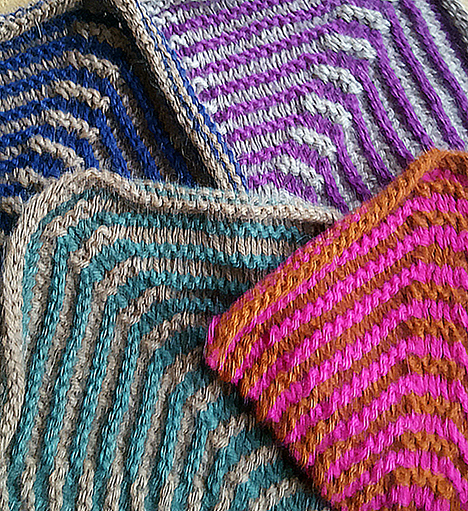
Or…we could take advantage of knitting’s ability to produce a single piece of fabric that contains within itself a change of grain. We could knit a mitered square.

Mitered squares are not at all difficult. They boil down to a simple recipe.

1. Cast on double the number of stitches you need for one side, plus one “spine” stitch that will be located halfway across the row.

2. Begin knitting. On every other row, decrease one stitch (using, theoretically, any single decrease) on either side of the spine stitch, which will be the center of the row.

3. Continue until you have about three stitches left.

4. Bind off.

That’s it. I mean, you can finesse it by pairing your decreases so they slant toward or away from the spine stitch. But really, that’s it.

What you get is a square with a horizontal (row) grain that bends 90 degrees when it reaches that spine.

Llama 2.3

And since almost any solid fabric that can be knit in stripes can be worked as shadow knitting, a shadow mitered square should be interesting. Not necessarily good, mind you. But interesting. We’ll see.

The Color of Shadows

I didn’t say much about the colors of the HiKoo Llamor in my pile last week. Here they are, chose from across the line’s Peruvian, Natural, and Carnival palettes.

Llama 2.4

I know. That pink is really pink. I want it that way. I’m in the mood for color, and the brilliance of the pink strikes me as a nice shot of energy in the midst of all the more muted shades.

In fact, I like all of these so much as a jumble that I’m not going to spend a whole lot of time deciding which two to pair in each square. I’m just going to grab and go.

Testing, Testing

The first square off the needles was promising. Not perfect, but promising.

Llama 2.5

I got the effect I wanted: a shadow triangle in each half, with contrasting shadow borders in the middle and sides. As with most shadow fabrics, there is a tendency to curl–but a nice wet block…

Llama 2.6

…calmed the curl and cause the fabric to bloom. The Llamor, which was already soft pre-blocking, became positively buttery; and unlike some pure llama yarns I’ve worked with, it gained a gentle halo instead of busting out in a total frizz.

I wasn’t absolutely satisfied with structural details of the square, but I’ve decided to do something kind of outside my comfort zone. Rather than rip the whole thing out and start again, I’m going to stick with it and press on. I have limited time and a limited supply of Llamor on hand.

Llama 2.7

Four down, a third in progress. (I know, I know. It’s a shaky photo. I was excited. And also 37,000 feet in the air on an Embraer RJ145 in the middle of turbulence.)

I think we’re going to make this a cowl.

Come back in two weeks, and I’ll show you what I’ve got.

Tools and Materials Appearing in This Issue

HiKoo® Llamor (100% baby llama; 109 yd per 50g ball), available in the Peruvian Palette, the Natural Palette, and the Carnival Palette
Schoppel-Wolle Gradient (100% merino wool; 284 yd per 100g ball)
addi® Olive Wood Circular knitting needles

About Franklin

Designer, teacher, author and illustrator Franklin Habit is the author of It Itches: A Stash of Knitting Cartoons (Interweave Press, 2008). His new book, I Dream of Yarn: A Knit and Crochet Coloring Book was brought out by Soho Publishing in May 2016 and is in its second printing.

He travels constantly to teach knitters at shops and guilds across the country and internationally; and has been a popular member of the faculties of such festivals as Vogue Knitting Live!, STITCHES Events, Squam Arts Workshops, the Taos Wool Festival, Sock Summit, and the Madrona Fiber Arts Winter Retreat.

Franklin’s varied experience in the fiber world includes contributions of writing and design to Vogue Knitting, Yarn Market News, Interweave Knits, Interweave Crochet, PieceWork, Twist Collective; and a regular columns and cartoons for Mason-Dixon Knitting, PLY Magazine, Lion Brand Yarns, and Skacel Collection/Makers’ Mercantile. Many of his independently published designs are available via Ravelry.com.

He is the longtime proprietor of The Panopticon, one of the most popular knitting blogs on the Internet (presently on hiatus).

Franklin lives in Chicago, Illinois, cohabiting shamelessly with 15,000 books, a Schacht spinning wheel, four looms, and a colony of yarn that multiplies whenever his back is turned.

Follow Franklin online via Twitter (@franklinhabit), Instagram (@franklin.habit), or his Facebook page.

Makers’ Minute – The Best Of Knit Purl Hunter Book

The Best of Knit Purl Hunter is an inspiring collection of 25 patterns from designer Michelle Hunter. Many of these patterns were originally featured as Knit-Alongs through her Progressive Needles series and are backed with the educational videos we’ve come to know and love from Michelle. Featuring all new stunning photography and a variety of projects such as socks, cowls, shawls and more. This book is a must-have for every knitter!

Featured yarns include HiKoo® CoBaSi, CoBaSi Tonal, Kenzie, Llamor, Rylie, Simplicity, Simpliworsted, Simplinatural, Sueno and Sueno Tonal, along with Schoppel Zauberball® and Zauberball® Crazy.

Click here to buy a copy today!


Fridays with Franklin – The Adventure of the Llama on the Corner, Part One

fwf-logo-v11The Adventure of the Llama on the Corner, Part One

When I move from one project to the next, I swing like a pendulum.

I’ve always been a little in awe of artists like Picasso who, famously, go through “periods” in which they obsess over a particular fascination for an extended time. Picasso’s Blue Period was what it sounds like–a span of three years in which almost every painting he undertook was a vision tinted with blue. Now, blue is my favorite color–but honestly, three years? A week, maybe a month. Variety. I need variety.

Maybe that’s just me.

Our last adventure was crochet in the bewitching Schoppel-Wolle yarn Leinen Los. Leinen Los has an attractive but limited palette of four colorways, three shown here…

Llama 1.1

…and using just two of them turned out a bag that had the earthy-crunchy hippie look I so desired.

Llama 1.2

With this finished, I find myself swinging in the opposite direction. I want to knit. And I want color, color, color, and more color. Our gray and gloomy spring is, no doubt, feeding the impulse. Even as the local flora has been obliging…

Llama 1.3

…the skies of Chicago, and the overall atmosphere, remain resolutely mucky.

This brings me to the choice of yarns for our next adventure. Last time I was at Makers’ Mercantile in person, I also dropped by the headquarters of Skacel Collection. I like it there. The people are nice, the light is flattering, and the air smells like fresh yarn and needles.

I was picking up a few Addi Swing crochet hooks, but in passing by someone’s desk I was arrested by the sight of a little pile of llama in a basket.*

It was a sampling of this, HiKoo® Llamor. It’s made from 100% Baby Llama.

Llama 1.4

“You want some?” they asked.

Hahahahahahahahahahahahahaha.

I took it all.

(I left the basket.)

Seriously, do not offer me yarn unless you mean it.

Now I have in mind to do something that will let me put (if possible) this whole tumble of buttery-soft color…

Llama 1.5

…into a single project.

Every Which Way

What I’d like to do is use them in a piece I have been mulling over–and even swatched a bit in various scrap yarns–for more than a year. It’s an idea for shadow knitting, the technique we explored with Schoppel-Wolle Gradient in the first Fridays with Franklin adventure. (If you’re unfamiliar with shadow knitting, also called illusion knitting, click here for the capsule explanation.)

One of the usual concerns in shadow knitting is legibility. You have a hidden motif in the fabric. Can you see it? Is it clear? Can it be read?

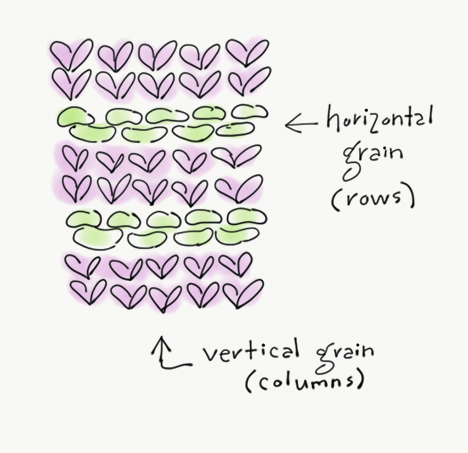
This is partly determined, of course, by where the viewer stands in relation to the fabric. The fabric has two grains, horizontal (rows) and vertical (columns).

Llama 1.6

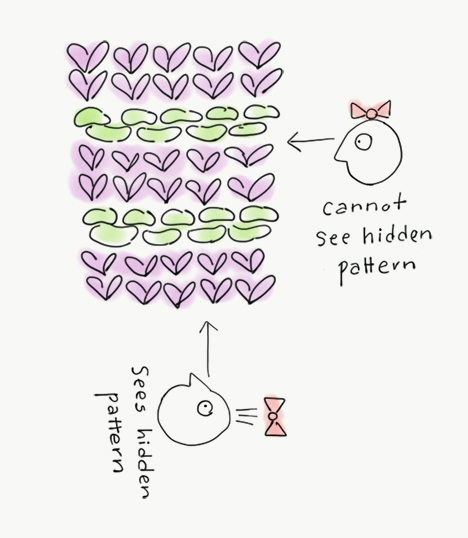
Only a person looking across the horizontal grain from a somewhat steep angle will be able to see the hidden pattern.

Llama 1.7

Messing around with shadow knitting (I love knitting it, and I teach it a great deal) has encouraged me to question the persistent emphasis on legibility. If a big part of the magic of the technique is that the “secret” images appear and disappear, why not focus on that–rather than expecting it to act as a billboard? I mean, if you want absolutely clearly to present a message, you can do that in stranded color work, intarsia, duplicate stitch, embroidery–any number of other techniques.

What I want to toy with is this: can I get an interesting effect from a piece of shadow knitting in which I deliberately obscure the pattern? Can I make a piece in which you will never, ever see all of the pattern at once–and if I can, what will the result be? Cool? Or just silly?

Curious? Stop back in two weeks and I’ll show you where this is going. In the meantime, I’m swatching and swatching and swatching with the HiKoo® Llamor. Divine. Colors deep as mountain lakes, soft as–well, soft as a baby llama…

Llama 1.8

*Llama in a Basket is the name of my new Peruvian funk metal band.

Shop Notes!

In celebration of Mother’s Day: until May 13, 2017, buy a Makers’ Mercantile gift card valued at $25 or more, and receive a Makers’ shopping bag, Lavishea Bar, and a calendar.

Tools and Materials Appearing in This Issue

Schoppel-Wolle Leinen Los (70% wool, 30% linen; 328 yd per 100g ball)
HiKoo® Llamor (100% baby llama; 109 yd per 50g ball), available in the Peruvian Palette, the Natural Palette, and the Carnival Palette
Schoppel-Wolle Gradient (100% merino wool; 284 yd per 100g ball)
addi® Swing crochet hooks

About Franklin

Designer, teacher, author and illustrator Franklin Habit is the author of It Itches: A Stash of Knitting Cartoons (Interweave Press, 2008). His new book, I Dream of Yarn: A Knit and Crochet Coloring Book was brought out by Soho Publishing in May 2016 and is in its second printing.

He travels constantly to teach knitters at shops and guilds across the country and internationally; and has been a popular member of the faculties of such festivals as Vogue Knitting Live!, STITCHES Events, Squam Arts Workshops, the Taos Wool Festival, Sock Summit, and the Madrona Fiber Arts Winter Retreat.

Franklin’s varied experience in the fiber world includes contributions of writing and design to Vogue Knitting, Yarn Market News, Interweave Knits, Interweave Crochet, PieceWork, Twist Collective; and a regular columns and cartoons for Mason-Dixon Knitting, PLY Magazine, Lion Brand Yarns, and Skacel Collection/Makers’ Mercantile. Many of his independently published designs are available via Ravelry.com.

He is the longtime proprietor of The Panopticon, one of the most popular knitting blogs on the Internet (presently on hiatus).

Franklin lives in Chicago, Illinois, cohabiting shamelessly with 15,000 books, a Schacht spinning wheel, four looms, and a colony of yarn that multiplies whenever his back is turned.

Follow Franklin online via Twitter (@franklinhabit), Instagram (@franklin.habit), or his Facebook page.

Makers’ with Vickie – Holey Scarves!

Vickie promo pic.png

For Our Needle Artists

This month on Makers’ with Vickie our friend, Vickie Howell gives an “Artfelt®” tutorial on how to make a wearable art piece using our hugely popular, Holey Scarf kit.

Using simple, easy-to-follow steps you’re just a draft, tack, and dryer cycle away from creating a head-turning accessory — and in just a few hours! You’ll be giddy over how how the saturated colors of the gorgeous roving mix and meld as you lay out pieces and then begin the felting process — it’s like painting with fiber, but without the requirement of being artistically inclined. Here’s the scoop!


https://www.facebook.com/plugins/video.php?href=https%3A%2F%2Fwww.facebook.com%2Fvickiehowell%2Fvideos%2F1198525706922643%2F&show_text=0&width=560


Get the Supplies

holeyscarf-group reduced white space

Artfelt Holey Scarf Kit, which includes everything you need to make this project:

  • Artfelt Needles
  • Paper
  • Plastic
  • Artfelt Roving
  • Instructions.

For Our Knitters

edition 3 holey scarf 02

(Shown: Edition 3 #2296)

Does the thought of setting down your knitting needles to create a felted art piece make you feel like something’s missing — like perhaps, there’s a crafty hole that needs to be filled? No worries, we’ve got you. You can still join in on the negative space fun with our knitted Holey Scarves Pattern (link below)!


Get the Supplies

lace-ball-100-glamour01

Lace-weight Version:

Holey Scarf Pattern (In Skacel Magazine Vol 10 2017) Free here.

1 Ball of Schoppel-Wolle Laceball 100 or Lace Ball

Size US 2 Addi Rockets, circular needle (any length)

Note: Straight needles will also work for this project.


Sport-weight Version:

edition-3-glamour02.jpg

Holey Scarf Pattern (In Skacel Magazine Vol 10 2017) Free here.

3 Balls Schoppel-Wolle Edition 3

Size US 6 (4.5mm) Addi Turbo circular needle (any length)

Note: Straight needles or other types will also work for this project.

We hope to see you back for more Makers’ with Vickie on the first Friday of every month. Next up: How to back knit or crochet button bands with ribbon, using hand-sewn, machine-sewn, and fabric glue methods! Tune in June 2nd at 10:30amPT to facebook.com/vickiehowell !

Vickie Howell is a knitting & crochet ambassador, author, and the Host/Executive Producer of the upcoming, The Knit Show with Vickie Howell (October ’17). Stay in touch by following @vickiehowell

Makers’ Minute – IVKO Women Clothing & Accessories

IVKO Woman specializes in designing and creating high class woven and knitted garments combining exceptional craftsmanship with state of the art knitting technology. They use only the finest natural fabrics and fibers in producing an exquisite range of fashion designed for the modern, independent woman.

Shop our online collection here.

Makers’ Minute – HiKoo® Rylie

Truly a trans-seasonal wonder, HiKoo® Rylie will become your new favorite year round yarn. The unique blend of alpaca, mulberry silk, and linen means a tactile feel, gleaming drape, and superb softness rolled into one sport weight yarn. Knit or crochet for days with this wonderful creation!

Shop all Rylie colors.

Shop Moon Rise Shawl Kits – SMALL.

Shop Moon Rise Shawl Kits – LARGE.

Shop Wispy Poncho Kits.

Fridays with Franklin – The Adventure of the Little Poser, Part Four

fwf-logo-v11The Adventure of the Little Poser, Part Four

For an introduction to what goes on in this column, click here.

For the first part of this adventure, click here.


The nice thing about having made as many mistakes as I have is that admitting one more isn’t terribly difficult.

Remember the lovely card-woven strap I started last time? The one meant to hold up my crocheted yoga mat bag with strength and style?

Poser 4.1

Everything was hunky-dory for about seven repeats. Then this happened.

Poser 4.2

That, my friends, is a broken warp thread. Now, broken warp threads happen in weaving all the time and they are usually no big deal. When they break, you fix them and weave on.

But this warp thread spelled doom. It was a confirmation of what I had known in my heart all along. Schoppel-Wolle Leinen Los is a wonderful, unique yarn–but it’s not suitable for warp. It’s not strong enough.

I’ll say it again: I knew this.

Warp yarns need to be firm and strong, which most often means constructed from multiple plies (strands) of a strong fiber or fiber blend, twisted firmly together. Leinen Los is a single strand held together by felting. There’s an old weaver’s test for warp strength: break the yarn in two. If it twangs or pings when you break it, it may be a good warp yarn. If it gives you more of a soft pop, pick another. Leinen Los made no sound at all, except perhaps the distant rumble of failure. It drifted apart.

Poser 4.3

So why did I do it? Because I’d fallen in love with the yarn. It’s bewitching. When it came time to weave the strap, I couldn’t get past the idea of using it for the entire bag even though I knew better. Strong attachment to your first idea can be fatal. It’s a rookie mistake, but I fear that in this way I will forever be a rookie.

That’s terribly poignant. I may have shed a pensive tear. And still I had a yoga mat bag with no strap.

I considered a few options, including pairing the Leinen Los as weft with a stronger warp yarn on my Schacht Cricket Rigid Heddle Loom. But I was on the road without either the loom or the other yarn. (Card weaving with Leinen Los and weft wouldn’t have been much of an option, as the weft yarn in card weaving is hidden by the warp.)

I swallowed my pride and my fancy concepts and I turned to crochet. Just good old double crochet…

Poser 4.4

…with a contrast edging all around in single crochet.

Poser 4.5

The edging not only gave a neater, more finished appearance; it also counteracted stretch and droop, because the grain of the edging runs counter to the grain of the strap.

Poser 4.6

Once the strap was complete I decided to kill two birds with one stone and simultaneously attach the band and add the piping that I wanted and the top and bottom edges of the bag.

To attach it, from the right side I worked single crochet through both the strap and the bag.

Poser 4.7

As Leinen Los is such a gently constructed yarn, working the join with crochet was a better option that sewing it on. Sewing pulls the working strand repeatedly through the fabric, wearing it a bit each time. Softly-spun knitting yarns may abrade so much even over a short sewn seam that they just fall to pieces. Or (worse) they may appear to survive–and your seam fails soon after you put it to the test. Crochet, on the other hand, doesn’t subject any one length of the strand to repeated stress during the working.

With the strap secured, I continued the single crochet around the bag until I met up with the beginning.

Poser 4.8

This is not a revolutionary idea. But it looks nice and it lends a bit more stability to the bag at two key points.

The bag and strap were now complete (yay) but plain (boo).

You may recall that I had hit upon a solution for dressing up the bag with little chains of flowerettes, or whatever the hell you want to call them, to weave in and out of the clusters in the fabric.

Poser 4.9

Happily, focusing on the strap for a while allowed me to return to the bag with fresh eyes. I saw that the chains were not cute, or fun, or unusual. They made the bag look like it was suffering from a vile dermatological complaint.

A couple of people told me to leave it plain. Flowers, they said, would make it too feminine–and then I couldn’t use it. Here’s my thought on that: if we’d perhaps like to slow down the destruction of the natural environment and the planet as a whole, maybe we should stop telling men and boys that flowers are something only women are supposed to enjoy.

I went back to my tiny crochet library, messing around with one vintage floral edging after another.

I learned a lot about making edgings, but even when I stripped an edging down to its fundament it always reminded me of something my grandmother would have put on a Sunday apron.

Poser 4.10

That’s not in and of itself a bad thing, except that it was wrong for this project. This project was supposed to recall my mid-1970s crochet-and-macramé borderline hippie Southwestern childhood.

I kept thinking and seeing daisies. Daisies. Daisies. Daisies. And more out of frustration than anything else I decided to see if I could make a single daisy on my own. After all the fooling around with edging motifs, and all the freeform experimentation in the The Adventure of the Fallen Flowers

Poser 4.11

…it turned out that I could. After so many setbacks, that felt great.

So I made a bunch of them.

Poser 4.12

Then I sewed them on the bag, after pinning them in place with the help of a friend and a full-length mirror. I wanted to make sure I got the best effect from the, uh, “random” placement.

I liked it.

Poser 4.13

Poser 4.14

I liked it so much that after making an i-cord drawstring out of two strands of Leinen Los held together, I added a daisy to each end. They’re cute, and they keep the string from pulling out of the bag.

Poser 4.15

And I had my yoga bag.

Poser 4.16

I was so jazzed that I made up a yoga playlist to go with it, drawn from the time in my life that inspired the bag. Ladies and gents, the mellow sounds of my parents’ stereo cabinet. Enjoy in a hammock with a nice rosé if vriksasana is not your thing.

  • Jim Croce, Operator (That’s Not the Way It Feels)
  • Gordon Lightfoot, If You Could Read My Mind
  • The Eagles, Peaceful Easy Feeling
  • Judy Collins, Both Sides Now
  • The Bee Gees, How Deep Is Your Love
  • John Denver, Annie’s Song
  • The Doobie Brothers, Listen to the Music
  • Fleetwood Mac, Dreams
  • Maria Muldaur, Midnight at the Oasis
  • Cat Stevens, Morning Has Broken
  • Jim Croce, Time in a Bottle

I’m ready for the next adventure. I hope you’ve enjoyed this one. See you in two weeks!
Tools and Materials Appearing in This Issue

Schoppel-Wolle Leinen Los (70% Virgin Wool, 30% Linen • 328 yards per 100 gram ball). Colors: 0908 (White) and 8495 (Gray-Brown)
Addi® Swing Crochet Hooks

Schacht Cricket Rigid Heddle Loom

About Franklin

Designer, teacher, author and illustrator Franklin Habit is the author of It Itches: A Stash of Knitting Cartoons (Interweave Press, 2008). His new book, I Dream of Yarn: A Knit and Crochet Coloring Book was brought out by Soho Publishing in May 2016 and is in its second printing.

He travels constantly to teach knitters at shops and guilds across the country and internationally; and has been a popular member of the faculties of such festivals as Vogue Knitting Live!, STITCHES Events, Squam Arts Workshops, the Taos Wool Festival, Sock Summit, and the Madrona Fiber Arts Winter Retreat.

Franklin’s varied experience in the fiber world includes contributions of writing and design to Vogue Knitting, Yarn Market News, Interweave Knits, Interweave Crochet, PieceWork, Twist Collective; and a regular columns and cartoons for Mason-Dixon Knitting, PLY Magazine, Lion Brand Yarns, and Skacel Collection/Makers’ Mercantile. Many of his independently published designs are available via Ravelry.com.

He is the longtime proprietor of The Panopticon, one of the most popular knitting blogs on the Internet (presently on hiatus).

Franklin lives in Chicago, Illinois, cohabiting shamelessly with 15,000 books, a Schacht spinning wheel, four looms, and a colony of yarn that multiplies whenever his back is turned.

Follow Franklin online via Twitter (@franklinhabit), Instagram (@franklin.habit), or his Facebook page.