The Adventure of the Llama on the Corner, Part Five

fwf-logo-v11For an introduction to what goes on in this column, click here.

For the first part of this adventure, click here.

I find that so often that the finishing touches on project can make or break it.

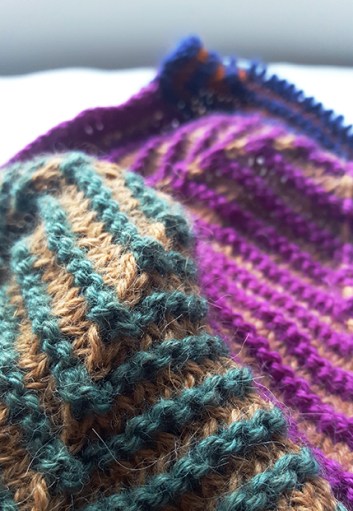
After weeks of fooling about with the structure, the mitered shadow cowl in HiKoo Llamor had reached full length.

fwf-46-aerial-scrunchy

But it was missing something.

This pink (1775):

fwf-46-pinknowriting
Before I go any further, remember that color choices are always personal. You may look at that pink and cringe. You may hate all pinks, or that pink in particular. You may look at the full length of the cowl and feel that there is already, if anything, too much color packed into it without adding more.

fwf-46-knitting-finished

To my eye, though, these foreground colors–unto and including the orange (1752)–are all muted. Dimmed. Pretty, but subdued. My intent was a piece full of energy. The crowd needed a brilliant party-starter to wake it up. Therefore:

fwf-46-pinkwriting

My first thought was to throw one ridge of the pink into a garter border running right round the edges. A test showed pretty quickly that even a narrow border like that…

fwf-46-edge-reject

…was too much. Too heavy, visually, for the piece. There’s so much pattern in the center that even garter stripes at the edge were de trop. I wanted a party. Not a riot.

Yet–is there not always a yet?–the cowl needed an edge treatment. Not only for color, but–is there not always a but?–for structure. HiKoo Llamor, being 100% baby llama, is buttery soft and superbly warm. It also drapes like crazy. That’s fabulous, unless the drape is so uncontrolled that the cowl sags around the neck like a wet rag and all the fancy mitering and shadowing has been for nothing.

I turned to an old ally, applied I-cord.

fwf-46-appliedcord

There. Yes. Color (but not too much) and structure.

fwf-46-jellyroll

I Need Closure

This was supposed to be a cowl, not a scarf, so it needed to close into a tube. That meant buttons. Lucky for me, Makers’ Mercantile is gearing up to present the entire (gigantic) line of Skacel Buttons.

Skacel Buttons is a new enterprise, so I was given special permission to dip into stock before it became generally available. If you want to see the full range, you can get a peek herebut do please keep in mind that you’re looking at a wholesale site. This means you can’t order directly from Skacel. If you see something you like, and you will, ask your favorite yarn, craft, or sewing retailer to order for you. The lines have just hit the market this season, so they’re ready when you are.

I asked to play with four different styles.

From the Corozo line…

fwf-46-round-buttons

From the Agoya Shell line…

fwf-46-shiny-buttons

From the Horn line…

fwf-46-big-buttons

fwf-46-carved-buttons

And engaged in the time-honored custom of laying them on the fabric and pushing them around and squinting…

fwf-46-buttons-compared

…until I determined that the iridescence, shape, and color of the Agoya Shell buttons were just right. Interesting, eye-catching, yet quiet enough to play second fiddle to the yarn.

I churned out a little more of the I-cord, unattached,

fwf-46-cordloops

to create three button loops. Everything got sewed on.


fwf-46-buttonloops

And, done! Well. Sorta done! Not quite done.

Because now the pink at the perimeter was so very pink that the center was sunk into gloom. It needed a lift.

fwf-46-no-embroider

Out came the tapestry needle. I spent a pleasant hour duplicate stitching  random bits of pink into the stockinette stripes of the rectangles. Think of it as speckled yarn for control freaks.

fwf-46-dupstitch

Better.

Success?

fwf-46-finished-folded

Hmm.

When the cowl is worn, the flickery effect of the shadow work appearing and disappearing isn’t as pronounced as I hoped, though it’s certainly there.

fwf-46-worndetail

I think my ultimate idea–a blanket–might show it off more because there’d be more surface area.  On the other hand, the color work is handsome enough that I don’t feel too crushed. But still…it needs…

Wait a minute. Wait wait wait. This will be the first Fridays with Franklin with an Afternoon Addendum. Yes.

Our next adventure starts in two weeks. But I’ll be back here in a few hours. I need to go get my scissors.


Tools and Materials Appearing in This Issue

HiKoo® Llamor (100% baby llama; 109 yd per 50g ball), available in the Peruvian Palette, the Natural Palette, and the Carnival Palette
HiKoo Kenzie (50% New Zealand Merino Wool, 25% Nylon, 10% Angora, 10% Alpaca, 5% Silk Noils; 160 yd per 50g ball) – used as the background in the button photographs
Skacel Buttons from the Corozo, Agoya Shell, and Horn lines
addi® Olive Wood Circular knitting needles

About Franklin

Designer, teacher, author and illustrator Franklin Habit is the author of It Itches: A Stash of Knitting Cartoons (Interweave Press, 2008). His new book, I Dream of Yarn: A Knit and Crochet Coloring Book was brought out by Soho Publishing in May 2016 and is in its second printing.

He travels constantly to teach knitters at shops and guilds across the country and internationally; and has been a popular member of the faculties of such festivals as Vogue Knitting Live!, STITCHES Events, the Maryland Sheep and Wool Festival, Squam Arts Workshops, the Taos Wool Festival, Sock Summit, and the Madrona Fiber Arts Winter Retreat.

Franklin’s varied experience in the fiber world includes contributions of writing and design to Vogue Knitting, Yarn Market News, Interweave Knits, Interweave Crochet, PieceWork, Twist Collective; and a regular columns and cartoons for Mason-Dixon Knitting, PLY Magazine, Lion Brand Yarns, and Skacel Collection/Makers’ Mercantile. Many of his independently published designs are available via Ravelry.com.

He is the longtime proprietor of The Panopticon, one of the most popular knitting blogs on the Internet (presently on hiatus).

Franklin lives in Chicago, Illinois, cohabiting shamelessly with 15,000 books, a Schacht spinning wheel, four looms, and a colony of yarn that multiplies whenever his back is turned.

Follow Franklin online via Twitter (@franklinhabit), Instagram (@franklin.habit), his Web site (franklinhabit.com) or his Facebook page.

The Adventure of the Llama on the Corner, Part Four

fwf-logo-v11

For an introduction to what goes on in this column, click here.

For the first part of this adventure, click here.

Looking at my little heap of Hikoo Llamor shadow knit mitered squares–version 2.0–I found myself wanting to simplify the piece even further. 

These squares made less noise, but they were still squares I’d need to sew together. No matter how I might arrange them, seam lines would be a distraction.

small-sq-pile

Turning over ideas, I noted that if you make a mitered square like this:

miter-square

then it stands to reason that you make a mitered rectangle like this:

miter-rectangle

and that could be interesting. (If you’re unfamiliar with the basic principle behind the mitered square in knitting, take a look at Part Two of this adventure.)

I intended the cowl to be two mitered squares high. Working each pair of squares as a single mitered rectangle would eliminate half the seams while giving me the same changes in grain. Groovy.

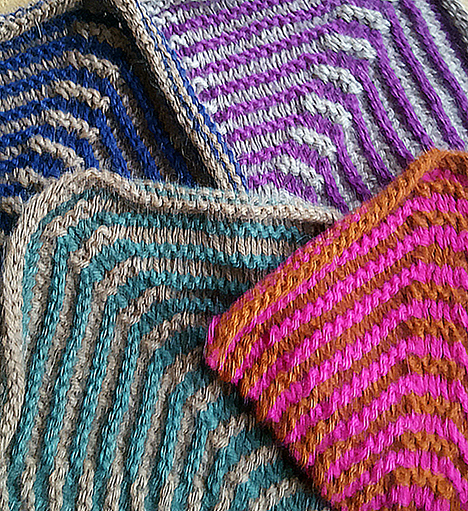
The effect in shadow knitting, viewed from the long edge, should be a large central triangle in a solid color, while the smaller triangles at either side would be in stripes.

rectangle-bottom

Viewed from the short edge, the same rectangle should offer small colored triangles flanking one large striped triangle.

rectangle-side

This is an arrangement quilters will recognize as the classic block “Flying Geese.”

fwf-45-geese

At the end of the first rectangle, I goofed around with attaching the next rectangle seamlessly. The first go was…weird. It was one of those times when theory was fine…

increase-theory

…but the reality was a mess.

fwf-45-mess

On the other hand, that mess has gone into my files for use in another project. When you try something new and it fails, take careful notes before you rip or cut or throw the whole thing out the window. I cannot tell you how many times Tuesday’s sad snarl has become the basis for Wednesday’s cover story.

Once I’d hit on a solution for the seamless join, I started fiddling with other details as the swatch progressed:

  • I mixed the colors to see what they do to each other.
  • I decided after some to make all the spine stitches in stockinette (even in the garter stitch stripes) to preserve the sharp line of the double decrease. I like the way it boldly divides the central triangle from the smaller triangles.
  • I fretted over the selvedges. They’re important to me. I wanted the upper and lower selvedges to be neat (of course) and also wanted them to match; and, if possible, I wanted them to be genuinely handsome, possibly even a design feature.

My swatch grew until it was nearly the length I needed for the finished cowl.

fwf-45-swatch

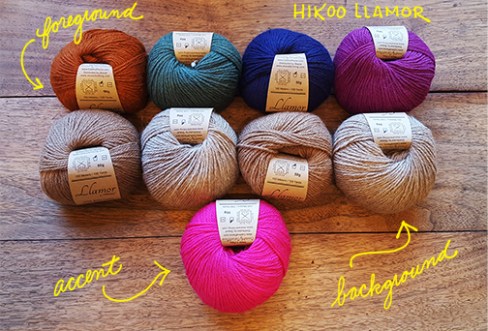
By this point, my yarns had been knit, ripped and cut so much that I ordered up a fresh pile of Hikoo Llamor. I worked out my color order. The foreground colors are the top line, the background colors are the bottom line.

llamor-palette

You’ll note that the hot pink–aptly named Rosa Fuerte, number 1775 from the Carnival Palette–is outside the line. That’s because it’s going to come into play as an accent and liven things up.

As I write this, the body of the cowl is nearing completion. I’m pleased to see the shadow effect is working pretty much as I had hoped.

Here it is from the top…

fwf-45-strip-top

…from the side…

fwf-45-strip-side

…and from the end.

fwf-45-strip-end

That means trim and finishing, and the final verdict on this experiment, are all that’s yet to come–in two weeks.

Tools and Materials Appearing in This Issue

HiKoo® Llamor (100% baby llama; 109 yd per 50g ball), available in the Peruvian Palette, the Natural Palette, and the Carnival Palette
addi® Olive Wood Circular knitting needles

About Franklin

Designer, teacher, author and illustrator Franklin Habit is the author of It Itches: A Stash of Knitting Cartoons (Interweave Press, 2008). His new book, I Dream of Yarn: A Knit and Crochet Coloring Book was brought out by Soho Publishing in May 2016 and is in its second printing.

He travels constantly to teach knitters at shops and guilds across the country and internationally; and has been a popular member of the faculties of such festivals as Vogue Knitting Live!, STITCHES Events, the Maryland Sheep and Wool Festival, Squam Arts Workshops, the Taos Wool Festival, Sock Summit, and the Madrona Fiber Arts Winter Retreat.

Franklin’s varied experience in the fiber world includes contributions of writing and design to Vogue Knitting, Yarn Market News, Interweave Knits, Interweave Crochet, PieceWork, Twist Collective; and a regular columns and cartoons for Mason-Dixon Knitting, PLY Magazine, Lion Brand Yarns, and Skacel Collection/Makers’ Mercantile. Many of his independently published designs are available via Ravelry.com.

He is the longtime proprietor of The Panopticon, one of the most popular knitting blogs on the Internet (presently on hiatus).

Franklin lives in Chicago, Illinois, cohabiting shamelessly with 15,000 books, a Schacht spinning wheel, four looms, and a colony of yarn that multiplies whenever his back is turned.

Follow Franklin online via Twitter (@franklinhabit), Instagram (@franklin.habit), his Web site (franklinhabit.com) or his Facebook page.

The Adventure of the Llama on the Corner, Part Three

fwf-logo-v11For an introduction to what goes on in this column, click here.

For the first part of this adventure, click here.

It’s not there yet.

This project, this mitered shadow knitting project, is knocking for me a loop right here on stage in front of you all. I won’t whine, though–this is what I signed on for back in the first column. When it doesn’t work, I’ll show you.

My last word on the first set of a squares…

Llama 2.7

…was that I liked them enough to move forward with them. That feeling didn’t last long.

As is so often the case, they’re weren’t “bad.” Just not right.

single-large-sq

The wide borders took up a lot of real estate. The shadow-knit spaces inside were puny. Squashed. And they were supposed to have been the main event. This, plus the changes in color, plus the texture of the yarn–it was all becoming too much.

Time to re-think and to simplify.

Over-complication is a perennial issue for me. When making plans, the imaginative half of my brain gallops while the sensible half trots. My notebooks fill up with schemes for projects with unusual structures and complicated color work and fine yarns and interesting texture, and

There’s an old saying in classic menswear that if a man wishes to be eye-catching but remain elegant, he gets one thing. One statement piece. That may be a boutonnière, a pocket square, a bowler hat, a bright bow tie, a boldly patterned jacket–but he must pick one and only one.

menswear

As a wise fellow behind a Savile Row counter once said to me, as I ogled an ornate silver set comprising cufflinks, tie clasp, money clip, pocket watch with chain and fob, lapel pin, and signet ring: “Respectfully, sir does not wish to appear to be a Christmas tree.”

franklin-tree

You may or may not agree with that notion, but I find it helps me whittle my designs down to a point where they don’t sag under the weight of too many Interesting Features. Also, to a point where they become something you can knit with only two hands and one brain.

What was the one thing to show off in this cowl? Why had I started this in the first place?

It was, I remembered, the potential magic of the shifting patterns in a piece of shadow knitting created with multiple changes of grain. I hoped that as the viewer’s viewpoint shifted, pattern would appear or vanish in different parts of the piece at the same time.

The borders interfered with that, so I took them out. I also made the spine as small as possible.

What had been arranged like this over seven stitches…

old-spine

…I now arranged over only three stitches.

new-spine

That caused a very abrupt change in grain at the decrease point. Now the differences between the two halves of the square really popped. Exactly what I wanted.

single-small-sq

I used a centered (sometimes called vertical) double decrease (sl2-k1-psso), which turns three stitches into one and gives you a neat, symmetrical bundle with the central stitch on top. It looks like this:

double-dec

Here’s how you do it.

  1. Work to the three stitches involved in the decrease.
  2. Slip the first two stitches together, as if to knit, from the left needle to the right needle.
  3. Knit the next stitch.
  4. Past the first two stitches, together or separately, over the knit stitch.

I use this double decrease all the time. It doesn’t lean to the right, like a knit three together (k3tog). That’s nice when, for example, you are bringing together a pair of converging lace diagonals. In fine and/or slippery yarns, it’s also much easier to control. When I k3tog in fine silk or cotton, I almost invariably drop one of the three live stitches before I’ve got them all secured. Not so with sl2-k1-psso.

I made these new squares little smaller, too, thinking they might look less clunky.

My square pile started growing again.

small-sq-pile

Then I got another idea. A much better idea. I think.

Dang it.

See you in two weeks?

Tools and Materials Appearing in This Issue

HiKoo® Llamor (100% baby llama; 109 yd per 50g ball), available in the Peruvian Palette, the Natural Palette, and the Carnival Palette
addi® Olive Wood Circular knitting needles

About Franklin

Designer, teacher, author and illustrator Franklin Habit is the author of It Itches: A Stash of Knitting Cartoons (Interweave Press, 2008). His new book, I Dream of Yarn: A Knit and Crochet Coloring Book was brought out by Soho Publishing in May 2016 and is in its second printing.

He travels constantly to teach knitters at shops and guilds across the country and internationally; and has been a popular member of the faculties of such festivals as Vogue Knitting Live!, STITCHES Events, the Maryland Sheep and Wool Festival, Squam Arts Workshops, the Taos Wool Festival, Sock Summit, and the Madrona Fiber Arts Winter Retreat.

Franklin’s varied experience in the fiber world includes contributions of writing and design to Vogue Knitting, Yarn Market News, Interweave Knits, Interweave Crochet, PieceWork, Twist Collective; and a regular columns and cartoons for Mason-Dixon Knitting, PLY Magazine, Lion Brand Yarns, and Skacel Collection/Makers’ Mercantile. Many of his independently published designs are available via Ravelry.com.

He is the longtime proprietor of The Panopticon, one of the most popular knitting blogs on the Internet (presently on hiatus).

Franklin lives in Chicago, Illinois, cohabiting shamelessly with 15,000 books, a Schacht spinning wheel, four looms, and a colony of yarn that multiplies whenever his back is turned.

Follow Franklin online via Twitter (@franklinhabit), Instagram (@franklin.habit), his Web site (franklinhabit.com) or his Facebook page.

Fridays with Franklin – The Adventure of the Llama on the Corner, Part Two

fwf-logo-v11The Adventure of the Llama on the Corner, Part Two

For an introduction to what goes on in this column, click here.

For the first part of this adventure, click here.

Here’s what I have in mind.

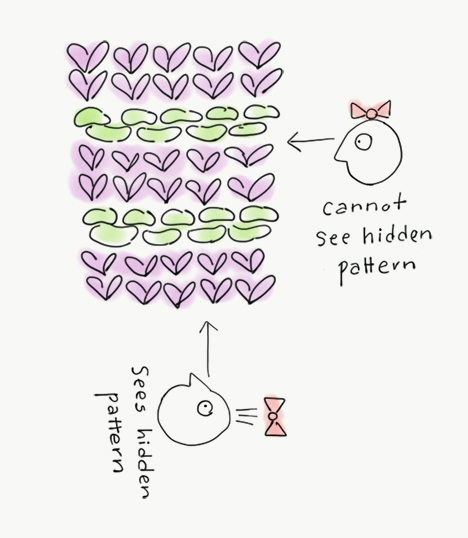
As I wrote in the previous installment, shadow knitting only shows its hidden pattern when the viewer is looking at the fabric from a low angle across the horizontal (row) grain.

Llama 2.1

What I have wanted to mess around with for ages is this: a piece of shadow knitting that deliberately obscures part of the hidden pattern from every angle. A piece that will never, ever, show you everything no matter where you stand.

This shouldn’t be terribly complicated. All it requires is that we make sure every so often to change the grain of the fabric. This could be as simple as knitting the work in pieces, with the grains at (for example) right angles to one another. One of my earliest sketches looked something like this.

Llama 2.2

That’s nothing more than two pieces joined together. It would work.

Or…we could take advantage of knitting’s ability to produce a single piece of fabric that contains within itself a change of grain. We could knit a mitered square.

Mitered squares are not at all difficult. They boil down to a simple recipe.

1. Cast on double the number of stitches you need for one side, plus one “spine” stitch that will be located halfway across the row.

2. Begin knitting. On every other row, decrease one stitch (using, theoretically, any single decrease) on either side of the spine stitch, which will be the center of the row.

3. Continue until you have about three stitches left.

4. Bind off.

That’s it. I mean, you can finesse it by pairing your decreases so they slant toward or away from the spine stitch. But really, that’s it.

What you get is a square with a horizontal (row) grain that bends 90 degrees when it reaches that spine.

Llama 2.3

And since almost any solid fabric that can be knit in stripes can be worked as shadow knitting, a shadow mitered square should be interesting. Not necessarily good, mind you. But interesting. We’ll see.

The Color of Shadows

I didn’t say much about the colors of the HiKoo Llamor in my pile last week. Here they are, chose from across the line’s Peruvian, Natural, and Carnival palettes.

Llama 2.4

I know. That pink is really pink. I want it that way. I’m in the mood for color, and the brilliance of the pink strikes me as a nice shot of energy in the midst of all the more muted shades.

In fact, I like all of these so much as a jumble that I’m not going to spend a whole lot of time deciding which two to pair in each square. I’m just going to grab and go.

Testing, Testing

The first square off the needles was promising. Not perfect, but promising.

Llama 2.5

I got the effect I wanted: a shadow triangle in each half, with contrasting shadow borders in the middle and sides. As with most shadow fabrics, there is a tendency to curl–but a nice wet block…

Llama 2.6

…calmed the curl and cause the fabric to bloom. The Llamor, which was already soft pre-blocking, became positively buttery; and unlike some pure llama yarns I’ve worked with, it gained a gentle halo instead of busting out in a total frizz.

I wasn’t absolutely satisfied with structural details of the square, but I’ve decided to do something kind of outside my comfort zone. Rather than rip the whole thing out and start again, I’m going to stick with it and press on. I have limited time and a limited supply of Llamor on hand.

Llama 2.7

Four down, a third in progress. (I know, I know. It’s a shaky photo. I was excited. And also 37,000 feet in the air on an Embraer RJ145 in the middle of turbulence.)

I think we’re going to make this a cowl.

Come back in two weeks, and I’ll show you what I’ve got.

Tools and Materials Appearing in This Issue

HiKoo® Llamor (100% baby llama; 109 yd per 50g ball), available in the Peruvian Palette, the Natural Palette, and the Carnival Palette
Schoppel-Wolle Gradient (100% merino wool; 284 yd per 100g ball)
addi® Olive Wood Circular knitting needles

About Franklin

Designer, teacher, author and illustrator Franklin Habit is the author of It Itches: A Stash of Knitting Cartoons (Interweave Press, 2008). His new book, I Dream of Yarn: A Knit and Crochet Coloring Book was brought out by Soho Publishing in May 2016 and is in its second printing.

He travels constantly to teach knitters at shops and guilds across the country and internationally; and has been a popular member of the faculties of such festivals as Vogue Knitting Live!, STITCHES Events, Squam Arts Workshops, the Taos Wool Festival, Sock Summit, and the Madrona Fiber Arts Winter Retreat.

Franklin’s varied experience in the fiber world includes contributions of writing and design to Vogue Knitting, Yarn Market News, Interweave Knits, Interweave Crochet, PieceWork, Twist Collective; and a regular columns and cartoons for Mason-Dixon Knitting, PLY Magazine, Lion Brand Yarns, and Skacel Collection/Makers’ Mercantile. Many of his independently published designs are available via Ravelry.com.

He is the longtime proprietor of The Panopticon, one of the most popular knitting blogs on the Internet (presently on hiatus).

Franklin lives in Chicago, Illinois, cohabiting shamelessly with 15,000 books, a Schacht spinning wheel, four looms, and a colony of yarn that multiplies whenever his back is turned.

Follow Franklin online via Twitter (@franklinhabit), Instagram (@franklin.habit), or his Facebook page.

Fridays with Franklin – The Adventure of the Llama on the Corner, Part One

fwf-logo-v11The Adventure of the Llama on the Corner, Part One

When I move from one project to the next, I swing like a pendulum.

I’ve always been a little in awe of artists like Picasso who, famously, go through “periods” in which they obsess over a particular fascination for an extended time. Picasso’s Blue Period was what it sounds like–a span of three years in which almost every painting he undertook was a vision tinted with blue. Now, blue is my favorite color–but honestly, three years? A week, maybe a month. Variety. I need variety.

Maybe that’s just me.

Our last adventure was crochet in the bewitching Schoppel-Wolle yarn Leinen Los. Leinen Los has an attractive but limited palette of four colorways, three shown here…

Llama 1.1

…and using just two of them turned out a bag that had the earthy-crunchy hippie look I so desired.

Llama 1.2

With this finished, I find myself swinging in the opposite direction. I want to knit. And I want color, color, color, and more color. Our gray and gloomy spring is, no doubt, feeding the impulse. Even as the local flora has been obliging…

Llama 1.3

…the skies of Chicago, and the overall atmosphere, remain resolutely mucky.

This brings me to the choice of yarns for our next adventure. Last time I was at Makers’ Mercantile in person, I also dropped by the headquarters of Skacel Collection. I like it there. The people are nice, the light is flattering, and the air smells like fresh yarn and needles.

I was picking up a few Addi Swing crochet hooks, but in passing by someone’s desk I was arrested by the sight of a little pile of llama in a basket.*

It was a sampling of this, HiKoo® Llamor. It’s made from 100% Baby Llama.

Llama 1.4

“You want some?” they asked.

Hahahahahahahahahahahahahaha.

I took it all.

(I left the basket.)

Seriously, do not offer me yarn unless you mean it.

Now I have in mind to do something that will let me put (if possible) this whole tumble of buttery-soft color…

Llama 1.5

…into a single project.

Every Which Way

What I’d like to do is use them in a piece I have been mulling over–and even swatched a bit in various scrap yarns–for more than a year. It’s an idea for shadow knitting, the technique we explored with Schoppel-Wolle Gradient in the first Fridays with Franklin adventure. (If you’re unfamiliar with shadow knitting, also called illusion knitting, click here for the capsule explanation.)

One of the usual concerns in shadow knitting is legibility. You have a hidden motif in the fabric. Can you see it? Is it clear? Can it be read?

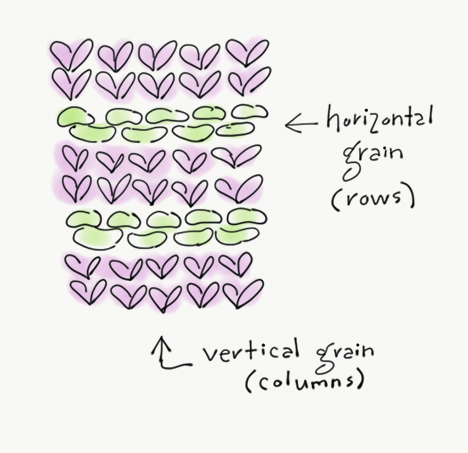
This is partly determined, of course, by where the viewer stands in relation to the fabric. The fabric has two grains, horizontal (rows) and vertical (columns).

Llama 1.6

Only a person looking across the horizontal grain from a somewhat steep angle will be able to see the hidden pattern.

Llama 1.7

Messing around with shadow knitting (I love knitting it, and I teach it a great deal) has encouraged me to question the persistent emphasis on legibility. If a big part of the magic of the technique is that the “secret” images appear and disappear, why not focus on that–rather than expecting it to act as a billboard? I mean, if you want absolutely clearly to present a message, you can do that in stranded color work, intarsia, duplicate stitch, embroidery–any number of other techniques.

What I want to toy with is this: can I get an interesting effect from a piece of shadow knitting in which I deliberately obscure the pattern? Can I make a piece in which you will never, ever see all of the pattern at once–and if I can, what will the result be? Cool? Or just silly?

Curious? Stop back in two weeks and I’ll show you where this is going. In the meantime, I’m swatching and swatching and swatching with the HiKoo® Llamor. Divine. Colors deep as mountain lakes, soft as–well, soft as a baby llama…

Llama 1.8

*Llama in a Basket is the name of my new Peruvian funk metal band.

Shop Notes!

In celebration of Mother’s Day: until May 13, 2017, buy a Makers’ Mercantile gift card valued at $25 or more, and receive a Makers’ shopping bag, Lavishea Bar, and a calendar.

Tools and Materials Appearing in This Issue

Schoppel-Wolle Leinen Los (70% wool, 30% linen; 328 yd per 100g ball)
HiKoo® Llamor (100% baby llama; 109 yd per 50g ball), available in the Peruvian Palette, the Natural Palette, and the Carnival Palette
Schoppel-Wolle Gradient (100% merino wool; 284 yd per 100g ball)
addi® Swing crochet hooks

About Franklin

Designer, teacher, author and illustrator Franklin Habit is the author of It Itches: A Stash of Knitting Cartoons (Interweave Press, 2008). His new book, I Dream of Yarn: A Knit and Crochet Coloring Book was brought out by Soho Publishing in May 2016 and is in its second printing.

He travels constantly to teach knitters at shops and guilds across the country and internationally; and has been a popular member of the faculties of such festivals as Vogue Knitting Live!, STITCHES Events, Squam Arts Workshops, the Taos Wool Festival, Sock Summit, and the Madrona Fiber Arts Winter Retreat.

Franklin’s varied experience in the fiber world includes contributions of writing and design to Vogue Knitting, Yarn Market News, Interweave Knits, Interweave Crochet, PieceWork, Twist Collective; and a regular columns and cartoons for Mason-Dixon Knitting, PLY Magazine, Lion Brand Yarns, and Skacel Collection/Makers’ Mercantile. Many of his independently published designs are available via Ravelry.com.

He is the longtime proprietor of The Panopticon, one of the most popular knitting blogs on the Internet (presently on hiatus).

Franklin lives in Chicago, Illinois, cohabiting shamelessly with 15,000 books, a Schacht spinning wheel, four looms, and a colony of yarn that multiplies whenever his back is turned.

Follow Franklin online via Twitter (@franklinhabit), Instagram (@franklin.habit), or his Facebook page.

Fridays with Franklin – The Adventure of the Little Poser, Part Four

fwf-logo-v11The Adventure of the Little Poser, Part Four

For an introduction to what goes on in this column, click here.

For the first part of this adventure, click here.


The nice thing about having made as many mistakes as I have is that admitting one more isn’t terribly difficult.

Remember the lovely card-woven strap I started last time? The one meant to hold up my crocheted yoga mat bag with strength and style?

Poser 4.1

Everything was hunky-dory for about seven repeats. Then this happened.

Poser 4.2

That, my friends, is a broken warp thread. Now, broken warp threads happen in weaving all the time and they are usually no big deal. When they break, you fix them and weave on.

But this warp thread spelled doom. It was a confirmation of what I had known in my heart all along. Schoppel-Wolle Leinen Los is a wonderful, unique yarn–but it’s not suitable for warp. It’s not strong enough.

I’ll say it again: I knew this.

Warp yarns need to be firm and strong, which most often means constructed from multiple plies (strands) of a strong fiber or fiber blend, twisted firmly together. Leinen Los is a single strand held together by felting. There’s an old weaver’s test for warp strength: break the yarn in two. If it twangs or pings when you break it, it may be a good warp yarn. If it gives you more of a soft pop, pick another. Leinen Los made no sound at all, except perhaps the distant rumble of failure. It drifted apart.

Poser 4.3

So why did I do it? Because I’d fallen in love with the yarn. It’s bewitching. When it came time to weave the strap, I couldn’t get past the idea of using it for the entire bag even though I knew better. Strong attachment to your first idea can be fatal. It’s a rookie mistake, but I fear that in this way I will forever be a rookie.

That’s terribly poignant. I may have shed a pensive tear. And still I had a yoga mat bag with no strap.

I considered a few options, including pairing the Leinen Los as weft with a stronger warp yarn on my Schacht Cricket Rigid Heddle Loom. But I was on the road without either the loom or the other yarn. (Card weaving with Leinen Los and weft wouldn’t have been much of an option, as the weft yarn in card weaving is hidden by the warp.)

I swallowed my pride and my fancy concepts and I turned to crochet. Just good old double crochet…

Poser 4.4

…with a contrast edging all around in single crochet.

Poser 4.5

The edging not only gave a neater, more finished appearance; it also counteracted stretch and droop, because the grain of the edging runs counter to the grain of the strap.

Poser 4.6

Once the strap was complete I decided to kill two birds with one stone and simultaneously attach the band and add the piping that I wanted and the top and bottom edges of the bag.

To attach it, from the right side I worked single crochet through both the strap and the bag.

Poser 4.7

As Leinen Los is such a gently constructed yarn, working the join with crochet was a better option that sewing it on. Sewing pulls the working strand repeatedly through the fabric, wearing it a bit each time. Softly-spun knitting yarns may abrade so much even over a short sewn seam that they just fall to pieces. Or (worse) they may appear to survive–and your seam fails soon after you put it to the test. Crochet, on the other hand, doesn’t subject any one length of the strand to repeated stress during the working.

With the strap secured, I continued the single crochet around the bag until I met up with the beginning.

Poser 4.8

This is not a revolutionary idea. But it looks nice and it lends a bit more stability to the bag at two key points.

The bag and strap were now complete (yay) but plain (boo).

You may recall that I had hit upon a solution for dressing up the bag with little chains of flowerettes, or whatever the hell you want to call them, to weave in and out of the clusters in the fabric.

Poser 4.9

Happily, focusing on the strap for a while allowed me to return to the bag with fresh eyes. I saw that the chains were not cute, or fun, or unusual. They made the bag look like it was suffering from a vile dermatological complaint.

A couple of people told me to leave it plain. Flowers, they said, would make it too feminine–and then I couldn’t use it. Here’s my thought on that: if we’d perhaps like to slow down the destruction of the natural environment and the planet as a whole, maybe we should stop telling men and boys that flowers are something only women are supposed to enjoy.

I went back to my tiny crochet library, messing around with one vintage floral edging after another.

I learned a lot about making edgings, but even when I stripped an edging down to its fundament it always reminded me of something my grandmother would have put on a Sunday apron.

Poser 4.10

That’s not in and of itself a bad thing, except that it was wrong for this project. This project was supposed to recall my mid-1970s crochet-and-macramé borderline hippie Southwestern childhood.

I kept thinking and seeing daisies. Daisies. Daisies. Daisies. And more out of frustration than anything else I decided to see if I could make a single daisy on my own. After all the fooling around with edging motifs, and all the freeform experimentation in the The Adventure of the Fallen Flowers

Poser 4.11

…it turned out that I could. After so many setbacks, that felt great.

So I made a bunch of them.

Poser 4.12

Then I sewed them on the bag, after pinning them in place with the help of a friend and a full-length mirror. I wanted to make sure I got the best effect from the, uh, “random” placement.

I liked it.

Poser 4.13

Poser 4.14

I liked it so much that after making an i-cord drawstring out of two strands of Leinen Los held together, I added a daisy to each end. They’re cute, and they keep the string from pulling out of the bag.

Poser 4.15

And I had my yoga bag.

Poser 4.16

I was so jazzed that I made up a yoga playlist to go with it, drawn from the time in my life that inspired the bag. Ladies and gents, the mellow sounds of my parents’ stereo cabinet. Enjoy in a hammock with a nice rosé if vriksasana is not your thing.

  • Jim Croce, Operator (That’s Not the Way It Feels)
  • Gordon Lightfoot, If You Could Read My Mind
  • The Eagles, Peaceful Easy Feeling
  • Judy Collins, Both Sides Now
  • The Bee Gees, How Deep Is Your Love
  • John Denver, Annie’s Song
  • The Doobie Brothers, Listen to the Music
  • Fleetwood Mac, Dreams
  • Maria Muldaur, Midnight at the Oasis
  • Cat Stevens, Morning Has Broken
  • Jim Croce, Time in a Bottle

I’m ready for the next adventure. I hope you’ve enjoyed this one. See you in two weeks!
Tools and Materials Appearing in This Issue

Schoppel-Wolle Leinen Los (70% Virgin Wool, 30% Linen • 328 yards per 100 gram ball). Colors: 0908 (White) and 8495 (Gray-Brown)
Addi® Swing Crochet Hooks

Schacht Cricket Rigid Heddle Loom

About Franklin

Designer, teacher, author and illustrator Franklin Habit is the author of It Itches: A Stash of Knitting Cartoons (Interweave Press, 2008). His new book, I Dream of Yarn: A Knit and Crochet Coloring Book was brought out by Soho Publishing in May 2016 and is in its second printing.

He travels constantly to teach knitters at shops and guilds across the country and internationally; and has been a popular member of the faculties of such festivals as Vogue Knitting Live!, STITCHES Events, Squam Arts Workshops, the Taos Wool Festival, Sock Summit, and the Madrona Fiber Arts Winter Retreat.

Franklin’s varied experience in the fiber world includes contributions of writing and design to Vogue Knitting, Yarn Market News, Interweave Knits, Interweave Crochet, PieceWork, Twist Collective; and a regular columns and cartoons for Mason-Dixon Knitting, PLY Magazine, Lion Brand Yarns, and Skacel Collection/Makers’ Mercantile. Many of his independently published designs are available via Ravelry.com.

He is the longtime proprietor of The Panopticon, one of the most popular knitting blogs on the Internet (presently on hiatus).

Franklin lives in Chicago, Illinois, cohabiting shamelessly with 15,000 books, a Schacht spinning wheel, four looms, and a colony of yarn that multiplies whenever his back is turned.

Follow Franklin online via Twitter (@franklinhabit), Instagram (@franklin.habit), or his Facebook page.

Fridays with Franklin – The Adventure of the Little Poser, Part Three

fwf-logo-v11The Adventure of the Little Poser, Part Three

For an introduction to what goes on in this column, click here.

For the first part of this adventure, click here.

Today I’m setting aside the bag part of the yoga mat bag, the one we’ve been making from Schoppel-Wolle Lenien Los (on sale through April 15, 2017 at 20% off for 2 or more balls), so that we can focus on the strap.

Poser 3.1

Homemade straps are a Dirty Little Secret of the knit and crochet world. It’s fun to knit your own bag. It’s fun to crochet your own bag. But most bags need straps or handles, and neither knitting nor crochet is particularly good at meeting the challenges of life as a strap.

You may well have been, as I once was, the victim of one of the ten million knitted beginner bag patterns that blithely instructs you to knit and attach a skinny yard of garter stitch. And what does garter stitch famously do? Garter stitch stretches.

Poser 3.2

Somehow, the patterns never get around to mentioning that.

In the same yarn and worked in an equivalent gauge, crochet usually stretches less than knitting–but still it stretches. Ask anyone who wore a crochet bikini in the 1960s.

What are we to do?

You can purchase a ready-made strap or handle, or even a whole support system. Lots of folks take this route. (The leather and plush caged purse kits offered by Makers’ Mercantile have been flying off the shelf.)

Poser 3.3

But what if you would like the entire piece in the same yarn? What if you want to make it all yourself?

When I first started collaborating with John Mullarkey––a fiber artist known particularly for his work with card weaving––this question came up immediately, because card weaving most often produces long, slim straps. And they’re strong. And guess what else? They don’t #@$%! stretch.

Our first experiment with this was a bag made from Hikoo CoBaSi. I knit the body in a mosaic design, and John wove the coordinating strap.

Poser 3.4

I’ve been using it ever since as a model in my mosaic knitting class, and students always coo over the strap and ask if they could do something like that.

Yep. Because card weaving is a very, very accessible form of weaving.

A Few Words About Card Weaving

I can’t possibly give you a full-length introduction to card weaving (also known as tablet weaving), but here’s a tiny bit about how it works. (If you’d like to dive in on your own, check out John’s DVD.)

First, the loom. The loom is a deck of cards.

No, I’m not kidding. The loom, shown here…

Poser 3.5

…is a deck of cards.

Cards come in different shapes, but the square is the most common.

Poser 3.6

You’ll note that each corner of the card has a hole, and the holes are lettered A, B, C, D.

To warp the loom–that is, to put on the threads that allow us to begin weaving–we follow a draft that tells us what color thread is put through each hole in each card, and whether they are put through the card front-to-back or back-to-front.

Here, for example, we have a card threaded front-to-back as follows: A, light; B, dark; C, dark; D, light.

Poser 3.7

The warped deck of cards then only needs something to hold each end of the warp threads taut. This could be (among the many possibilities) two sticks in the ground; two poles; the weaver’s own belt and a tree; or clamps attached to a table.

A more portable solution is an inkle-style loom pressed into service with the beginning and end of the warp tied together, which creates a circular warp.

Poser 3.8

(This particular small loom from my collection is one John Mullarkey produces for use in his classes, but others–such as the Schacht Inkle Loom, available by special order through Makers’ Mercantile–would serve the same purpose.)

Card weaving is usually warp-faced, meaning these warp threads are going to dominate the appearance of the finished fabric.

To weave our pattern, we follow our draft to turn the cards either forward (away from the weaver) or backward (toward the weaver) so that a different hole comes into the top position.

Poser 3.9

And as we do this, different combinations of threads are brought to the top of the shed, as you can see here. These are two of the sheds used to make the strap design.

Poser 3.10

Poser 3.11

The shed, for those new to weaving, is the space between the raised and lowered warp threads that our cute little shuttle

Poser 3.12

passes through, carrying the weft thread that locks the fabric together.

So we turn the cards, pass the shuttle, turn the cards, pass the shuttle, and–if all goes well–out comes a beautiful, strong patterned band.

Poser 3.13

Will all go well?

How about we talk about that in two weeks, when we bring this adventure to a close?

Tools and Materials Appearing in this Issue


Schoppel-Wolle Leinen Los (70% Virgin Wool, 30% Linen • 328 yards per 100 gram ball). Colors: 0908 (White) and 8495 (Gray-Brown) – On sale through April 15, 2017 at 20% off for 2 or more balls!

Hikoo CoBaSi (55% Cotton 16% Bamboo 8% Silk 21% Elastic Nylon • 220 yards per 50 gram ball).

Leather and Plush Caged Purse Kit (shown in Ripe Plum–other colors available)

About Franklin

Designer, teacher, author and illustrator Franklin Habit is the author of It Itches: A Stash of Knitting Cartoons (Interweave Press, 2008). His new book, I Dream of Yarn: A Knit and Crochet Coloring Book was brought out by Soho Publishing in May 2016 and is in its second printing.

He travels constantly to teach knitters at shops and guilds across the country and internationally; and has been a popular member of the faculties of such festivals as Vogue Knitting Live!, STITCHES Events, Squam Arts Workshops, the Taos Wool Festival, Sock Summit, and the Madrona Fiber Arts Winter Retreat.

Franklin’s varied experience in the fiber world includes contributions of writing and design to Vogue Knitting, Yarn Market News, Interweave Knits, Interweave Crochet, PieceWork, Twist Collective; and regular columns and cartoons for Mason-Dixon Knitting, PLY Magazine, Lion Brand Yarns, and Skacel Collection/Makers’ Mercantile. Many of his independently published designs are available via Ravelry.com.

He is the longtime proprietor of The Panopticon, one of the most popular knitting blogs on the Internet (presently on hiatus).


Franklin lives in Chicago, Illinois, cohabiting shamelessly with 15,000 books, a Schacht spinning wheel, four looms, and a colony of yarn that multiplies whenever his back is turned.

Follow Franklin online via Twitter (@franklinhabit), Instagram (@franklin.habit), or his Facebook page.

Fridays with Franklin – The Adventure of the Little Poser, Part Two

fwf-logo-v11The Adventure of the Little Poser, Part Two

For an introduction to what goes on in this column, click here.

For the first part of this adventure, click here.

Before we go any further with this crocheted yoga mat bag,I want to make sure you understand something.

When it comes to crochet, I still don’t really know what I’m doing. I’m enthusiastic. I’m ambitious. But when you get right down to it, in this adventure I’m no more than a little kid suddenly announcing to his mother that he is a fireman, or a dragon slayer, or prima donna assoluta of the Royal Opera House, Covent Garden.

Wishing will not make it so.

This is a dangerous place to be. I know just enough crochet to have ideas about what I want to make. Yet my technical skills aren’t within a mile of my imagination.

So my swatches have been bizarre–curiosity, fumbling, swearing, and ripping. So much ripping.

I have had in mind a yoga mat bag with an open mesh structure. And I’ve known that I want it to be floral. How exactly? Not sure. Just…floral.

Poser 2.1

I can draw it.

Poser 2.2

It’s the transition from ink to yarn that’s been sticky.

I messed around with a floral mesh I found in an old stitch dictionary and thought for certain I’d cracked the code. I got exactly this far

Poser 2.3

and got stuck, and cried a little, and then ripped it out.

I thought I might do the whole bag in filet crochet. For those not familiar, filet crochet is form of lace based upon a square mesh made primarily of double crochet. It’s very old-fashioned and it polarizes the crochet community–you either hate it or love it. I love it. I mean, look at this design from Grand Album de Modèles pour Filet No. 3, published in 1908.

Poser 2.4

And, boy oh boy, filet crochet is dead easy to chart. Light squares are filled bits of mesh. Dark squares are open bits of mesh. I can do that.

Poser 2.5

So I tried it with Schoppel-Wolle Leinen Los, only to find that while I adore filet in fine, smooth yarns, in a larger gauge and more rustic yarn it bears an unfortunate resemblance to the lumpy raffia tote bags that my late grandmother’s more adventurous friends used to bring back from package tours of the Caribbean. So I took a shot at lancet stitch, which is often used in conjunction with filet crochet.

Poser 2.6

Nope! It’s a hard truth of fiber arts: not every yarn is suited to every technique. I really like Leinen Los. I really like lancet stitch. I do not like them together.

The meshes I tried were all either too open or too closed or too dang ugly; or, most often, I’d get one round into the making of some mesh I’d dreamt up and realize I couldn’t get there from here–I didn’t have the knowledge to realize my idea.

Poser 2.7

I whined to my buddy John Mullarkey about this. He’s primarily a weaver, but has years of crochet under his belt. We were teaching together at Stitches West, and I showed him the little misbegotten snippets and my sketches of wild, ornate open fabrics.

“I don’t think crochet will do that,” he said. Repeatedly.

I was by then desperate to make progress, and rather equally desperate to not turn out yet another yoga mat bag composed primarily of double crochet.

“Try this,” he said.

“This” was little clusters of treble crochet alternating with open spaces.

Poser 2.8

It wasn’t going to set the world on fire, but sometimes I just need to move forward somehow, anyhow, or I’ll get into one of those states where the neighbors find me on the front sidewalk attempting to set fire to all my yarn.

John suggested I alternate the colors randomly, rolling a die for the number of stripes. I tried it. It felt…wrong. My gut was telling me to do a simple round-by-round change. As you can see above, I went with my gut.

This wasn’t unattractive. It also wasn’t floral or especially original. However, I’d learned in The Adventure of the Fallen Flowers that one of the joys of crochet is that it readily accepts the addition of new layers and new elements­–far more so, I find, than knitting.

Maybe I could use this simple mesh as a framework. A trellis.

What if I made flowers separately, as a second step?

So I started to noodle around with different flower shapes, separating my experiments with lengths of chain stitching.

Then it hit me. Why not go ahead and work the all the flowers on chains,

Poser 2.9

then twine the floral chains through the mesh?

Poser 2.10

I like it. It’s not exactly right yet. I don’t know how original it is. I don’t know if ultimately it will be a success. But right now, I like it. It’s giving me something of the overall effect I had in my head, and I don’t feel like I have seen it already in seven free patterns.

And so…onward. In two weeks, I’ll show you how it’s come along–and I think we’ll be ready to talk about making the strap.

A Note About the Crochet Hook

The mention of the quizzically shaped Addi® Swing Crochet Hook in the last column stirred up a bunch of questions. After a couple weeks of using it, here’s my take.

I use a “knife” rather than “pencil” hold when I crochet, which is the grip that the Swing was designed to accommodate.

Poser 2.11
This means my thumb rests exactly where the designer intended, and the positioning is effortless. When I picked up the hook, that’s where my thumb landed. The grip of my other fingers feels equally natural.

The handle is made of soft, light plastic that’s easy on the hands, but doesn’t feel cheap or flimsy.

I have arthritis in both wrists and spend upwards of eight to ten hours a day doing handwork. For me, the Swing has made crochet far more comfortable. I find myself working steadily for longer periods with far less fatigue, though I am still careful to take reasonable breaks.

Now, a caveat: no two people have the same hands, and no two people crochet exactly the same way. If you have been crocheting for a long time, you might find yourself taking some time to adjust to a different grip. But especially if you’ve got issues with your wrists or fingers, as I do, an Addi® Swing might help you as it has helped me.

See you in two weeks!

Tools and Materials Appearing in This Issue

Schoppel-Wolle Leinen Los (70% Virgin Wool, 30% Linen • 328 yards per 100 gram ball). Colors: 0908 (White) and 8495 (Gray-Brown).

Addi® Swing Crochet Hooks

About Franklin

Designer, teacher, author and illustrator Franklin Habit is the author of It Itches: A Stash of Knitting Cartoons (Interweave Press, 2008). His new book, I Dream of Yarn: A Knit and Crochet Coloring Book was brought out by Soho Publishing in May 2016 and is in its second printing.

He travels constantly to teach knitters
at shops and guilds across the country and internationally; and has
been a popular member of the faculties of such festivals as Vogue
Knitting Live!, STITCHES Events, Squam Arts Workshops, the Taos Wool Festival, Sock Summit, and
the Madrona Fiber Arts Winter Retreat.

Franklin’s varied experience in the fiber world includes contributions of writing and design to Vogue Knitting, Yarn Market News, Interweave Knits, Interweave Crochet, PieceWork, Twist Collective; and a regular columns and cartoons for Mason-Dixon Knitting, PLY Magazine, Lion Brand Yarns, and Skacel Collection/Makers’ Mercantile. Many of his independently published designs are available via Ravelry.com.

He is the longtime proprietor of The Panopticon,
one of the most popular knitting blogs on the Internet (presently on hiatus).

Franklin lives in Chicago, Illinois, cohabiting shamelessly with
15,000 books, a Schacht spinning wheel, four looms, and a colony of
yarn that multiplies whenever his back is turned.


Fridays with Franklin – The Adventure of the Little Poser, Part One

fwf-logo-v11The Adventure of the Little Poser, Part One

For an introduction to what goes on in this column, click here.

I live in a rather up-and-coming part of Chicago’s North Side, in the sort of neighborhood where we already have three coffee shops on three successive blocks, but so far only one of them is a Starbucks.

I do a fair amount of knitting in one of those coffee shops. As the neighborhood has grown trendier the profile of the patrons has shifted from mostly punk rockers too young to have heard Joey Ramone live, to mostly pampered college students who never set foot in a library, to mostly Angry Yoga Moms taking a break after an hour of Vinyasa Flow.

This newest crowd has two topics of conversation: how doing yoga gives you inner peace, and how having children takes it away again. Therefore: Angry, Yoga, Moms.

They drink a lot of very strong coffee very quickly.

They’re also pretty much the worst advertisement for the benefits of yoga in the history of people bending over. The big yoga magazines always put somebody on the cover who looks like this.

Poser 1.1
The Angry Yoga Moms always look like this.

Poser 1.2

Of course it’s not really fair to blame that face on the yoga, but it was always easier to do that than to try doing yoga. I already have one of those faces that–on a happy day–inspires total strangers to hand me pamphlets bearing the word DESPERATE? in large type with a toll free number underneath.

Poser 1.3

What finally got me onto a mat was the sudden onset of not being able to reach things any more.

I don’t mean things on high shelves. I am a short man; I have never been able to reach things on high shelves. I mean that I began to have problems picking up things from the floor, and frankly even when I’m standing up no part of me is all that far from the floor.

Something had to give. Turns out it was my hamstrings, which hadn’t stretched since Carter was in the White House and I was sitting on a carpet square with nineteen other kindergarteners, already complaining about the lack of lumbar support.

Breathe In

Turns out yoga is pretty easy to get into. No great outlay of cash is required, nor must you invest heavily in supplies.

Your classes will likely cost you something, of course. You’ll also need a mat. Probably you’ll want a towel, and maybe a bottle for your water. Some people buy special yoga clothes, though few of the guys in my all-male class do. That’s about it. These things can get pricey–the alpha Angry Yoga Mom at the coffee shop has a $200 mat–but they don’t have to be.

In fact, compared to what I spend on yarn and yarn-related goodies in a month, starting yoga was practically free. Which is nice, because hobbies that interfere with my ability to purchase yarn and yarn-related goodies quickly become ex-hobbies. (Priorities, people. Priorities.)

Stretch Out

After two weeks with a great teacher, surrounded by nice men who didn’t complain when I accidentally farted during pigeon pose, I was hooked.

So far as I was concerned, the only thing that could improve yoga would be somehow to mix it with yarn. Walking home with my mat rolled under my arm, I flashed back to the early 1970s and my first encounter with yoga.

The yogini was a woman named Linda. She lived across the street from us in Tucson and she was into all kinds of things that my mother and her friends considered alluringly exotic if possibly dangerous: office work, platform shoes, wine with dinner, belly dancing, divorce, and yoga.

She also crocheted. And she kept her yoga mat, I now remembered, in a special crocheted floral bag that exactly matched the crocheted floral poncho she threw over her leotard on the way to and from class.

Carrying a rolled yoga mat under your arm is uncomfortable and inconvenient. I’d seen a short strap on sale for tying it up–for twenty bucks. Twenty bucks? For a strap? Nope.

I’d make myself a bag. In fact, by way of a tribute to Linda, I’d crochet one.

And I did. I used a whole huge pile of lovely multi-colored worsted wool kindly sent along from Australia, and the bag (worked from a free pattern recommended by a friend) was handsome and serviceable, if extremely basic in its construction.

But as I got deeper into yoga, I felt the urge to make a new bag that would be really mine–my own design. After The Adventure of the Fallen Flowers, I wasn’t scared of crochet any more. Not much. I wasn’t an expert, no; but I felt I could branch out beyond double crochet repeated ad nauseam.

I started sketching.

Poser 1.4

Poser 1.5

And of course I started swatching, too. I had my eye on a pretty unusual yarn: Schoppel Leinen Los from Skacel.

Poser 1.6

What you’re looking at here is a singles (the final s is not a typographical error–the word is “singles”) yarn. Rather than multiple strands being twisted (plied) together to make the finished strand, there’s only one strand held together by felting. And that single strand is made from 70% virgin wool and 30% linen.

Poser 1.7

Yes, linen. I’ve been teaching a lot in the south lately, and it has reminded me what a fantastic fiber linen is–something easy to forget when you live in the Land of Horizontal Snow and are always thinking warm, warm, warm.

Warm is wonderful, but what I wanted for my bag was strength and resilience. Thirty percent is enough linen that the fiber has an appreciable effect on the look, feel, and performance of the yarn. Linen begins rough to the touch but softens with wear, and wears like iron. In fact, unlike many fibers, the more it wears, the better it looks. It’s supple, but doesn’t stretch–very desirable in a bag.

Knitters and crocheters tend to touch a skein of linen, wince, and put it back down again. That’s a shame, because once you get the feel for the stuff you realize there’s nothing else quite like it.

Performance aside, I just loved the look. A little rustic. Certainly natural. But absolutely modern. It made me think of Linda, pony tail blowing in the desert wind, striding down the driveway to her green Volkswagen Beetle and trailing a cloud of patchouli, or maybe it was Wind Song.

Poser 1.8

As long as I was trying out a new fiber, I decided to also try a new (to me) hook: the addi® Swing.

Poser 1.9

After the chaste natural beauty of the addi® Olive Wood hooks I’d used before, these looked distinctly unnatural. The handles reminded me of the weirdly curvy, brightly-colored Scandinavian furniture in Linda’s living room. Surely that must be a sign?

Time, and two weeks, will tell.

In the meantime…swatches!

Poser 1.10

Tools and Materials Appearing in This Issue

Schoppel Leinen Los (70% Virgin Wool, 30% Linen • 328 yards per 100 gram ball). Colors: 0908 (White) and 8495 (Gray-Brown).

Addi® Olive Wood Crochet Hooks

Addi® Swing Crochet Hooks

About Franklin

Designer, teacher, author and illustrator Franklin Habit is the author of It Itches: A Stash of Knitting Cartoons (Interweave Press, 2008). His new book, I Dream of Yarn: A Knit and Crochet Coloring Book has was brought out by Soho Publishing in May, 2016 and is in its second printing.

He travels constantly to teach knitters
at shops and guilds across the country and internationally; and has
been a popular member of the faculties of such festivals as Vogue
Knitting Live!, STITCHES Events, Squam Arts Workshops, Sock Summit, and
the Madrona Fiber Arts Winter Retreat.

Franklin’s varied experience in the fiber world includes contributions of writing and design to Vogue Knitting, Yarn Market News, Interweave Knits, Interweave Crochet, PieceWork, Twist Collective; and a regular columns and cartoons for Mason-Dixon Knitting, PLY Magazine, Lion Brand Yarns, and Skacel Collection. Many of his independently published designs are available via Ravelry.com.

He is the longtime proprietor of The Panopticon,
one of the most popular knitting blogs on the Internet (presently on hiatus).

Franklin lives in Chicago, Illinois, cohabiting shamelessly with
15,000 books, a Schacht spinning wheel, four looms, and a colony of
yarn that multiplies whenever his back is turned.


Fridays with Franklin – The Adventure of the Transparent Excuse to Show You More Pictures of My Adorable Dog, Part Six

fwf-logo-v11

The Adventure of the Transparent Excuse to Show You More Pictures of My Adorable Dog, Part Six

For an introduction to what goes on in this column, click here.

For the first part of this adventure, click here.

So, at last, the moment of truth.

Snip, snip, snip, went the steeks. Like a beautifully de-boned chicken, Rosamund’s new sweater lay open on the table.

Transparent 6.1

In this shot, the live stitches along the underside of the tummy, which had been held on scrap yarn, have been transferred to a short (8-inch) Addi Turbo circular needle.

After turning under and whip stitching the halves of the bridges…

Transparent 6.2

…it was time for the first try-on. The moment of truth.

It fit.

Transparent 6.3

Transparent 6.4
Celebratory cookies all around.

While I was doing my victory dance, Rosamund wandered off to chew on Mr. Happy Fuzzy Pumpkin (now the late Mr. Happy Fuzzy Pumpkin), still wearing the sweater. As she is recently turned two years old and therefore officially a dog teenager, that is her way of saying, “Oh, my dear Papa! Your loving generosity thrills me through and through! To think that I, a dog of humble origins, am now favored with made-to-measure handknits! I adore you and am so grateful.”

At length, a discreet bribe of two more peanut butter cookies allowed me to retrieve the work-in-progress so that I might apply the finishing touches.

First, the forelegs each got about two inches of simple knit 2, purl 2 rib worked on stitches picked up and knit on four double-pointed needles. I could have done them on an eight-inch addi Turbo circular needle, but the double-pointed needles were close to hand and the circular needle was All The Way Over There. You know how it is.

Next, the turtleneck. I love how Rosamund looks in a turtleneck, and she seems to appreciate the warmth.

Transparent 6.5

This was done on a short circular needle after picking up and knitting stitches through the cast-on edge, in more knit 2, purl 2 rib.* Of course, I could have done the turtleneck first as part of the body. So why do it afterwards? Because I am still new at fitting Rosamund, and wanted to hedge my bets. Had the body once again come out low at the shoulders, I could have camouflaged it with an even taller turtleneck.

I’ve learned by watching Rosamund live in her first sweater that I needed to stitch that turtleneck edge down after folding or it would be forever unrolling. I took a few stitches at each of six points spaced evenly around the neckline. I think this will hold the collar nicely without sacrificing stretch. If not, I’ll try something else.

The last step was a bit of edging all around the lower edge of the tummy (those stitches shown above, waiting on the short circular needle) and the three sides of the rear flap.

The flap was particularly in need of further attention as the two final ridges of garter did nothing to stop it from curling up.

Transparent 6.6

I ought to have foreseen this, I know, and worked more garter stitch at the tush end to begin with; but I’ll know better next time.

Also from a purely aesthetic perspective, the edges of the flap where the bridge halves had been turned under still looked naked . It’s rare to leave any steek untrimmed, because no matter how neatly you work that newly-created selvedge is always a bit wonky.

The tummy stitches didn’t need more than four rows (so, two ridges) of garter stitch to finish them off.

The flap I decided to handle this way: pick up and knit stitches along this path on a circular needle…

Transparent 6.7

…and work in flat garter stitch for about four ridges (that’s eight rows).

And at the tush end, I thought it would be nice to curve the trim by throwing in some short rows.

Short rows have a reputation for being complex, but I can never quite understand why. A short row is–as the name suggests–no more than a row in which you stop and turn your work before all the stitches have been knit. There are many (many) ways of dealing with the holes that develop at the turning points, but those methods aren’t complicated once you understand what is to be done.

Garter stitch short rows are even simpler, because you don’t do anything at the turning point but turn. I kid you not. You get holes, yes. But the tendency of garter stitch ridges to pull together in the finished fabric means the holes won’t show up unless you’re working at quite a loose gauge.

So this was the path of the knitting at the end of the flap.

Transparent 6.8

That’s just one short ridge, but it was enough to give the end of the flap a gentler, curved shape; and the additional garter stitch eliminated the curl.

With all complete, we put the sweater back on and stepped outside on an unseasonably pleasant day for the official test drive.

Transparent 6.9

The sun was brilliant, the wind was sharp. I was elated to find that the high relief of the garter borders–the fabric that you, dear readers, told me to use–caught the shadows beautifully.

Transparent 6.10

Transparent 6.11

The HiKoo® Simpliworsted was warm and comfortable enough that we were able to enjoy the garden–even in its drab winter disarray–long enough for a much-needed frolic and breath of air before returning indoors for a celebratory cookie.

Transparent 6.12

It’s tough to express how much I’ve come to love this yarn–a pleasure to work with, lovely to look at, and durable enough to survive on a dog who expresses her love of nature by rolling around in it.

So, I’m calling this adventure a success. If you’ll please join me in two weeks, there will be something entirely new to play with.

Meanwhile, Rosamund says thank you very much to all of you for helping with her sweater.

Transparent 6.13


*Is there a stitch in all of knitting more interminable than knit 2, purl 2 rib? Working those five inches of turtleneck felt like climbing Everest on a pogo stick.

Tools and Materials Appearing in This Issue

Simpliworsted by HiKoo® (55% Merino Superwash, 28% Acrylic, 17% Nylon; 140 yds per 100g skein). Colors: 033, Red Hat Purple; and 013, Violette.


addi® Turbo circular needle

About Franklin


Designer, teacher, author and illustrator Franklin Habit is the author of It Itches: A Stash of Knitting Cartoons (Interweave Press, 2008). His new book, I Dream of Yarn: A Knit and Crochet Coloring Book has was brought out by Soho Publishing in May, 2016 and is in its second printing.

He travels constantly to teach knitters
at shops and guilds across the country and internationally; and has
been a popular member of the faculties of such festivals as Vogue
Knitting Live!, STITCHES Events, Squam Arts Workshops, Sock Summit, and
the Madrona Fiber Arts Winter Retreat.

Franklin’s varied experience in the fiber world includes contributions of writing and design to Vogue Knitting, Yarn Market News, Interweave Knits, Interweave Crochet, PieceWork, Twist Collective; and a regular columns and cartoons for Mason-Dixon Knitting, PLY Magazine, Lion Brand Yarns, and Skacel Collection. Many of his independently published designs are available via Ravelry.com.

He is the longtime proprietor of The Panopticon,
one of the most popular knitting blogs on the Internet (presently on hiatus).

Franklin lives in Chicago, Illinois, cohabiting shamelessly with
15,000 books, a Schacht spinning wheel, four looms, and a colony of
yarn that multiplies whenever his back is turned.