Fridays with Franklin – The Adventure of the Fallen Flowers: Part Two

fwf-logo-v11

The Adventure of the Fallen Flowers: Part Two

For an introduction to what goes on in this column, click here.

For the first part of this adventure, click here.


It probably speaks volumes about me that even my freeform crochet adventure had to start with some kind of plan.

Attitude Adjustment

The more I thought it over, the more the idea of creating a delicate fabric of scattered blossoms appealed to me. It was, for one thing, the opposite of the crochet I’d known growing up. That crochet came in two flavors: the zigzag afghan and the daisy place mat.

It may be that you recall zigzag afghans and daisy place mats with a fond smile. I’m sorry that I do not.

I recall the former as being worked always in three or more colors of stiff yarn so plastic it smelled like Tupperware. My memory kicks in around 1976, the American Bicentennial; so zigzags in red, white, and blue were the home accessory du jour along with colonial style console televisions and floor lamps in the of shape butter churns. My mother, never a slave to fashion, made our afghan in a range of rusts and browns that didn’t show dirt because they already looked like dirt.

Fallen 2.1

The daisy placemats in vivid white, yellow, and orange thread may sound cheerful; but these were not the sunny, nodding, butterfly-kissed daisies of the open field. These scratchy daisies marched in regimental rows across the Formica dinette with all the charm of an invading army. Their pinched faces and lurid coloring make me think now of women I met years later while living in an unspeakable Boston suburb: identical dead eyes, fake tans, and secret fears that somewhere in Middlesex County someone might be having a good time.

Fallen 2.2

What both specimens had in common, I now realize, is that they were textiles you wouldn’t want to touch. They looked nasty and felt nastier. All they had going for them, really, was that they were easy to clean. You could just throw them in the wash. Hell, you could lay them in the driveway and hose them down. They were impossible to destroy.

I thought for years that this must be the nature of crochet: to be, in a word, unpleasant.

It wasn’t until the very recent past that the work of designers like Cécile Balladino, Sophie Digard, Jenny King, and Kathy Merrick (this is but a partial list) began to open my mind.

Fallen 2.3

That is absolutely crochet, yet it positively begs to be touched. The color mix is masterful. It’s beautiful.

So at last I had learned a funny thing about crochet: if you work it tightly in ugly yarn, it comes out tight and ugly. If you don’t–it doesn’t. Just like knitting.

Loosen Up

If I wanted my carpet of flowers to drape, the experts I spoke with all gave pretty much the same advice.

1. Choose yarn that drapes well.

2. Work it at a gentle gauge.

3. Keep your individual freeform units on the small side.

I’d already chosen my yarns–Schoppel Wolle Zauberball® and Hikoo® Tiara–before thinking much about that first point. They seemed drapey enough.

As to numbers two and three, I was only too happy to work with a light touch and a small motif. A small motif, it seemed to me, offered fewer opportunities to screw up. On a quiet afternoon not long ago I set off into the heart of a baroque nineteenth century hexagon full of picots and doubles and half-doubles and double-doubles and double-trebles and layovers and whoopee-doos; and got so lost I had to be airlifted to safety.

The Motif

I turned to Edie Eckman’s Connect the Shapes Crochet Motifs,

Fallen 2.4

which I mentioned in the last column and which had by now become my guidebook for this project.

Edie’s larger motifs are often matched with tiny “fillers” that act as decorative joins. It was one of these–a four-petaled flower–that caught my eye. Cute, simple, and contained no stitches I didn’t already know how to do. Winner!

For those who’d like to play along, Edie has graciously allowed me to share the pattern with you here:

Begin with sliding loop.

Rnd 1. Ch 1, 8 sc in ring, join with slip st to first sc.

Rnd 2. Ch 1, Block Stitch in same st, skip 1 sc, *Block Stitch (see below) in next sc, skip 1 st; rep from * around, join with slip st to first sc.

Fasten off.

Block Stitch: Sc in st or space indicated, ch 3, 3 dc inside of sc just made.

Fallen 2.5

Two rounds and done. I can handle that.

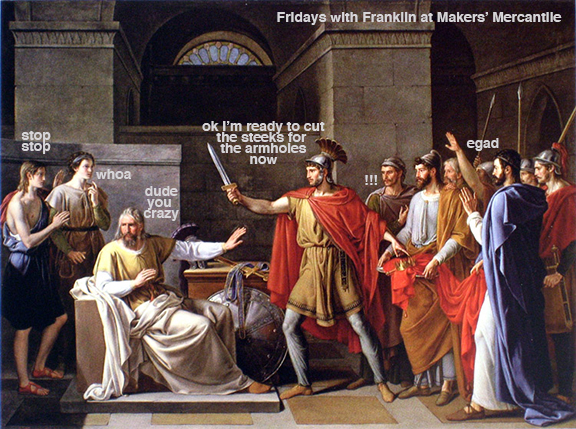
Now, some folks will say that if I’m only using one motif, even if I’m attaching pieces at will and changing both colors and yarns, I’m not really creating freeform crochet. To those folks I can only say

Fallen 2.6

The Rules of the Game

With yarn, hooks, sketch, and motif all in order, I still couldn’t jump in.

Fallen 2.7

This was becoming embarrassing.

So I fell back on a tool in my knitting kit that I’ve used almost as much as my tape measure. Here it is.

Fallen 2.8

When I’m at a crossroads in a piece of work and just can’t make a decision, I like to give it up to chance. To make it into a game.

Here are the rules of my game:

Roll 1, 2, 3, 4, or 5: Work the blossom with Zauberball®.


Roll 6: Work the blossom with Tiara.


A new blossom may be attached to any part of the fabric any number of times.

I stacked the odds heavily in favor of Zauberball® since I wanted the Tiara to be an accent sprinkled around the fabric. So, provided my die wasn’t loaded, only 1 in every 6 blossoms would be purple.

Now I was ready.

See you in two weeks…

Tools and Materials Appearing in This Issue

Connect the Shapes Crochet Motifs by Edie Eckman (Storey Publishing)

Schoppel Wolle Zauberball® (75% Superwash Wool, 25% Nylon), 420m/100g ball. Color: 1993 (Chocolate Cream)

Hikoo® Tiara (10% Kid Mohair, 5% Wool, 49% Acrylic, 22% Nylon, 10% Bead, 4% Sequin), 188 yd/100g hank. Color: 74 (Amethyst)

addi® Olive Wood Crochet Hooks

Six-sided die from, I dunno, must have fallen out of an old Yahtzee set or something

Fridays with Franklin – The Adventure of the Fallen Flowers: Part One

fwf-logo-v11The Adventure of the Fallen Flowers: Part One

For an introduction to what goes on in this column, click here.

When I was drawing I Dream of Yarn: A Knit and Crochet Coloring Book, my friend and frequent collaborator John Mullarkey visited the studio and asked to watch as I worked over a piece from rough sketch to finished art.

I’ve seldom had someone spy on that process, which usually starts with a very light and wobbly sketch in pencil…

Fallen 1.1

…followed by increasingly bold lines made by repeated goes with the pencil and a great deal of erasing…

Fallen 1.2

…followed, with luck, by the slow process of inking the lines to make them permanent and printable.

Fallen 1.3

John was struck by how many layers lay under what (I hope) appears to be a polished, unified final image.

Not everyone who draws follows that path, but I always have. Every finished drawing is the sum of a dozen unfinished drawings, one atop the other. To be terribly honest–honesty being a goal of these columns–one of the things that always drives me nuts about knitting is that it doesn’t usually lend itself to that multi-layered process.

Yes, you can swatch for knitting. And yes, I do. I also sketch and I plan–as I did for Rosamund’s sweater in our last adventure.

But when the sketches and swatches give way to the final piece you move from start to finish in a mostly linear fashion. You can rip back. And yes, I do. Boy, do I. Usually about a dozen times. For a hat.

But once a knitting project reaches an advanced stage, you can’t decide casually that it would be sweet to toss in a little cable action at the shoulders or move that stripe up four inches or narrow the color motif by two stitches without re-knitting the dang thing.

Please Feel Free

That’s one reason I love trying my hand at different fiber arts. Sometimes the nature and structure of knitting are precisely what I crave. Sometimes not. Sometimes I feel like messing around, changing directions, experimenting, reserving the right to go back and edit, add, and elaborate without a ton of ripping.

With that in mind I started checking out the freeform work that is the passion of artists like Australia’s Prudence Mapstone, whose designs are known internationally as the vanguard of the field.

Freeform pieces don’t follow a pattern in the commonly accepted sense of the word. You may have a template or a sketch; but aside from that, you just…go. One improvised motif or fragment or what-have-you (Prudence evocatively calls it a “scrumble”) of knitting or crochet leads to the next, and to the next, and the fabric grows as it will. Or rather, as you wish it to, bit by bit.

Fallen 1.4

Prudence works in both knitting and crochet (often combined, as in the piece above). As I had just finished a mess of knitting I felt the pendulum in my brain swing from needles to hooks.

Inspiration from Edie Eckman

Then, at this summer’s edition of Stitches Midwest, I ran into Edie Eckman at the Makers’ Mercantile booth in the Marketplace. Edie was one of my first needlework teachers, back when I decided to try taking classes after a lifetime of learning on my own. Now we’re friends and colleagues, which I find both miraculous and humbling.

She was there to sign her crochet books–which are excellent, numerous, and famous (everyone who crochets should have The Crochet Answer Book)–and I decided to pick up a copy of Connect the Shapes Crochet Motifs.

Fallen 1.5

I had admired the book since the year it came out, when Edie appeared at Stitches Midwest wearing this remarkable  one-skein snowflake shawl from the patterns section.

Fallen 1.6

I was tempted to mug her and run away with it, since at the time my crochet skills weren’t up to making one myself. Now, having got granny squares under my belt, it might be possible to try something that complex on my own.

In Connect the Shapes, Edie dwells briefly on the topic of working
freeform. I wondered if I might select an
hors d’oeuvres from her extensive buffet of motifs, then multiply and vary it to make an improvised fabric.

“Do you think I could do it?” I asked Edie.

“You can do it,” said Edie firmly. “And if you have questions, call me.”

Yarns, Hooks, and Plans

The more I thought about the idea of freeform, the more excited I got. My first impulse was to reach for Schoppel Wolle Zauberball, color 1993 (Chocolate Cream) – a series of slow shifts from warm black through cream by way of milky cocoa and tan.

Fallen 1.7

Then I realized that nothing prevented me from mixing not only a different color, but an entirely different yarn. It could be a different fiber, a different weight, a different texture. Maybe all three?

This skein of Hikoo Tiara in color 74 (Amethyst) had been sitting here staring at me for ages.

Fallen 1.8

This yarn is quirky. It blends kid mohair, wool, acrylic, and nylon with beads and sequins. I liked it as an art object, but couldn’t figure out what the heck to do with it. Frankly, I’m not a fellow who goes in for sparkle and fuzz. It might be useful, though, as a striking change of pace from the quiet rusticity of the Zauberball.

Should I? Beads? Sequins? Why not? In for a penny, in for a pound.

As to hooks, I will admit without hesitation that one of the reasons I chose to make this a crochet adventure was the chance to work again with the addi® Olive Wood hooks that I mentioned in the last column.

Fallen 1.9

They’re pretty to look at and dreamy to handle. Can you blame me?

So I put everything on the worktable, poured myself a cup of tea…and froze.

Could I really charge forward without any kind of plan at all?

Fallen 1.10

As much as I would love to make this a truly out-on-a-limb adventure, in which I crochet the day away without a second thought as to what I’m doing, I am not that person. I never have been that person. At my age, it is unlikely that anything short of being sucked onto a flying saucer in which long-fingered green aliens neatly switch my brain with that of Indiana Jones (or Prudence Mapstone) will turn me into that person.

And so we come full circle this week–back to my paper and pencils. I started scribbling and found my head was full of flowers. Maybe it was because fall has arrived here in Chicago, where I know I won’t see anything in bloom except mildew for about the next nine months.

I remembered a passage by legendary gardener Gertrude Jekyll, describing how with the aid of teams of housemaids she gathered thousands of roses to make potpourri. I remembered watching purple jacaranda petals fall and cover the sidewalks during my childhood in Hawaii. I thought of showers of white Mountain Laurel near my grandmother’s house in Pennsylvania, and pink cherry blossoms drifting across a Japanese scroll in my collection.

Fallen 1.11

A carpet of scattered flowers.That’s what I wanted to make. To be used as…

Fallen 1.12

To be used as…as…uh…

Fallen 1.13

Well, I don’t know what it will be used as. I’m not even sure how I’m going to make it. Let’s talk more about that in two weeks.

Tools and Materials Appearing in This Issue

I Dream of Yarn: A Knit and Crochet Coloring Book by Franklin Habit (Soho Publishing)

Connect the Shapes Crochet Motifs by Edie Eckman (Storey Publishing)

Schoppel Wolle Zauberball (75% Superwash Wool, 25% Nylon), 420m/100g ball. Color: 1993 (Chocolate Cream)

Hikoo Tiara (10% Kid Mohair, 5% Wool, 49% Acrylic, 22% Nylon, 10% Bead, 4% Sequin), 188 yd/100g hank. Color: 74 (Amethyst)

addi® Olive Wood Crochet Hooks

Fridays with Franklin: The Adventure of the Warm Puppy, Part Four

fwf-logo-v11

The Adventure of the Warm Puppy: Part Four

For an introduction to what goes on in this column, click here.

For the the first part of this adventure, click here.


Rosamund is still waiting patiently for her new sweater.

Warm 4.1

A View of the Bridge

When last we left our steek, it looked like this.

Warm 4.2

Before we go further, let’s take a closer look at the place where all the action is going to happen: the bridge.

The bridge is the fabric we created specifically so that we could cut it open. Our version–used in making the leg openings for Rosamund’s sweater–requires an odd number and a minimum of five. This swatch steek has seven stitches, worked in reverse stockinette.

Warm 4.3

That center stitch is where we cut. The pairs of stitches on either side are where we secure the fabric before cutting, so that cutting does not lead to unraveling.

To this point we’ve been looking at the steek from the right side of the fabric…

Warm 4.4

…but now we’re going to flip it over so that the wrong side is uppermost. This shows us the little Vs of the reverse stockinette, which makes it easier find our way around.

Warm 4.5

It’s useful to have guideline for both the securing and the
cutting; so once the knitting is finished, I sew a running stitch right
up the center column with a piece of scrap yarn. I can, quite literally,
cut along the dotted line.

Securing the Bridge: Part I

We will secure our bridge using my favorite method: the crocheted steek. I didn’t invent it, I just love it. There are several variations; this one is not the “correct” one–it’s the one I use, and therefore the one I feel comfortable demonstrating.

If you don’t think of yourself as one who crochets, even if you have never used a hook to do more than pick up dropped stitches, don’t stop reading just because I used the C word. This is about the simplest crochet there is. You can do it.

We need, of course, a crochet hook. While knitting Rosamund’s sweaters I fell so in love with my addi® Olive Wood circular needle that I decided I should try out the Olive Wood crochet hooks, as well. The construction is top-notch, and the handles aren’t just comfortable; they’re little works of art.

Warm 4.6

The size hook I choose is usually equal to or slightly smaller in diameter than the needle used to knit the fabrics. If you’re using a slippery fiber, choose the smaller size.

Recall that we wish to secure the pairs of stitch columns immediately on either side of the center stitch. To be specific, we wish to crochet together the legs at the center of each pair, here colored red.

Warm 4.7

We’ll begin by inserting the hook under the legs at the base of the right-hand column, then pulling through a loop of our crochet yarn.

Warm 4.8

(I could have used the sweater yarn, but the purple Simpliworsted is easier to see in this demonstration.)

Then, bring the working yarn over the hook once more to make a loop, and pull this loop through the stitch legs and through the first loop on the hook.

Warm 4.9

*We move up to the next pair of legs, and put the hook through both.

Warm 4.10

Yarn over the hook again, and pull this new loop through the stitch legs and through the loop on the hook.

Warm 4.11

Repeat from * until you have secured all the legs in the pair of columns.

Warm 4.12

When you’ve finished, snip the working yarn leaving a six-inch tail and pull the yarn through the final loop to secure it.

Confession Interlude

The sharp-eyed among you will have noticed that in the above photos, I actually moved out from the center one stitch too far when working my chain. I could pretend that never happens to me, but I promised when this column began that I would show you stuff that goes wrong.

So what did I do? I pulled the crochet out and did it over. Both the bridge and I survived the operation unharmed.

My point? It’s no big deal.

Steeks are no big deal.

Securing the Bridge: Part II

When side one is complete, turn the work upside-down (so the last of your chain crochet stitches is now nearest you) and work side two exactly the same way.

When you’re finished, this is what you get. (I’ve trimmed the yarn tails here to get them out of the way.)

Warm 4.13

Get the Scissors

Then we cut along the dotted line. Use small, sharp scissors (embroidery scissors are my favorite). Take your time. If you’re cutting something circular, put a piece of paper or cardboard or a slim book inside the tube to make sure you cut only the bridge.

Warm 4.14

Warm 4.15

Warm 4.16

Voilà, a beautifully shaped and utterly stable opening in our knitting.

Warm 4.17

Was that so hard?

Warm 4.18

The edges of what used to be the bridge fold to the wrong side, and can be gently sewn down using whip stitch. I prefer to do this using the yarn used to knit the fabric.

Warm 4.19

And here we have the view from the right side.

Warm 4.20

The edges of the opening are now ready for whatever you wish to do next. One of the reasons I left the reserved stitches on a scrap of yarn is that nine times out of ten, I will finish the opening with a picked-up edging or by picking up stitches for a sleeve. Those reserved stitches are waiting for me to do either. It saves a bit of time and trouble.

Puppy, Warmed

And so my experimental sweater for Rosamund is complete.

Warm 4.21

My finishing touches–to mitigate the over-large leg holes and the unintended off-the-shoulder neckline–were additional ribbing at the legs and collar. I think the turtleneck rather suits her, don’t you?

Warm 4.22

Warm 4.23

Warm 4.24

She loves the sweater. I had to chase her around to get it off her, even though she knew that as a reward for modeling nicely we would play in the sprinkler.

This test piece has shown me what to do and not to do for her next sweater. I learned a lot about knitting to fit a dog, and I had a blast doing it. There will be a lot more Rosamund sweaters in “Fridays with Franklin,” because it seems to me they could be fun way to test new techniques and design new fabrics.

Plus, as Charles M. Schulz famously wrote, happiness is a warm puppy.

Ready for a new adventure? I’ll meet you back here in two weeks.

Floralia Update

Kits and patterns for the Floralia Blanket (and a matching pillow) from this adventure are available from Makers’ Mercantile.

Warm 4.25

If you’d like help in choosing colors for your project, a member of staff will be delighted to assist you. They’re awfully good at that sort of thing.

Tools and Materials Appearing in This Issue

Simpliworsted by HiKoo® (55% Merino Superwash, 28% Acrylic, 17% Nylon; 140 yds per 100g skein). Color: 611, Earth and Sky.

addi® Olive Wood circular needles size US 4, 16 inch (40 cm)

addi® Olive Wood crochet hooks

About Franklin

Designer, teacher, author and illustrator Franklin Habit is the author of It Itches: A Stash of Knitting Cartoons (Interweave Press, 2008). His newest book, I Dream of Yarn: A Knit and Crochet Coloring Book was brought out by Soho Publishing in May 2016 and is in its second printing.

He travels constantly to teach knitters at shops and guilds across the country and internationally; and has been a popular member of the faculties of such festivals as Vogue Knitting Live!, STITCHES Events, the Maryland Sheep and Wool Festival, Squam Arts Workshops, the Taos Wool Festival, Sock Summit, and the Madrona Fiber Arts Winter Retreat.

Franklin’s varied experience in the fiber world includes contributions of writing and design to Vogue KnittingYarn Market News, Interweave KnitsInterweave CrochetPieceWorkTwist Collective; and a regular columns and cartoons for Mason-Dixon Knitting, PLY Magazine, Lion Brand Yarns, and Skacel Collection/Makers’ Mercantile. Many of his independently published designs are available via Ravelry.com.

He is the longtime proprietor of The Panopticon, one of the most popular knitting blogs on the Internet (presently on hiatus).

Franklin lives in Chicago, Illinois, cohabiting shamelessly with 15,000 books, a Schacht spinning wheel, four looms, and a colony of yarn that multiplies whenever his back is turned.

Follow Franklin online via Twitter (@franklinhabit), Instagram (@franklin.habit), his Web site (franklinhabit.com) or his Facebook page.


Fridays with Franklin: The Adventure of the Warm Puppy, Part Three

fwf-logo-v11The Adventure of the Warm Puppy: Part Three


For an introduction to what goes on in this column, click here.

For the the first part of this adventure, click here.


In the two weeks since the last installment, I’ve had more than a few inquiries about one aspect of Rosamund’s sweater-in-progress…

Warm 3.1

…namely, the leg openings and how they were made.

I knew from the first that I wanted to work this piece in the round, with steeks cut for the forelegs. That aroused comment, because there is a widespread sentiment in the knitting community about steeks.

Warm 3.2

This is silly.

Steeks are not frightening in the least, nor are they difficult. They’re like everything else in knitting: bewildering, when you don’t know how they’re done; and exciting, once you do.

Since so many of you asked for more information about steeks, we’re going to devote the next two parts of this adventure to those in Rosamund’s sweater.

Steek?

A steek, if you are unfamiliar with the term, is an opening cut into a piece of knit fabric that follows the vertical* grain–the columns of stitches, as opposed to the rows or rounds. The word comes to us (thanks to the inimitable Alice Starmore) from the Shetland word for “gate” or “opening.” Steeks are traditionally much used on Fair Isle sweaters.

Warm 3.3

You will sometimes find “steek” definied as a “slashed vertical opening” because “slashed” sounds more dramatic than “cut,” as though you went at your sweater with a kitchen knife or meat cleaver. Indeed, who among us has not felt the impulse?

But steeks are almost never impulsive. You plan for them.

Planning the Opening(s)

Rosamund has two front legs. Therefore, two steeks. Therefore, double the fun. Where to place them?

Let’s take another look at the measurements.

Warm 3.4

Measurement F, the distance from the collar to the shoulder, tells us how long our top-down sweater must be when the openings begin: 5 inches.

The sweater reached 5 inches after a series of increase rounds–described in detail in the previous installment. At this point, the number of stitches per round had risen to 124 stitches.

To figure out where in that round to start the openings, this is what we do.

1. Take note of our gauge, which is 4.5 stitches and 6.5 rounds per inch.

2. We look at measurement E, the space between the legs: 4 inches. At our gauge, that means we must preserve 18 stitches at the bottom center between the openings.

3. Next we look at measurement H, the leg circumference, to figure out how many stitches are required in this first round for each opening. The total measurement is 9 inches, and we will make use of roughly one half** of that number: 4.5 inches, which at our gauge is roughly 20 stitches.

And so that first round–the foundation round of our steeks–will look something like this:

Warm 3.5

Knitting the Openings

With calculations complete, we start knitting.

It would have been kind of messy to show this on the actual sweater, so instead I cooked up a simple swatch to demonstrate how one steek opening is made. The swatch is small–only 26 stitches wide–and knit flat; but the process was the same on the circular sweater.

Here I’ve knit a few rows of stockinette to stand in for the sweater from the collar down to the foundation round of the leg holes–the round we planned above.

Warm 3.6

In that foundation round, when we reach the stitches needed to begin the opening, we slip them onto a piece of scrap yarn

Warm 3.7

and then we cast on*** a certain number of brand new stitches to serve as the foundation of what is often called the “bridge.” This is the fabric that’ll be cut. The number of stitches in the bridge can vary. For the steek technique I have in mind, we need an odd number and a minimum of five. I used five in Rosamund’s sweater, but to make this demonstration very clear I cast on seven.

Warm 3.8

Now, if you are accustomed to reading your knitting, you won’t necessarily need stitch markers on either side of your bridge stitches. But if you are new to steeks and/or not confident in reading your knitting, they can be helpful.

Warm 3.9

With the bridge stitches cast on we simply continue knitting.

The main fabric, as before, is in stockinette. To distinguish the bridge fabric, we work it in reverse stockinette.

Warm 3.10

If we want to shape the opening, and we often do, it’s easy and frankly rather magical. Let’s say we want to expand the width of this opening at both sides. First, we knit up to the last two stitches before the first marker, and we knit two together.

Warm 3.11

We slip the marker and work the bridge stitches as usual. THIS IS IMPORTANT: All shaping happens outside the bridge. The bridge stitches do not decrease or increase; if we start with seven, we end with seven.

Once past the bridge and second marker, we slip, slip, knit to decrease in the first two stitches.

Warm 3.12

In the following row, we do not decrease.

If we repeat these two rows–one with decreases, one without–five times, we begin to see that our opening is changing shape**** and the knitting looks extremely odd. People who have never worked steeks will begin to think you are some kind of mad genius. There is no reason to tell them otherwise.

Warm 3.13

Once the steek has reached its full height, we bind off only (only!) the bridge stitches. Be sure not to bind off any stitches that are part of the main fabric. If you’ve been using markers, you can discard them now.

Warm 3.14

When, in the following row or round, we come to the place where the bridge used to be, we cast on whatever number of stitches the pattern calls for. This number will vary. In the photograph above, you’ll see that I cast on ten stitches–the total number I had decreased–so the swatch will lie nice and flat while I demonstrate the cutting process…in two weeks.

Warm 3.15

See you then!

*There is a method for cutting an opening that follows the horizontal grain, and we will certainly play with it another time because it’s super fun.

**This was a guess on my part, and gave a very wide leg hole. Next time, I will probably go with a smaller fraction of the total measurement–something closer to about a quarter.

***Working with a single color, I typically use a simple backward loop cast on.

****Please don’t get the impression that you must mirror your shaping. You may shape in any way that suits you. Rosamund’s leg openings were shaped only along the upper edge, rather like a racer-back tank top, because I didn’t want to remove any of the fabric covering her delicate pink undercarriage.

Tools and Materials Appearing in This Issue

Simpliworsted by HiKoo® (55% Merino Superwash, 28% Acrylic, 17% Nylon; 140 yds per 100g skein). Color: 611, Earth and Sky.

addi® Olive Wood circular needles size US 4, 16 inch (40 cm)

About Franklin

Designer, teacher, author and illustrator Franklin Habit is the author of It Itches: A Stash of Knitting Cartoons (Interweave Press, 2008). His newest book, I Dream of Yarn: A Knit and Crochet Coloring Book was brought out by Soho Publishing in May 2016 and is in its second printing.

He travels constantly to teach knitters at shops and guilds across the country and internationally; and has been a popular member of the faculties of such festivals as Vogue Knitting Live!, STITCHES Events, the Maryland Sheep and Wool Festival, Squam Arts Workshops, the Taos Wool Festival, Sock Summit, and the Madrona Fiber Arts Winter Retreat.

Franklin’s varied experience in the fiber world includes contributions of writing and design to Vogue KnittingYarn Market News, Interweave KnitsInterweave CrochetPieceWorkTwist Collective; and a regular columns and cartoons for Mason-Dixon Knitting, PLY Magazine, Lion Brand Yarns, and Skacel Collection/Makers’ Mercantile. Many of his independently published designs are available via Ravelry.com.

He is the longtime proprietor of The Panopticon, one of the most popular knitting blogs on the Internet (presently on hiatus).

Franklin lives in Chicago, Illinois, cohabiting shamelessly with 15,000 books, a Schacht spinning wheel, four looms, and a colony of yarn that multiplies whenever his back is turned.

Follow Franklin online via Twitter (@franklinhabit), Instagram (@franklin.habit), his Web site (franklinhabit.com) or his Facebook page.

Fridays with Franklin: The Adventure of the Warm Puppy, Part Two

fwf-logo-v11The Adventure of the Warm Puppy: Part Two

For an introduction to what goes on in this column, click here.

For the the first part of this adventure, click here.


With my HiKoo Simpliworsted and measurements at the ready,

Warm 2.1

it was time begin to cooking up a sweater for Rosamund.

Warm 2.2

It would be a very simple sweater, likely quite imperfect, meant to serve as a fitting guide for other, more complex designs. Rosamund is going to need a whole wardrobe, you see. This is no ordinary dog. This is a dog so clever, good-tempered, and beautiful that she might well have a lucrative career ahead of her as a therapy dog, or even a Tumblr meme.

Warm 2.3

Warm 2.4

Warm 2.5

Warm 2.6

You can’t have a dog of such quality walking around in just any old thing.

Sketching It Out

Even when I’m planning a project this plain, it helps to do up a simple sketch that maps the key features.

Warm 2.7

Then I like to mark up the sketch with thoughts about what techniques might work best.

Warm 2.8

I reserve the right to change my mind at any time, of course. I usually do. But this gives me a place to start.

Down the Slope

In Part One, I wrote about a knitter I met who got her jollies by knitting fitted rock cozies. We didn’t get to know each other well, but she once showed me the fundamental principle for figuring where and how much to increase and decrease. I’ve used it ever since, in countless and varied projects.

Here’s an example of how I put it to work in shaping Rosamund’s new sweater, literally right at the start.

First, note two places in which you have a noticeable difference in circumference. In this case, the first was the neckline–where the sweater would begin–and the shoulders, where Roz’s legs join her body.

Warm 2.9

That’s a difference of seven inches.

And we note how long the distance is between these two measurements, along the shoulder slope.

Warm 2.10

Now we take into account what this means in terms of our gauge, which is 4.5 stitches and 6.5 rounds per inch.

Warm 2.11


A Brief Diversion on Fudging

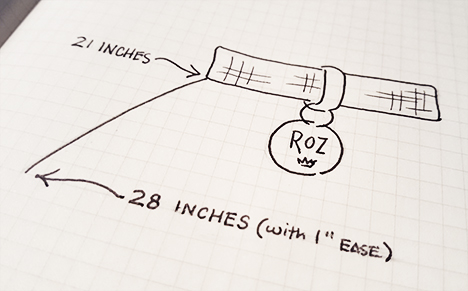
The mathy among you will have noticed some funny business is going in the photograph above. For one thing, the neck measurement is 21 inches, and at 4.5 stitches to the inch, that means the neck should be 94.5 stitches around. Instead, it’s given as approximately 92 stitches.

What gives?

Well, first of all–we can’t cast on half a stitch.

Second, our original sketch indicates that we want to begin this circular sweater with a collar of knit 2, purl 2 (k2p2) ribbing. That requires a number of stitches evenly divisible by 4, and neither 94 nor 94.5 will work.

So what do we do? We fudge. We find the nearest number to 94.5 that is divisible by 4. We could go higher, but I chose to go slightly lower, to 92 stitches.

It’s a tiny difference. It’s not going to throw the piece out of whack.

By the same token, we don’t worry that the shoulder measurement of 28 inches “should” require 126 stitches, not 124. We also want to end the sweater with k2p2 ribbing, and so it will be convenient if we maintain numbers evenly divisible by 4 throughout. Therefore, 124.

I could have chosen to use 128 as my fudged number, rather than 124. Why didn’t I? It just felt like the right thing to do at the time. If I had been worried that two stitches less would make the piece too small, I could have gone up. Instead, I decided that with a limited yarn supply (only two skeins to hand) it would be a good idea to eliminate stitches where possible, and went down.

A big part of becoming a confident, adventurous knitter is learning not to sweat the small stuff. Two stitches in a worsted weight dog sweater is small stuff.

Fudge it.

Now, Back to the Math

So this is our problem (and it’s a math problem, but the sort of math problem even I can do).

We need to increase from 92 stitches to 124 stitches, a total of 32 stitches.

Warm 2.12

And we have, potentially, 32.5 (we’ll call it an even 32–more fudging) rounds over which to increase this number of stitches.

This is where things get slightly fuzzy, if you will pardon the expression. You have a choice to make based on your own judgement. Is the shaping gentle (like, for example, most sweater waist shaping) or sharp (like the explosion of stitches that shape a knitted tam)?

Warm 2.13
Roz’s shoulder slope looks to me gradual, which means we want to space the increases out over many rounds, rather than do them all at once. The nice thing about working with knitted fabric is that it is obligingly stretchy and drapey–it almost wants to fit whatever you put inside it. That means there’s not one correct answer, but a range of possible correct answers. So, we can take a guess and try it out.

Here’s my guess. To calculate 32 increases over 32 rows, we divide the number of rounds by the number of stitches. And we get…drum roll, please:

1

Which means 1 increase in every round.*

For gentle shaping, it’s usually best to put at least one plain round between increase rounds. (The more plain rounds between increases, the gentler the shaping will be.) So here, at Rosamund’s shoulders, I prefer to increase two stitches every other round. Spreading decreases out also gives the shaped area of the fabric a smoother line, though of course the change will still be noticeable.

A reasonable plan, right? Right. The only remaining question was where in each round to place the increases. It seemed logical to stick them opposite each other another along the lines of the shoulder. Where the body grows, so does the fabric.

To sum up:

  1. Figure the difference in stitches between Point A and Point B.
  2. Figure the number of rows/rounds between Point A and Point B.
  3. Divide the number of rows/rounds by the number of stitches to increase.** This will give you the number of increases per row/round. If you end up with fractions, choose a nearby whole number using your best judgment.
  4. Decide exactly where in your rows/rounds you want your shaping stitches to occur.

Decreases work the same way.

Many Rounds Later…

We’re going to jump ahead now to the first fitting. I had decided early on to work the entire body in one piece, in the round, with steeks for the leg holes. Perhaps you shudder at the mention of steeks–because there is a widespread misconception that steeks are frightening. They aren’t, but I want to set aside steek talk for our next installment.

Today, let’s look at where all the calculating and knitting and calculating and knitting got us.

Warm 2.14

These are catch-as-catch-can photos, because Rosamund was not as interested in showing off her sweater as she was in the squirrels making whoopee in the porch rafters.

Verdict: Not bad.

Warm 2.15

I could have given this another inch or two of length from neck to shoulder. And it might be cute to knit her a turtleneck. I think she could carry that off. (In case you’re wondering, the orange scrap yarn is holding live stitches conveniently created during the formation of the steeks.)

Warm 2.16

I used short rows to make the sweater longer on the back than the belly, so she’d be nice and warm at the rear but wouldn’t pee on my knitting. I could have done more short rows for additional back length. In fact, I could use an additional two to three inches all around here. So that’s duly noted for next time.

Warm 2.17

Clearly–meaning, you can see it from down the block–the biggest flaw is the size of the leg*** holes. After I opened the steeks I realized that my own biceps fit easily through them. I’m small, but I’m not as small as Roz–whose legs measure about nine inches around where they join her body.

This is what happens when you don’t trust your own numbers. I kept looking at pictures of her (as opposed to actual her, since my travel schedule meant much of the knitting had to be away from home) and thinking, “That’s not big enough. She’s so muscular. Thighs like a shot put champion. Man, I’d love to have those thigh muscles. Let’s make this just a bit wider. And she’ll need ease, so she can run around. Lots of ease.”

So I wound up with 14-inch leg holes.

Still, now I know what not to do. That’s the point of this exercise, after all–to figure out what basic measurements and shaping Rosamund’s sweaters should (and shouldn’t) have.

I believe I can do something about the legs and make this into a wearable sweater, good for early fall if not the coldest parts of winter. Let’s talk more about the legs, and about steeks, in two weeks. By which time it may well be winter in Chicago.

*Have you any idea how relieved I was that the math worked out so nicely? Pure chance, but I’ll take it.

**If the number of stitches to increase is greater than the number of rows/rounds across which you will increase, flip this around. Divide the number of stitches by the number of rounds.

***I keep typing “arm holes.” Knitting for an animal is kinda weird.

Tools and Materials Appearing in This Issue

Simpliworsted by HiKoo® (55% Merino Superwash, 28% Acrylic, 17% Nylon; 140 yds per 100g skein). Color: 611, Earth and Sky.

addi® Olive Wood circular needles size US 4, 16 inch (40 cm)

About Franklin

Designer, teacher, author and illustrator Franklin Habit is the author of It Itches: A Stash of Knitting Cartoons (Interweave Press, 2008). His newest book, I Dream of Yarn: A Knit and Crochet Coloring Book was brought out by Soho Publishing in May 2016 and is in its second printing.

He travels constantly to teach knitters at shops and guilds across the country and internationally; and has been a popular member of the faculties of such festivals as Vogue Knitting Live!, STITCHES Events, the Maryland Sheep and Wool Festival, Squam Arts Workshops, the Taos Wool Festival, Sock Summit, and the Madrona Fiber Arts Winter Retreat.

Franklin’s varied experience in the fiber world includes contributions of writing and design to Vogue KnittingYarn Market News, Interweave KnitsInterweave CrochetPieceWorkTwist Collective; and a regular columns and cartoons for Mason-Dixon Knitting, PLY Magazine, Lion Brand Yarns, and Skacel Collection/Makers’ Mercantile. Many of his independently published designs are available via Ravelry.com.

He is the longtime proprietor of The Panopticon, one of the most popular knitting blogs on the Internet (presently on hiatus).

Franklin lives in Chicago, Illinois, cohabiting shamelessly with 15,000 books, a Schacht spinning wheel, four looms, and a colony of yarn that multiplies whenever his back is turned.

Follow Franklin online via Twitter (@franklinhabit), Instagram (@franklin.habit), his Web site (franklinhabit.com) or his Facebook page.


Fridays with Franklin: The Adventure of the Warm Puppy, Part One

fwf-logo-v11

The Adventure of the Warm Puppy: Part One


For an introduction to what goes on in this column, click here.


Meet Rosamund

I must begin this adventure by making introductions.

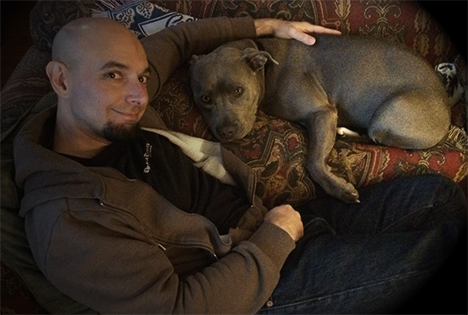
I would like you, please, to meet my dear companion, Rosamund Adelaide.

Warm 1.1

When Rosamund arrived, she was only eighteen months old; yet she had already suffered a life, as Lady Bracknell put it in The Importance of Being Earnest, “crowded with incident.”

Born into an “accidental” (read “irresponsible”) litter in downstate Illinois, she was taken from her mother far too soon and sold via Craigslist to an abusive brute.

When the authorities arrived to remove the brute’s wife and child to a safe place, they begged that the dog also be taken away, as he would likely kill her by way of revenge. She was emaciated, so much so that she was nearly dead already.

She was dropped at a shelter where, because of her breed (she is a bluenose pit bull), she was marked for swift euthanasia. In the nick of time, a rescue society claimed her and brought her back to health. A foster home cared for her until the happy day she left all that to be with me. She was re-christened, rather grandiosely, after a fictional duchess and an actual queen. In casual settings, she answers* to Roz.

Warm 1.2

In spite of all she suffered, she loves everyone–men, women, children, other dogs, even cats. She is polite, endlessly playful, and touchingly affectionate. Her sole aversions are pigeons and rats–a distaste we share.

Warm 1.3

It has only been three months. I can’t imagine life without her.

Winter Is Coming

She took up residence here in Chicago just as warm weather arrived. Our summer, though hot, is at best fleeting. Winter lasts for about nine months and is famously brutal.

One look at Rosamund’s short, sleek coat and nearly bare tummy told me that she would require a sweater. No. Many sweaters.

You can buy dog sweaters, of course. Quite nice ones, if you are prepared to pay handsomely. But for this tiny girl, I wanted only the very best–and if possible, I wanted to make it with my own hands.

Solid as a Rock

Way back when I first attended a knitting circle, there was a woman in the group whose specialty was knitting rock covers. By which I mean that she enjoyed knitting covers for rocks. She would trawl the lake shore or construction sites or public parks looking for odd-shaped hunks of stone about the size of her first, then knit little stockinette cozies that grew and shrank to snugly enclose each one.

What she did with them after that, I have no idea. Perhaps she hurled them through the windows of journalists who wrote things like, “Knitting–it isn’t just for grandmothers any more.”

I wasn’t tempted to try knitting for rocks myself, but when confronted with the wriggling bundle of compact, muscular curves that is Rosamund, I thought of it. The Rock Knitter had told me a bit about her method–measuring the difference between two points, making simple calculations, and doing some guesswork.

Rosamund, when stubborn, is very much like a rock with bewitchingly soulful eyes. Perhaps the same calculating and guessing could guide me to a sweater that would make both of us happy on a snowy day.

The Measure of the Mutt

Mind you, I’d never knit a dog sweater before. Not from a pattern, not at all. So I set out knowing that this first attempt might go cockeyed. In fact, it probably wouldn’t end in a wearable garment.

But that’s not unusual in made-to-measure, is it? A fine suit or gown requires multiple fittings. A couture design begins with a test garment called a toile–also called a muslin–that’s meant only to serve as a guide for making the real thing.

This first go would be my toile. Once the basic shape was established, I could vary it to my heart’s content.

I needed measurements. Lots of them.

Happily, Rosamund was wonderfully docile–even amused–during our little gavotte with the tape measure. She gave it a nibble, found it didn’t taste good, and decided to indulge me and my odd fancies.

She has all kinds of angles I’d never considered until I started trying to map her topography. I wasn’t sure exactly what I’d need, so I might have gone slightly overboard. Better too much information than too little.

Warm 1.4

These are the measurements I took, in no particular order:

A. Neck (with collar): 21 inches

B. Collar to end of ribs, measured along chest: 13 inches

C. Chest circumference: 27 inches

D. Waist circumference: 21.5 inches

E. Space between forelegs (across chest): 4 inches

F. Neck (at collar) to shoulder: 5 inches

G. Chest to waist: 10 inches

H. Circumference of leg: 9 inches

I. Outside width of leg: 5.5 inches

Raw Ingredients

I hedged my bets with my choice of yarn.

HiKoo® Simpliworsted is a workhorse–soft, reasonably priced, and resilient; with wool for warmth, nylon for strength, and acrylic to keep its shape. It’s easily washable, too. So if the coat did come out well, it’d withstand the abuse Rosamund would inflict upon it. If it didn’t come out well, I wouldn’t have broken the bank and could try again.

Warm 1.5

This variegated colorway seemed a good choice, too. I didn’t plan any stylish details in this prototype, but the gentle color changes of the yarn itself would offer interest even in plain stockinette.

And Of Course…

I swatched.

This was more fun than you might expect, because I was using my first addi® Olive Wood circular needle. These needles are absolutely delicious, by the way: strong, smooth, and beautiful, with a nice, sharp tip. Soft in the hand. Isn’t the grain lovely?

Warm 1.6

I knit up a generous swatch to test the drape and density of the fabric, to decide between 2/2 and 1/1 ribbing, and to check my stitch and row gauge.

Warm 1.7

Many knitters only pay lip service to swatching for gauge, but for the kind of knitting I intended it was absolutely vital. Without accurate measurements, I’d be lost before I began.

I know it’s common to say, cynically, that swatches lie. I’ve said it myself. But even the most deceitful swatch tells you more then no swatch at all.

After all this, at last we come to calculating the cast on and getting down to knitting.

Warm 1.8

So much more about that in two weeks.

*Especially if you are holding cheese.

Tools and Materials Appearing in This Issue

Simpliworsted by HiKoo® (55% Merino Superwash, 28% Acrylic, 17% Nylon; 140 yds per 100g skein). Color: 611, Earth and Sky.

addi® Olive Wood circular needles size US 4, 16 inch (40 cm)

About Franklin

Designer, teacher, author and illustrator Franklin Habit is the author of It Itches: A Stash of Knitting Cartoons (Interweave Press, 2008). His newest book, I Dream of Yarn: A Knit and Crochet Coloring Book was brought out by Soho Publishing in May 2016 and is in its second printing.

He travels constantly to teach knitters at shops and guilds across the country and internationally; and has been a popular member of the faculties of such festivals as Vogue Knitting Live!, STITCHES Events, the Maryland Sheep and Wool Festival, Squam Arts Workshops, the Taos Wool Festival, Sock Summit, and the Madrona Fiber Arts Winter Retreat.

Franklin’s varied experience in the fiber world includes contributions of writing and design to Vogue KnittingYarn Market News, Interweave KnitsInterweave CrochetPieceWorkTwist Collective; and a regular columns and cartoons for Mason-Dixon Knitting, PLY Magazine, Lion Brand Yarns, and Skacel Collection/Makers’ Mercantile. Many of his independently published designs are available via Ravelry.com.

He is the longtime proprietor of The Panopticon, one of the most popular knitting blogs on the Internet (presently on hiatus).

Franklin lives in Chicago, Illinois, cohabiting shamelessly with 15,000 books, a Schacht spinning wheel, four looms, and a colony of yarn that multiplies whenever his back is turned.

Follow Franklin online via Twitter (@franklinhabit), Instagram (@franklin.habit), his Web site (franklinhabit.com) or his Facebook page.

Fridays with Franklin: The Adventure of the Stealth Blanket, Part Four

fwf-logo-v11For an introduction to what goes on in this column, click here.

For the first installment of this series, click here.

The delicious moment of epiphany that capped Part Three, was itself capped by a less delicious moment of epiphany.

Stealth 4.1

I still had half the blanket to knit. Another thirty two squares. Plus seaming. Plus a border.

I felt queasy.

When you write a column like this, you’re not supposed to say that. You’re supposed say this:

And here, dear readers, I must leave you–for the joys quill and paper are as nothing to the thrill that awaits at the work table. Such brilliant yarn! Such dear little squares! I warrant I shall not sleep these ten days ’til I have had my fill of knitting them. Anon!

Stealth 4.2

Okay, maybe most writers wouldn’t say it exactly that way–there would probably be a “yummy” and a “squee” and generous use of “ZOMG” plus a smiley emoticon. Such is the current fashion.

But what you are never, ever supposed to do is admit in public that you are not fainting with delight over every single stitch.

Pssst. Pssst. You wanna know a secret? We aren’t always fainting with delight over every single stitch, any more than you are. But don’t tell anybody I told you.

You may recall, however, that I started this adventure by admitting the blanket would be a minefield of personal aversions: big, repetitive, garter stitch. That was part of the point. Could I do it? Or would I fall apart in front of you all and pretend a throw pillow made of these two blocks was really what I wanted the whole time?

Garter on the Go

By this time, the two-color square pattern had engraved itself upon my brain as deeply as the alphabet, my telephone number, and the theme tune from “Mister Belvedere.” They had become such mindless knitting that on more than one occasion, I found myself binding off a square I could not remember casting on.

So I knit them in a sports bar…

Stealth 4.3

On a Chicago rooftop…

Stealth 4.4

On several airplanes, of which this was one…

Stealth 4.5

On the back porch with a dear companion…

Stealth 4.6

I knit through conference calls, waiting in line at the grocery store, sitting in a coffee shop, sitting in the park, lying in bed, lying in the bath, lying on the sofa, lying to myself, lying in wait.

I continued the running tally of my squares to make sure I knit enough–and not too many–of each combination.

Stealth 4.7

To my great surprise, in much less time than I’d anticipated the table was covered with the requisite number of squares.

Stealth 4.8

Whipped

Then I sewed them up with whip stitch (more about that in Part Two), once again following a sequence inspired by the way quilters put their blocks together.

Stealth 4.9

Choosing the color for the sewing was nerve-wracking. My original intent was to use one of the quiet background colors, thinking the joining method shouldn’t draw attention to itself.

But…why not? Why not celebrate the sewing? And pull the counterpoint color into the blanket more fully?

Stealth 4.10

Edged

Finally, a border–to recall the binding that is the finishing touch on almost every patchwork quilt. By now, I was addicted to the sunny, Bayberry colorway and figured I might as well run with it.

I considered knitting the border as circular garter stitch, picking up stitches all around and increasing at the four corners as I progressed outward from the center. I’ve edged lace shawls that way, and it worked well.

However, a lace shawl–even a large lace shawl–doesn’t weigh as much as this blanket. I started to calculate the number of stitches I’d have on my needle, and how long that needle would have to be. I thought about alternate rounds made up of purl stitches. I thought about the difference between my flat gauge and my circular gauge.

I decided to do this, instead:

Stealth 4.11

The same rate of increase that gives you the first half of the two-color square also gives you a perfect mitre at each corner.

Stealth 4.12

The Finish Line

I did it. I did it! I knit my first blanket. And…I enjoyed it. The repetition, the garter stitch, the sewing. I enjoyed it.

I call it Floralia.*

Stealth 4.13

Stealth 4.14

I finished it on a day the heat index in Chicago hit 102 Farenheit with 86 percent humidity, and I still wanted to wrap up in it. It’s that cuddly. It’s that deluxe.

Here are the vital statistics.

Yarn: Kenzington by HiKoo® (60% Merino, 25% Nylon, 10% Alpaca, 5% Silk Noils; 208 yds per 100g skein). Colors: 1015 (Boysenberry), 1027 (Takahe), 1018 (Seal), 1000 (Pavlova), 1005 (Bayberry). 2 skeins of each color.

Gauge: 5 stitches/10 rows = 1 inch in garter stitch

Finished Dimensions: 3 feet by 3 feet

Needles: addi® Click circular needles, size US 6 (4mm) with 16-inch (40 cm) cable (for working the patches) and 40-inch cable (joined to 16-inch with connector for working the border)

My friends at Maker’s Mercantile liked it, too, so they’ve decided to take action.

For Your Knitting (and Shopping) Pleasure…

If you’d like to knit your own Floralia, a detailed pattern is available via Makers’ Mercantile.

If you will be visiting Stitches Midwest, August 4-7 in Schaumburg, Illinois, you can shop in person at the Makers’ Mercantile Booth, Number 412. You’ll find Kenzington and Kenzie (among other beautiful yarns, accessories, and notions) and kits for both the Floralia Blanket and a matching pillow–plus a whole lot of other goodies.

And I’ll be signing copies of my newest book, I Dream of Yarn: A Knitting and Crochet Coloring Book, in the booth on Saturday morning.

Stealth 4.15

Do pay us a call if you can. We’d love to meet you.

And please join me here in two weeks for the start of a new knitting adventure

*A rather frisky ancient Roman spring festival (begun on April 27 or 28, depending upon which calendar you use) in honor of the goddess Flora.

Tools and Materials Appearing in This Issue

Kenzington by Hikoo (60% Merino, 25% Nylon, 10% Alpaca, 5% Silk Noils; 208 yds per 100g skein). Colors: 1015 (Boysenberry), 1027 (Takahe), 1018 (Seal), 1000 (Pavlova), 1005 (Bayberry).

addi® Click Turbo Interchangeable Circular Needles

About Franklin

Designer, teacher, author and illustrator Franklin Habit is the author of It Itches: A Stash of Knitting Cartoons (Interweave Press, 2008). His newest book, I Dream of Yarn: A Knit and Crochet Coloring Book was brought out by Soho Publishing in May 2016 and is in its second printing.

He travels constantly to teach knitters at shops and guilds across the country and internationally; and has been a popular member of the faculties of such festivals as Vogue Knitting Live!, STITCHES Events, the Maryland Sheep and Wool Festival, Squam Arts Workshops, the Taos Wool Festival, Sock Summit, and the Madrona Fiber Arts Winter Retreat.

Franklin’s varied experience in the fiber world includes contributions of writing and design to Vogue KnittingYarn Market News, Interweave KnitsInterweave CrochetPieceWorkTwist Collective; and a regular columns and cartoons for Mason-Dixon Knitting, PLY Magazine, Lion Brand Yarns, and Skacel Collection/Makers’ Mercantile. Many of his independently published designs are available via Ravelry.com.

He is the longtime proprietor of The Panopticon, one of the most popular knitting blogs on the Internet (presently on hiatus).

Franklin lives in Chicago, Illinois, cohabiting shamelessly with 15,000 books, a Schacht spinning wheel, four looms, and a colony of yarn that multiplies whenever his back is turned.

Follow Franklin online via Twitter (@franklinhabit), Instagram (@franklin.habit), his Web site (franklinhabit.com) or his Facebook page.

Fridays with Franklin: The Adventure of the Stealth Blanket, Part Three

fwf-logo-v11

For an introduction to what goes on in this column, click here.

For the first installment of this series, click here.

The design process is, at bottom, a series of questions. The more honest your answers, the better your design.

Most of the questions are Am I happy with this?

Facing the Swatch

This sixteen patch Ohio Star block is probably the largest single swatch I’ve ever knit for a project.

Stealth 3.1.jpg

As I wrote in Part Two, I liked it well enough to begin an entire quilt-inspired blanket. But an even, good swatch suggests what you might do better.

I wanted a few changes.

First: more color. There’s not a shade of Kenzie I don’t like–it’s been a favorite of mine since it was introduced. The blue and grey are perfectly handsome, but too quiet for my current mood. This blanket is going to take a lot of time to knit, so I want it to make a statement. A bold statement. A really bold statement. If I could make it dance the hippy hippy shake while singing “Ain’t We Got Fun?” I would.

Second: more heft. The Kenzie fabric is soft, drapey, and sweet to cuddle. However, I live in Chicago, in a Victorian apartment house, and I don’t use blankets as decorative accents. Come February, I use them for survival. Heavier is better.

Kenzington Calling

The Hikoo line offers a yarn I think of as Kenzie’s bigger, fancier cousin: Kenzington. The two share similar fiber blends– both have New Zealand merino, nylon, alpaca, and silk noils.* Kenzington is thicker, though; and rather than being twisted, it’s held together by what the industry calls “chainette” construction. Look at it closely, and you’ll see the strand is, indeed, a teeny weeny little chain.

Stealth 3.2

When I first wrote about this yarn, someone asked me if it’s as soft as it looks. I told her it feels like an extremely stylish angel kissing you on the cheek.

Am I happy with this?

Oh, you bet I am.

The Unnatural Colorist

Now, which colors of Kenzington to use?

There was a time when this question would have sent me straight under the bed to shiver among the dust bunnies. I am not what you would call a natural-born colorist.

I lay this partly at the feet of my mother, who had a remarkable aversion to color. Our house and most things in it were a low-key mélange of brown, tan, ecru, beige, and rust. When she was in a carnival mood, she’d throw in a dash of hunter green.

How, you might ask, could such a person be a quilter? Well…in her all-too-brief lifetime she turned out a heap of beautifully made quilts in brown, tan, ecru, beige, and rust (with an occasional bit of hunter green). Such was her taste.

What’s more, as an American boy I was conditioned to limit myself to the so-called “masculine” palette of black, grey, blue, and khaki with a touch of moss green. Unless it was a color you could find on a battleship or a rotting log, I wasn’t allowed to wear it.

I overcame this to become a knitter who is in middle age perhaps almost too fond of mixing colors together in my work. In fact, these days I teach other knitters how to do it. It’s not–as I used to think–an arcane talent with which one must be born. You can learn, if you apply yourself a little and mess around a lot.

Coloring the Block

Here’s how I did it for this project.

I started with a color I really liked: Color 1015 Boysenberry, the purple.

Stealth 3.3

I chose it for no other reason than that: I liked it. I figured I would enjoy knitting with it.

I had an idea that this would be the dominant color in the star; but I didn’t want it to stand alone. I wanted a second, closely related color, and reached for Color 1027 Takahe, the blue.

Stealth 3.4

The two are similar enough (cool, dark in value, containing blue) that a star made of both would (or should) still read as a single unit of design.

For the background, I needed something that less intense that wouldn’t draw attention to itself. Grey had worked well in the Kenzie swatch block, so it was easy to choose a similar grey, Color 1018 Seal, in Kenzington.

Stealth 3.5

If the star has two colors, why not have the background in two colors as well? Kenzington offers a pale tan, Color 1000 Pavlova, that is similar in value (very light) to the grey, and so should read well as a continuation of the background.

Stealth 3.6

This is where, once upon a time, I would have stopped. All these colors sit nicely next to one another. Nothing jars. I have learned, though, that therein lies a problem. If everything goes together too well, the mix is inclined to be quiet. That can be soothing; but just as often can be dowdy or boring. I needed a jolt energy, and that comes from adding something very different.

So into the cool mix I dropped Color 1005 Bayberry, an orange-red. This would be primarily for the diamonds between the blue-and-purple stars. There would be less of it, and so I didn’t need to worry about it overwhelming the blanket–I hoped. You never know, do you?

Stealth 3.7

Am I happy with this?

Indeed I am.

Seeing Stars

Before knitting the new patches I drew a sketch of the block, so I would know how many of each patch I’d need.

Stealth 3.8

As the patches were finished, I laid them out to watch the blocks shape up.

Stealth 3.9

When I had finished the first block, I was happy enough with it to knit the second. Then the fun really started.

My original plan was these two blocks, repeated.

Stealth 3.10

Cute, right? I mean, fine. Yeah.

Am I happy with this?

Kinda. I mean, it was…fine. It wasn’t bad. It would work.

But as long as the squares were all laid out, I figured I’d not try some other arrangements. Like this.

Stealth 3.11

Or this.

Stealth 3.12

Or even set aside the Ohio Star entirely and try something else. Why not?

Stealth 3.13

And suddenly, in my head and stomach, the happy little vibrations that tell me, “That’s it. That’s the answer,** right there.”

Am I happy with this?

Yes! Yes! Yes!

Never. Stop. Playing.

I have a whole lot of knitting and sewing to do. And I think we are going to need a border to finish this thing.

See you in two weeks.

*Kenzie also includes a touch of angora.

**The answer for me. Your answer may differ, and that’s as it should be.

Tools and Materials Appearing in This Issue

Kenzie by Hikoo® (50% New Zealand Merino, 25% Nylon, 10% Angora, 10% Alpaca, 5% Silk Noils; 160 yds per 50g skein). Colors 1002 (Grey Salt) and 1013 (Tekapo).

Kenzington by Hikoo (60% Merino, 25% Nylon, 10% Alpaca, 5% Silk Noils; 208 yds per 100g skein). Colores

addi® Click Turbo Interchangeable Needles

About Franklin

Designer, teacher, author and illustrator Franklin Habit is the author of It Itches: A Stash of Knitting Cartoons (Interweave Press, 2008). His newest book, I Dream of Yarn: A Knit and Crochet Coloring Book was brought out by Soho Publishing in May 2016 and is in its second printing.

He travels constantly to teach knitters at shops and guilds across the country and internationally; and has been a popular member of the faculties of such festivals as Vogue Knitting Live!, STITCHES Events, the Maryland Sheep and Wool Festival, Squam Arts Workshops, the Taos Wool Festival, Sock Summit, and the Madrona Fiber Arts Winter Retreat.

Franklin’s varied experience in the fiber world includes contributions of writing and design to Vogue KnittingYarn Market News, Interweave KnitsInterweave CrochetPieceWorkTwist Collective; and a regular columns and cartoons for Mason-Dixon Knitting, PLY Magazine, Lion Brand Yarns, and Skacel Collection/Makers’ Mercantile. Many of his independently published designs are available via Ravelry.com.

He is the longtime proprietor of The Panopticon, one of the most popular knitting blogs on the Internet (presently on hiatus).

Franklin lives in Chicago, Illinois, cohabiting shamelessly with 15,000 books, a Schacht spinning wheel, four looms, and a colony of yarn that multiplies whenever his back is turned.

Follow Franklin online via Twitter (@franklinhabit), Instagram (@franklin.habit), his Web site (franklinhabit.com) or his Facebook page.


Fridays with Franklin: The Adventure of the Stealth Blanket, Part Two

fwf-logo-v11

For an introduction to what goes on in this column, click here.

For the first installment of this series, click here.

Today, as we continue the quilt-inspired blanket, I’m going to talk an awful lot about the S word. Sewing.

Stealth 2.1

Don’t make that face at me. I wish I had a ball of Cashmere Queen for every knitter who has said, “Oh, I hate sewing,” after she has tried it once, for about half an armhole, then got frustrated and stuffed the project into a bag and shoved the bag into a closet and then moved to a new house without opening the closet again.

I’m not saying you have to love sewing. I’m not promising you ever will love sewing. I do believe that if you give basic sewing a fair shake, you’ll be glad to have it in your arsenal when a simple seam will get you the results that you want.

Why Sew?

You might well ask why a knitted blanket must involve sewing at all. Many of you have asked. More than a few have asked indignantly, suggesting in heated terms that alternate methods (from join-as-you-go squares to garter stitch intarsia) would allow me to work the whole project in a single piece and avoid…shudder…sewing.

Those alternate methods all have merit, and the question is a fair one. So here’s my answer.

If I try to work a blanket this size in one piece, I know I will never finish it.

This isn’t going to be a bedspread, just a little lap blanket; but even a lap blanket becomes a chore to haul around once you’re about a third finished. You can’t tuck it into a pouch or a pocket. You either knit it at home, stationary, confined to what I hope is a comfortable chair. Or you find a bag big enough to encompass it (along with the long, long needles and enough yarn to see you through the long, long rows) and you drag the bag from pillar to post until your shoulders give out.

If I can work on this only when I’m at home and at rest, I’ll never finish. I have to nibble away at it, square by square, wherever I happen to be–for example, in a taxi on the way to the airport–

Stealth 2.2

or on the back porch–

Stealth 2.3

until I’ve got enough squares to amount to something. Since the basic square is so simple, light, and small, it makes a perfect traveling project.

The sixteen I made to test this idea were worked at home, on the subway, in a few taxicabs, in four airports, in three hotels, on six airplanes, in the car, in a clutch of restaurants, and in seven states.

That’s why it’s a stealth blanket. If I’m going to knit it, I have to knit it almost without realizing I’m knitting it. If that means sewing–okay, fine. I’ll sew.

But First, I Block

My childhood needlework teacher, my late grandmother Pauline, beat it into me* that successful sewing owes much to proper preparation. We have here many small squares that we hope to join into one large square.

Stealth 2.4


To get the best results those small squares really need to be square and equal. That means blocking them all to the same size and shape.

I prefer wet blocking, so all the squares went into a nice bath of warm water with a touch of gentle baby shampoo and sat there for about forty minutes.

Stealth 2.5

While they relaxed, I set up an impromptu blocking frame. This idea isn’t original. In fact it’s been parroted so many times I finally gave up on trying to find the originator. Whoever you are, I salute you.

You need, first, a base of something firm but penetrable–it might be a couple layers of thick corrugated cardboard, a Styrofoam block, or–in my case–a piece of insulating foam left over from a home improvement project.

On this base, use a good straightedge (mine was one of Mom’s quilting rulers) to mark out a square the size that your finished knit squares need to be. Keep in mind that we are blocking gently–don’t expect to stretch a five-inch square to seven inches unless you’re knitting lace.

Stealth 2.6

Then get yourself eight metal (and rust-proof!) double-pointed knitting needles a few sizes smaller than the needles you used to knit your squares. (Mine are eight-inch addi® double-pointed aluminum needles.)

Insert the needles into the base, as perpendicular** as you can get them: one at each corner of the square, and one in the center of each side.

Stealth 2.7

After a thorough rinse, retrieve your squares from the bath and gently press out the excess water. They should still be damp, but not sopping.
One by one, stretch them over your uprights and slide them down to the base. Soon you will have a stack of clean squares blocked to match. The sight is immensely satisfying. Take a moment to enjoy it.

Stealth 2.8

The downside of this method is that the stack can take a long time*** to dry. To hurry it up a bit, I a) blow a fan on it and b) peel off the topmost squares as they finish drying.

Next, We Plan

In assembling the squares for a blanket, we would do well to follow the wise example of quilters everywhere, including my own, dear mother.

Step One. Squares are sewn together into strips.

Stealth 2.9

Step Two. Strips are sewn together into blocks.

Here’s the plan for sewing our block, which mimics the traditional pattern many quilters call Ohio Star.****

Stealth 2.10

The arrows in the top row indicate that we first sew the four squares into a strip.

Then we sew the squares in the three rows below into three strips.

Then we sew the strips together to form the block.

This orderly approach keeps us from making grave mistakes, and also means each piece of the blanket is handled as little as possible–handling can lead to stretching, which leads to un-square squares.

Clever people, those quilters.

Then, We Prepare

Sewing isn’t knitting, even when you’re sewing two pieces of knitting together. It has a few special requirements; and if you’ll just take care to meet those you’ll be well on your way to success.

Light. Sewing needs a lot of light–in general, more than you need to knit. You can feel your way along a row of knitting, even in a dim lecture hall or a dark theatre. In sewing, you must be able to see clearly where the next stitch is to be taken. The usual table lamp in the living room may be insufficient. Work in good daylight, or under the very best artificial lighting you can muster. This is especially vital when working with dark colors.

Surface. Most of us knit with the work–even when it’s large–in our laps. Very small bits of sewing might be that portable; but you’ll do best to sew a blanket with the aid of a work surface. Do what you can to clear a level, stable area of table or desk to hold your supplies and the piece in progress. As you begin to sew the strips together into the finished block, the table will support the fabric and keep it from stretching. You’ll be able to focus on your stitches, not managing the bulk.

Length. Don’t reel off 50 inches of yarn to sew a 40-inch seam. The maximum length of yarn or thread to work with is somewhere between 20 and 22 inches. Longer than that, and you will suffer snarls, knots, and kinks sufficient to make you wish you had never been born. What’s more, long strands of knitting yarn may well weaken or wear through from repeated pulling through the fabric, and your seam will break.

Now, We Whip

I like to sew yarn to yarn with yarn–in this case, the blue (Color 1013, Tekapo) of my two-color pairing of Kenzie. My needle is the same I use for weaving in ends.

The stitch is whip stitch. It has many virtues. It is quick, easy, strong, flexible, and the same on both sides. Pattern writers from the great flourishing of knitted counterpanes in the nineteenth century usually called for blocks to be whipped together, and they knew what they were about.

Read these notes first.

General Notes. You will work your seam from right to left–unless you are left handed, in which case you may prefer to work left to right.

If you knit your squares according to the recipe in the previous column, you’ll find you have created slipped-stitch edges that look like elongated stitches. I chose this edge in part because it will help you see where to sew. When you take your stitches, always take them under both legs of that slipped edge stitch.

Stealth 2.10

Don’t make your stitches too tight or too loose. You want an even tension that brings adjoining squares together with a firm but supple seam. Tight stitches will make the fabric pucker and stiffen. Loose stitches flop around shamelessly and leave gaps in the work. If after you work a seam you find your tension isn’t quite right, use the tip of your sewing needle to adjust the stitches. Nobody else needs to know.

Now, we sew.

Step One. Align your two pieces with wrong sides facing, and hold them in your non-dominant hand like a little sandwich. I work whip stitch while looking at the right sides, so I can really see what I’m doing.

Step Two. Insert your needle at the rightmost corner of the piece nearer to you, as shown. Pull the yarn through, leaving a five-inch tail hanging from the work.

Stealth 2.11

Step Three. Insert the needle at the rightmost corner of the further piece, from the right side to the wrong side. In the same motion, bring the needle under the edge stitch immediately to the left of your first stitch in the nearer piece. Note that you are pointing the needle directly at yourself as you do this. Pull the yarn through until the selvages of your pieces just kiss one another. Mwah!

Stealth 2.12

Step Four. Repeat Step Three, taking your next stitch in the further fabric under the edge stitch immediately to the left of your first sewing stitch. Proceed in this way to the end of the seam, taking one sewing stitch under every edge stitch your selvages.

Stealth 2.13

Stealth 2.14

Step Five. When you reach the end of the seam, cut the yarn leaving a five inch tail. Weave in both tails on the wrong side just as you weave in any loose ends on your knitting.

In Summary. *Insert needle from far side of work to near side under both slipped selvages and pull yarn through. Repeat from *, moving one slipped selvage stitch to the left to begin the next sewn stitch.

And At Last…

When the squares have become strips and the strips have been joined, we have a blanket.

Stealth 2.15

Well, we have a blanket square. Fairly large–mine measures 21 x 21 inches. Nice for a big pillow cover, or a mat for the new baby to lie on while it does neonatal yoga.

Stealth 2.16

I love the yarn. The design and construction have proven themselves worthy. But there’s one thing I’m not crazy about…the color. Rather, the lack thereof. This is fine. But I’m in a mood lately for lots of color. Not two colors, even two pretty colors like these.

I’m also thinking I’d like to try this in a slightly heavier yarn, to make the blanket really deluxe. But after sixteen squares, can I bear to start over?

Enter Kenzie’s beautiful big sister, Kenzington.

Stealth 2.17

Yeah, baby. Yeahhhhh. See you in two weeks.

*But don’t get crazy. If you find yourself using a square, level, and plumb, you are overthinking it.

**Not an exaggeration. I have a dent on my head where the yardstick landed.

***Eternity.

***Names of quilt blocks are like names of knitting stitches. They abound, they vary, they contradict. You might well call this block by another name, or you might well know a different block as Ohio Star. What a world, my friends. What a world.

Tools and Materials Appearing in This Issue

Kenzie by HiKoo® (50% New Zealand Merino, 25% Nylon, 10% Angora, 10% Alpaca, 5% Silk Noils; 160 yds per 50g skein). Colors 1002 (Grey Salt) and 1013 (Tekapo).

Kenzington by Hikoo® (60% Merino, 25% Nylon, 10% Alpaca, 5% Silk Noils; 208 yds per 100g skein).

addi® Click Interchangeable Circular Needles

addi® 8″ Aluminum Double Pointed Needles

About Franklin


Designer, teacher, author and illustrator Franklin Habit is the author of It Itches: A Stash of Knitting Cartoons (Interweave Press, 2008). His newest book, I Dream of Yarn: A Knit and Crochet Coloring Book was brought out by Soho Publishing in May 2016 and is in its second printing.

He travels constantly to teach knitters at shops and guilds across the country and internationally; and has been a popular member of the faculties of such festivals as Vogue Knitting Live!, STITCHES Events, the Maryland Sheep and Wool Festival, Squam Arts Workshops, the Taos Wool Festival, Sock Summit, and the Madrona Fiber Arts Winter Retreat.

Franklin’s varied experience in the fiber world includes contributions of writing and design to Vogue KnittingYarn Market News, Interweave KnitsInterweave CrochetPieceWorkTwist Collective; and a regular columns and cartoons for Mason-Dixon Knitting, PLY Magazine, Lion Brand Yarns, and Skacel Collection/Makers’ Mercantile. Many of his independently published designs are available via Ravelry.com.

He is the longtime proprietor of The Panopticon, one of the most popular knitting blogs on the Internet (presently on hiatus).

Franklin lives in Chicago, Illinois, cohabiting shamelessly with 15,000 books, a Schacht spinning wheel, four looms, and a colony of yarn that multiplies whenever his back is turned.

Follow Franklin online via Twitter (@franklinhabit), Instagram (@franklin.habit), his Web site (franklinhabit.com) or his Facebook page.

Fridays with Franklin: The Adventure of the Stealth Blanket, Part One

fwf-logo-v11

For an introduction to what goes on in this column, click here.

I often wonder that more knitters do not keep Life Lists in the way that ardent bird watchers do.

A birder’s Life List is (as the name implies) a tally of all birds s/he has definitively spotted. But many Life Lists are also aspirational; they include all the species that might be spotted in a neighborhood, in a country, on a continent, or (for the extremely ambitious) around the world.

Completing that kind of Life List could require a trip fraught with expense and discomfort solely to check one little box. Behold, at last I have seen the Speckle-Breasted Willie Warmer. Check.

fwf stealth 1 .jpg

Me, I have a running tally–in the form of my Ravelry projects page. Yes, I have knit a square shawl, a triangular shawl, a circular shawl, cuff-down socks, toe-up socks…Check, check, check, check.

You probably have one, too. Ravelry project pages are common as corner houses. But what about a list of the things I haven’t knit? What’s missing? I started taking stock.

Would you believe it turns out I’ve never knit a blanket?

Again and Again and Again

I have knit bits of blanket. In other words, I have finished a piece here and there that, had I knit many more of that piece, and sewn them all together, I would have made a blanket.

My problem is that I am not by nature a knitter who thrives on repetition. I can finish a second sock, because my feet are small, my socks go quickly, and the idea of stopping after only one makes me feel abashed and ridiculous. But when I meet someone who tells me she’s making her eleventh shawl from the same pattern, all I can do is stand and blink. Eleven of the same thing? Eleven? How do you do that?

Mother Was a Quilter

My late mother, bless her memory, thrived on repetition. She often fixed early in the year on a single project–an electrified ceramic Christmas tree, a macramé hanging shelf, a suite of framed floral cross stitch miniatures–and would turn into a one-woman gift factory, turning out two dozen identical specimens for delivery to friends and relations well in time for December 25. She was always organized and she never sweated.

I did not inherit any of this from her.

Near the end of her life she discovered quilting and went into orbit. Precision! Repetition! Protocol! It was an art form she’d been born to explore. Sadly, after two years and a dozen perfect quilts, she was gone from us forever. Four uncompleted projects were still sitting, waiting, in her sewing room on the day she died. Along with her pin cushion, just as she’d left it.

fwf stealth 2.jpg

Knitting Patchwork

I got to thinking that I might like to make a patchwork-inspired blanket as an homage to Mom. I would knit it, but I’d take my design and construction cues from quilting.

One of the most common design units in quilting, often the first a new quilter is taught, is a square patch made of two identical triangles, like this:fwfw stealth 3.jpg

I’ve sewn a lot of these. I’d never knit one, but I knew it wouldn’t be difficult. Just do up a square on the bias, changing yarns halfway across. It’s such a simple idea I know I can’t be the first person to try it. I’m probably not even the twentieth. But I didn’t rush off to Ravelry to check. When I do something like this, I’d rather find my own way if I possibly can. Do I reinvent the wheel sometimes? Sure I do. I also learn a heck of a lot more about how stuff works.

Square Recipe

I sat down with one of my favorite tweedy yarns – Hikoo® Kenzie, and a size US 6 (4mm) addi® Click needle that I guessed would give me (your gauge may vary) the kind of garter stitch I like: firm. You want the fabric in a blanket to drape, but not droop. Loose garter stitch tends to stretch in a frowsy fashion I find extremely unattractive.

As to the yarn choice, the Kenzie has what I consider to be an ideal fiber mix for a luxurious blanket. The merino and alpaca are both soft and warm. The nylon is durable and resists stretching out of shape. The angora gives a hint of halo without obscuring the stitches. And the silk noils, which take dye so differently than the other fibers, give the yarn a shimmer that adds depth without glitz.

After a few attempts, I’d refined my two-triangle square to give it equal amounts of both colors (oddly enough, by using slightly more of the second color), and four nice sharp corners.fwf stealth 4.jpg

Since I was working in garter stitch, for increasing I used Elizabeth Zimmerman’s make one: create a backward loop with the working yarn over the right needle. When you encounter this loop on the following row, knit it through the back.

fwf stealth 5.jpg

It’s quick, it’s simple, and in garter stitch fabric it pretty much disappears.

Here’s my recipe for one 5.5 inch square.

Gauge: 4 sts / 8 rows = 1 inch

Yarn: Kenzie by Hikoo (50% New Zealand Merino, 25% Nylon, 10% Angora, 10% Alpaca, 5% Silk Noils; 160 yds per 50g skein). Color 1: 1002 (Grey Salt), Color 2: 1013 (Tekapo).

First Triangle

With C1, cast on 3 sts.

Row 1 (RS) Knit.

Row 2 (WS) Slip first stitch as if to purl with yarn in front, make 1, knit 1, make 1, knit 1. (2 stitches increased.)

Row 3 (RS), Slip first stitch as above. Knit across, knitting the increases from the previous row through the back.

Row 4 (WS). Slip first stitch as above, make 1, knit to last stitch, make 1, knit 1. (2 stitches increased.)

Repeat rows 3 and 4 until you complete the WS row that gives you 35 stitches.

Break C1, leaving 5-inch tail.

Transition Rows

NOTE: Do not slip the first stitches of these rows.

Row 1 (RS). Join C2. Knit across, knitting the increases from the previous row through the back.

Row 2 (WS). Knit across.

Second Triangle

NOTE: Your shaping rows will now be right side rows.

Row 1 (RS). Slip first stitch as above, slip-slip-knit, knit to last 3 sts, k2tog, k1. (2 stitches decreased.)

Row 2 (WS). Slip first stitch as above, knit across.

Repeat rows 1 and 2 until you complete the WS row after decreasing to 5 sts.

End of Square

Row 1 (RS). Slip first stitch as above, slip 2 stitches together as if to knit, knit the next stitch, pass the slipped stitches over the knit stitch. Knit the final stitch. (2 stitches decreased; 3 stitches remain.)

Row 2 (WS). Bind off as follows: slip first stitch as above, knit the following stitch, pass slipped stitch over–2 stitches. Knit the next stitch, pass the previous stitch over–1 stitch. Break C2 and pull end through.

Block and weave in ends.

Play With Your Blocks

This patch is wildly versatile. It can be arranged in so many different ways that entire books have been devoted to it. I knit sixteen–which was, in itself, a milestone for me–and spent a pleasant afternoon arranging them in different ways.fwf stealth 6.jpg

fwf stealth 7.jpg

fwf stealth 8.jpg

fwf stealth 9.jpg

fwf stealth 10.jpg

These aren’t nearly all the possible combinations–just some I that I tried. I love a project that allows you experiment with changes in direction as you move along. The first thing you try out is so seldom the thing that works best.

Mind you, this is still not a blanket. It’s just a pile of squares. They need to be sewn together, and there needs to be more of them. Many more. Many, many more.

We’ll talk about that in two weeks.

Tools and Materials Appearing in This Issue

Kenzie by Hikoo (50% New Zealand Merino, 25% Nylon, 10% Angora, 10% Alpaca, 5% Silk Noils; 160 yds per 50g skein). Colors 1002 (Grey Salt) and 1013 (Tekapo).

addi® Click Turbo Interchangeable Needle Set

About Franklin

Designer, teacher, author and illustrator Franklin Habit is the author of It Itches: A Stash of Knitting Cartoons (Interweave Press, 2008). His newest book, I Dream of Yarn: A Knit and Crochet Coloring Book was brought out by Soho Publishing in May 2016 and is in its second printing.

He travels constantly to teach knitters at shops and guilds across the country and internationally; and has been a popular member of the faculties of such festivals as Vogue Knitting Live!, STITCHES Events, the Maryland Sheep and Wool Festival, Squam Arts Workshops, the Taos Wool Festival, Sock Summit, and the Madrona Fiber Arts Winter Retreat.

Franklin’s varied experience in the fiber world includes contributions of writing and design to Vogue KnittingYarn Market News, Interweave KnitsInterweave CrochetPieceWorkTwist Collective; and a regular columns and cartoons for Mason-Dixon Knitting, PLY Magazine, Lion Brand Yarns, and Skacel Collection/Makers’ Mercantile. Many of his independently published designs are available via Ravelry.com.

He is the longtime proprietor of The Panopticon, one of the most popular knitting blogs on the Internet (presently on hiatus).

Franklin lives in Chicago, Illinois, cohabiting shamelessly with 15,000 books, a Schacht spinning wheel, four looms, and a colony of yarn that multiplies whenever his back is turned.

Follow Franklin online via Twitter (@franklinhabit), Instagram (@franklin.habit), his Web site (franklinhabit.com) or his Facebook page.