Fridays with Franklin: The Zitron Art Deco Challenge Part Two, Poppin’ Wheelies

fwf-logo-columnsizeFor an introduction to what goes on in this column, click here.

To see the first part of this Zitron Art Deco challenge, click here.

This week, we’re back to crochet. I love having multiple forms of craft in play all at once. I find that I get more finished when I do. It’s refreshing to set aside knitting and play with crochet; or do a bit of weaving and then change over to embroidery.

A change, as my grandmother often reminded me when I had finished washing the woodwork and was set about weeding the garden, is as good as a rest.

Ye Ollde Crochette

Once again, my current challenge is to take Zitron Art Deco (a USA exclusive to Makers’ Mercantile, shown here in Color 03)…

zitronartdecoyarncolor05
Zitron Art Deco, Color 03

…and work it so that the planned self-patterning is all mixed up; but gives a result that’s pleasing.

I am still miles away from knowing enough about crochet to design anything interesting. So I turned to my shelf of antique and vintage patterns in search of something fun.

In the twenty-eighth series of Weldon’s Practical Crochet, published in London in the last quarter of the nineteenth century (pinning down more exact dates for individual issues of Weldon’s Practical Needlework is tricky), I found this tantalizing little number.

photogravure
Mmmmmmyeeeeeaaaahhhhbaybeeeee

This was intended to be worked in white Number 10 or Number 12 cotton as an antimacassar–a decorative but practical cover for the back of chair, meant to protect the upholstery from the macassar oil used by men to dress their hair.

I wanted to see it with Zitron Art Deco–a heavier gauge, and splashed with color. While I was waiting for the Art Deco to arrive in the mail, I grabbed some of the Schoppel-Wolle Edition 6 left over from the Five Hour Baby Jacket embroidery and had a go.

test-wheel-edition6-yarn
Test wheel in Schoppel-Wolle Edition 6

This was enough to get me excited. I worked it straight from the original pattern, albeit with the usual pause to check the differences between British and American crochet terms. Of course, I paused only after I had already done it wrong. I always guess, and guess incorrectly, when I can’t recall whether British single crochet is bigger or smaller than American single crochet.

Here, translated into modern American crochet language, is the pattern.

Antimacassar Worked in Wheels
originally published in Weldons’ Practical Crochet, Twenty-Eighth Series (1880s)

Note on gauge: with the Zitron Art Deco yarn used in the sample and an addi® Colours crochet hook size US B (2.5mm), the author created large motifs measuring about 3.5 inches in diameter.

Beginning. Chain 8, join into a ring.

Round 1. Work 16 single crochet into ring.

Round 2. Chain 7 (counts as first treble crochet and chain 2). *Treble crochet under both threads of next single crochet, chain 2. Repeat from * until you have 16 treble crochet (including beginning chain). Join final chain 2 to fifth stitch in beginning chain.

Round 3. Work 3 single crochet into each chain 2 space of previous round. (Total of 48 single crochet.) Join to close round.

Round 4. Chain 7 (counts as first double treble crochet). Work 3 double treble crochet under both threads of next three single crochet, chain 5. **Work 4 double treble crochet into next 4 single crochet, chain 5. Repeat from ** until you have 12 groups of 4 double treble, all separated by chain 5. Join to close round.

Round 5. Work 1 single crochet between the second and third double trebles of the first group of the previous round. Work 8 single crochet around the following chain 5. Continue in this way, working 1 single crochet between the second and third stitches of each group of 4, and 8 single crochet around each chain 5.

Subsequent wheels are joined in the fifth round by uniting*** fourth and firth single crochet stitches of two successive outer loops to the corresponding stitches of previous wheels (see illustrations).

The space between a group of four wheels is filled with a small circle (the original pattern charmingly calls it a “circlet”) formed by working the wheel motif through Round 3. In working Round 3, unite*** the center stitch of every fourth space to the outer loop of an adjacent wheel.

***I used a flat join for these.

Wheels on Fire

Turns out the dang wheels are addictive – and easy to memorize. After wheeling twice, in the privacy of my own home…

two-wheels
…I took to wheeling in public. Without a pattern. Without caring who saw me. I HAD NO SHAME. I HAD TO MAKE MORE WHEELS.

four-wheels

When I eventually regained full control over my faculties, I found I had a little garland of wheels.

wheels-unblocked-strip

I liked it very much. It made me smile. It made me giggle. It made want to flip up my kilt and run barefoot through a meadow.

The garland was a little wrinkly, so I soaked and blocked it. No pins. Just soaked in clean water, patted into shape, and laid flat to dry.

blocked-artdeco-garland
Then I liked it even more.

blocked-garland-closeup
The way the self-patterning colors break up, the individual wheels look a little odd and unbalanced–but connected as a large piece, they look vibrant. And the motifs are bold enough to stand out in through the color changes.

fwf-68-newsletter-photo
I want to keep adding to the garland until it becomes a scarf or a shawl. I know I will, since I am unable to stop making these wheels and they all have to go somewhere. In the meantime, with the work at about 17 inches long, Little Girl Upstairs (Rosamund’s dear friend, and big sister to Upstairs Baby) was kind enough to model it for me.

zitron-artdeco-wheels-finished
She told me she expects to get it when it’s finished.

Update on the Part One of the  Zitron Art Deco Challenge: Knitting

The knitting part of the challenge is complete. I made the short-rowed cowl in Color 01 about as high as I figured it ought to be and bound off. Decent little thing. Cute fabric, good drape. Amusing to knit.

unblocked-cowl-dressform
As I’ve said before, my customary practice with all knitting is to wet finish. It smooths out the stitches, cleans the fabric, and lends a more professional appearance.

This cowl is an object lesson in the benefits of wet blocking. I soaked it for a couple hours in plain, tepid water; then removed it from the water, rolled it up in old towels, and jumped up and down on it until it was still damp, but not sopping.

Then I laid it flat to dry. Look what happened.

unblocked-cowl-dressform
Before Blocking
blocked-nolablel-dressform
After Blocking

Not only is it (much) larger, with better drape; but the fabric itself is handsomer. The short-row lozenges have opened up beautifully as the stitches relaxed.

cowl-fabric-blocked
And all that comes from about half a ball. Yes, that will do.

blocked-knit-artdeco-dressform

We’re going to make the complete pattern for this available as a free Makers’ Mercantile download. Watch this space.

Coming Up Next…

For the third part of the Zitron Art Deco challenge, I’ll be weaving this…

zitronartdecoyarncolor02
Get over here, you cute little thing, you.

…on a Schacht Zoom Loom. Self-patterning yarns usually do crazy cool stuff when you weave with them. I expect shenanigans of the very best kind.

New in the Shop

Makers’ Mercantile was so pleased with the demand for my “Yarn Sheep” leggings that they asked me to do another yarn-themed design for them. The result is “Endless Yarn”–cats and balls entangled forever. Available in sizes XS to 6XL–full details are here.

cats-and-yarn-inked
“Endless Yarn,” a new design for leggings for Makers’ Mercantile.

Tools and Materials Appearing in This Issue

Zitron Art Deco (80% Virgin Wool, 20% Nylon; 437 yards per 100 gram ball). Shown in Colors 01, 02, and 03.

addi® Colours Crochet Hook Set

Schacht Zoom Loom

“Endless Yarn” Leggings designed by Franklin Habit

“Yarn Sheep” Leggings designed by Franklin Habit

About Franklin

Designer, teacher, author and illustrator Franklin Habit is the author of It Itches: A Stash of Knitting Cartoons (Interweave Press, 2008). His newest book, I Dream of Yarn: A Knit and Crochet Coloring Book was brought out by Soho Publishing in May 2016 and is in its second printing.

He travels constantly to teach knitters at shops and guilds across the country and internationally; and has been a popular member of the faculties of such festivals as Vogue Knitting Live!, STITCHES Events, the Maryland Sheep and Wool Festival, Squam Arts Workshops, the Taos Wool Festival, Sock Summit, and the Madrona Fiber Arts Winter Retreat. He will lead his own knitting cruise to Bermuda in September, 2018.

Franklin’s varied experience in the fiber world includes contributions of writing and design to Vogue KnittingYarn Market News, Interweave KnitsInterweave CrochetPieceWorkTwist Collective; and a regular columns and cartoons for Mason-Dixon Knitting, PLY Magazine, Lion Brand Yarns, and Skacel Collection/Makers’ Mercantile. Many of his independently published designs are available via Ravelry.com.

He is the longtime proprietor of The Panopticon, one of the most popular knitting blogs on the Internet (presently on hiatus).

Franklin lives in Chicago, Illinois, cohabiting shamelessly with 15,000 books, a Schacht spinning wheel, four looms, and a colony of yarn that multiplies whenever his back is turned.

Follow Franklin online via Twitter (@franklinhabit), Instagram (@franklin.habit), his Web site (franklinhabit.com) or his Facebook page.

Fridays with Franklin: The Zitron Art Deco Challenge Part One, Get Shorty

fwf-logo-columnsizeFor an introduction to what goes on in this column, click here.

My first idea is seldom my best idea.

I started my three-part Zitron Art Deco challenge with knitting. It felt good to be back on familiar ground again after so much crochet.

Mind you, I’m increasingly fascinated by crochet. But I’m in that Slough of Despond I reach whenever I’ve learned enough about a new craft to want to play with it, yet haven’t learned enough to get very far on my own.

My challenge is to take this self-patterning yarn…

beauty-03

…and use three techniques (knitting, crochet, ZoomLoom weaving) to mess around with the patterning that Zitron intended. Their pattern is very handsome; I’m just a congenital contrarian.

Now, commercial self-patterning yarns most often assume three things:

1) you’ll be knitting stockinette,
2) you’ll be knitting at an “average” gauge (not notably tight or loose),
3) you’ll be making rounds or rows of “average” length (not notably short or long).

So the first and easiest way to break the self-patterning is to choose a texture other than stockinette. Even switching to garter stitch will incite a metamorphosis.

I didn’t feel much like playing with very loose gauge, and only a die-hard masochist would undertake very tight gauge. I picked a needle I figured would give me decent garter stitch and cast on.

It’s also fun to see what happens to self-patterning yarns when you employ any method that pulls a stretch of yarn out of what would otherwise be its accustomed row. Knitting into the row below will do it; so will slip stitch knitting.

slippy-the-slipstitch
Slippy McSlipstitch is three rows high.

In all my years of knitting I’d not yet tried what you might call extreme slip stitch, in which the stitches to be slipped are given extra yarn (usually through double, or even triple, yarn overs); and then these stitches are slipped on three, four, five, or even six (or more) rows.

That’s where I started, and the result was okay.

slipped-swatch

It’s not unattractive. With some elaboration–changing the frequency of the slipping, or varying the lengths–it might become quite interesting. It didn’t grab me, though. I was mildly curious about what else to pursue along this line, but only mildly.

Is mildly enough?

There’s one other tactic you can take with self-patterning yarns. Rather than breaking up the pattern–which is really a carefully organized form of color pooling–you can keep the pooling, but change the way it shows up.

I was thinking about this as I set out to once again clean up the samples in my workroom. The ad-libbed short row purse liner from Cage Match came to light,

fwf-50-finished-closeup
Cage Purse with Knitted liner in various Makers’ Mercantile yarns and fabric lining by Cotton + Steel.

and I wondered if I might not just use the same technique–building of up a fabric made of continuous short-rowed motifs–to alter the pooling and patterning in Art Deco.


I won’t get into the nitty-gritty of short rows here–if you’d like to know more, do click over to read the Cage Match series–but in brief, I decided I’d try knitting a fabric built up gradually from small short row lozenges like this.

path-of-shortrows
Many turns make a lozenge.

The early stages were, as early stages in any repeating fabric often are, ungainly. When I teach motif design, a point I hammer home is that a repeating motif only begins to sing when you let it repeat.

One round of lozenges wasn’t much too look at. It wasn’t enough knitting to even bring every color in the color way into play.

beginning-cowl
You’ll notice there are also little passages of stockinette mixed in with the garter. At first, this was a mistake. It happened because I turned the work and knit in the wrong direction.

You may have heard, though, that a mistake repeated regularly becomes a design element. I thought, why not keep it and see what happens?

So the fabric grew.

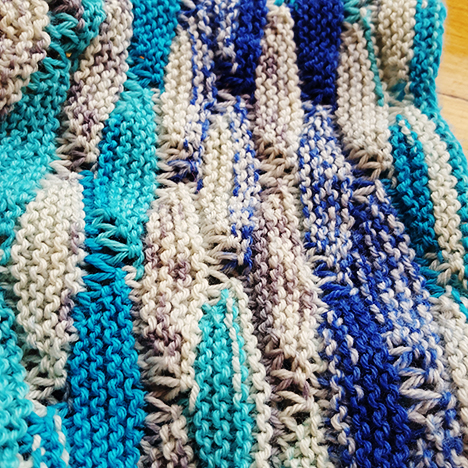
beauty-closeup
And as it has grown larger, I have found myself very pleased indeed. The self patterning is there…it’s just not there in the way the maker intended.

beauty-02

beauty-01
I like this so much that when the challenge is complete, we will put the pattern together–it’s a cowl, worked in the round–and issue it right here on the Makers’ Mercantile blog.

Meanwhile, the second part of the challenge–crochet–is under way with Art Deco in Color 05. I’ll show you in two weeks.

zitronartdecoyarncolor05

Where Are They Now? – An Occasional Look at Past Projects

I am pleased to report that the embroidered Tunisian crochet pillow (in HiKoo CoBaSi Plus) is giving excellent service as a companion to loafing and napping. It still looks as crisp as the day it was finished. Please enjoy this action shot starring Rosamund.

rosamund-finished-pillow
We have plans to eliminate the remaining ugly green throw pillows as quickly as possible.

Tools and Materials Appearing in This Issue

Zitron Art Deco (80% Virgin Wool, 20% Nylon; 437 yards per 100 gram ball). Shown in Colors 01, 02, and 03.

Makers’ Mercantile Leather Purse Cage (shown in Brown)

addi Click Turbo Interchangeable Needle

About Franklin

Designer, teacher, author and illustrator Franklin Habit is the author of It Itches: A Stash of Knitting Cartoons (Interweave Press, 2008). His newest book, I Dream of Yarn: A Knit and Crochet Coloring Book was brought out by Soho Publishing in May 2016 and is in its second printing.

He travels constantly to teach knitters at shops and guilds across the country and internationally; and has been a popular member of the faculties of such festivals as Vogue Knitting Live!, STITCHES Events, the Maryland Sheep and Wool Festival, Squam Arts Workshops, the Taos Wool Festival, Sock Summit, and the Madrona Fiber Arts Winter Retreat. He will lead his own knitting cruise to Bermuda in September, 2018.

Franklin’s varied experience in the fiber world includes contributions of writing and design to Vogue KnittingYarn Market News, Interweave KnitsInterweave CrochetPieceWorkTwist Collective; and a regular columns and cartoons for Mason-Dixon Knitting, PLY Magazine, Lion Brand Yarns, and Skacel Collection/Makers’ Mercantile. Many of his independently published designs are available via Ravelry.com.

He is the longtime proprietor of The Panopticon, one of the most popular knitting blogs on the Internet (presently on hiatus).

Franklin lives in Chicago, Illinois, cohabiting shamelessly with 15,000 books, a Schacht spinning wheel, four looms, and a colony of yarn that multiplies whenever his back is turned.

Follow Franklin online via Twitter (@franklinhabit), Instagram (@franklin.habit), his Web site (franklinhabit.com) or his Facebook page.

Fridays with Franklin: Whither Shall I Wander?

fwf-logo-columnsizeFor an introduction to what goes on in this column, click here.

For the first part of the granny blanket project, click here.

I decided to break open the fourth bun of HiKoo Concentric, and give the granny square blanket a border and edging. In for a penny, in for a pound.

unblocked
My first granny square blanket, as yet unadorned.

Maybe half a pound. I briefly entertained the idea of making the edging elaborate–even frilly. I have vintage crochet books stuffed with hilariously complex edging patterns that look like they’d be at home on Belle Watling’s underwear.

1e84ef69e23e0148010325fbd3154e9e--gone-with-the-wind-southern-belle
Belle Watling, as played by the immortal Ona Munson in “Gone with the Wind.” Her simple, spare style was a revelation to my pre-teen self. Please note, and admire, the owl lamp.

Frills take time, though. I’m still not a quick or clever crocheter; and the calendar was pressing me to finish this project and move on with others. Sometimes a deadline is my best friend–it keeps me from going bananas with those tiny touches that, in sufficient numbers, can crush the life right out of a design.

So my border, at last, was no more than three rounds of double crochet triplets circumnavigating the assembled granny squares.

border-edging
And my edging was a single round of a simple scallop, worked into each open space, with slip stitches between.

crochet-border-simple-franklin-habit-makers-mercantile
I wanted the edging stitch motif to have a bit of heft to it, to give the blanket (which was already drapey in excelsis) even more comforting heft. So the scallop, compared to the typical granny square triplet


stitch-comparison
uses more yarn to fill in the same amount of space.

The swing of the blanket it delicious. But what happens when you cram so many additional stitches of the same gauge into an edging–any edging, knitted or crocheted? The edge will ruffle.

edge-ruffle

I decided to call this a design feature. See my amazing ruffled edge? I meant to do that. Shut up.

I’m honestly awfully fond of this blanket. You can do up a less expensive granny square blanket, to be sure. If you are crocheting one that is going to be dragged around the house by the kids, and have soda pop and corn chips spilled on it, and require heavy laundering once a week, you might prefer to go with something more robust and economical, like HiKoo Simpliworsted.

However, if you are making a special gift; or if you have a reached that divine level of adulthood that allows you to spoil yourself silly with something plush and gorgeous while you nap or cuddle, I don’t think you’d be disappointed in HiKoo Concentric.

Certainly, my personal Blanket Quality Inspector, Rosamund, is taken with it. I was still shooting photographs when she decided to hop up on the worktable and make herself comfortable.

rosamund-grannysquare-franklinhabit
It took some doing, including the rare promise of a spoonful of peanut butter, to get her to give up her seat. And if you think Rosamund is easily pleased by any old blanket, you have not met Rosamund.

hikoo-concentric-grannysquare-draped-franklinhabit

hikooconcentric-crochet-grannysquare

What’s Next?

With the border approaching completion I began to wonder what I ought to show you next. I’m still knitting the second Bee Sock, so that’s not much to see.

But then Makers’ Mercantile told me they’d brought in a new self-patterning yarn from Zitron called Art Deco. In fact, they’re the sole American retailer to offer it. They sent me a few balls to play with, and I’ve decided to use it in a challenge.

artdecoyarnafricanbasket
I love the little basket they sent with the yarn–woven by an ethical collective in Bolgatanga, Ghana; and imported on fair trade terms by Big Blue Moma. Makers’ Mercantile has them in stock, along with larger shopping and project bags.

Zitron Art Deco is designed with self-patterning in mind; but I’m going to try it out in three techniques–knitting, crochet, and weaving on a Zoom Loom–and in every case do my darnedest to mess up the handsome pattern that the very clever and hard-working people at Zitron intended to appear.

I hope they won’t mind too much. I’ve always been contrary when given instructions. As a child I had a collection of Matchbox toy cars, as American boys of my generation were supposed to. But instead of zooming around racetracks and smashing into one another, my cars all had aristocratic titles and eccentric personalities, and gathered for tea and theater parties. (Lady Mathilde Heffington-Smythe was born a Studebaker.)

Remember, just because the label tells you how you should knit it, doesn’t mean you have to knit it the way they tell you. Or that you have to knit with it at all.

So, three two-ball projects with Zitron Art Deco.

One project in Color 01,

zitronartdecoyarncolor01
Zitron Art Deco Yarn, Color 01

one project in Color 02,

zitronartdecoyarncolor02
Zitron Art Deco Yarn, Color 02

one in project in Color 05.

zitronartdecoyarncolor05
Zitron Art Deco Yarn, Color 05

Challenge one: knitting! See you in two weeks…

Tools and Materials Appearing in This Issue

HiKoo Concentric (100% Baby Alpaca; 437 yards per 200 gram cake). Shown in Color 1027 (Trixie).
Zitron Art Deco (80% Virgin Wool, 20% Nylon; 437 yards per 100 gram ball). Shown in Colors 01, 02, and 05.
Woven Pot Basket from Big Blue Moma
Schacht Zoom Loom
addi Color-Coded Crochet Hooks

About Franklin

Designer, teacher, author and illustrator Franklin Habit is the author of It Itches: A Stash of Knitting Cartoons (Interweave Press, 2008). His newest book, I Dream of Yarn: A Knit and Crochet Coloring Book was brought out by Soho Publishing in May 2016 and is in its second printing.

He travels constantly to teach knitters at shops and guilds across the country and internationally; and has been a popular member of the faculties of such festivals as Vogue Knitting Live!, STITCHES Events, the Maryland Sheep and Wool Festival, Squam Arts Workshops, the Taos Wool Festival, Sock Summit, and the Madrona Fiber Arts Winter Retreat. He will lead his own knitting cruise to Bermuda in September, 2018.

Franklin’s varied experience in the fiber world includes contributions of writing and design to Vogue KnittingYarn Market News, Interweave KnitsInterweave CrochetPieceWorkTwist Collective; and a regular columns and cartoons for Mason-Dixon Knitting, PLY Magazine, Lion Brand Yarns, and Skacel Collection/Makers’ Mercantile. Many of his independently published designs are available via Ravelry.com.

He is the longtime proprietor of The Panopticon, one of the most popular knitting blogs on the Internet (presently on hiatus).

Franklin lives in Chicago, Illinois, cohabiting shamelessly with 15,000 books, a Schacht spinning wheel, four looms, and a colony of yarn that multiplies whenever his back is turned.

Follow Franklin online via Twitter (@franklinhabit), Instagram (@franklin.habit), his Web site (franklinhabit.com) or his Facebook page.

Fridays with Franklin: From Bun to Blanket

fwf-logo-columnsize

For an introduction to what goes on in this column, click here.

The last time I wrote about granny squares in this column it was to exult over having finally figured out how to do them.

Those who learned to crochet at mama’s knee are welcome to snicker, but they were a tough nut for me to crack. I was brand new to crochet. I knew nothing. And so often, the answers I got from crocheters to whom I appealed for help were, shall we say, opaque.

lost-bunny

One authority’s response was, “Granny squares? Oh, they’re easy. Just a ring and then double crochet and make sure to work four corners. You can do more corners or fewer if you want a different shape. Okay? Bye.”

I was reminded of a Victorian knitting pattern in my collection that instructs you to make a baby’s jacket by first casting on “stitches sufficient to reach around the baby.”

In any case, after poring over a pile of crochet books, and going so far as to draw maps for myself,

granny-map

I did finish six granny squares and assemble them into a multi-purpose accessory for the bath. You can see it here.

But I still hadn’t made myself the sine qua non of granny-based fabrics: a blanket.

Concentric Buns

Since this space is supposed to be the place where I try new stuff while people watch, it made sense to ask Makers’ Mercantile if I could use one of the newer HiKoo yarns, Concentric, for my blanket.

HiKoo Concentric is interesting stuff. It’s spun from 100% Baby Alpaca, so it’s soft and drapey–two qualities highly desirable in a blanket.

The construction is wild. Check this out.

The strand is made up of what are, essentially, four strands of two-ply lace weight. These four strands aren’t twisted together–they just lie next to one another.

yarn-01

There’s more. Every so often, one of the plies in one of the strands changes color.

yarn-02

A bit further along, a second ply changes color.

yarn-03

Then another, then another, and so forth until they have all changed.

yarn-04

yarn-05

yarn-06

The result is a slow gradient yarn, but the shifts from one color to the next are attractively speckled or flecked.

The yarn is put up into a bullseye bun from which you can work without prior winding.

fwf-63-hikoo-concentric

I picked this colorway, Trixie, and planned a simple experiment.

KISS My Buns

Emphasis on simple. I had a boss once who was entirely useless except as a dispenser of clichéd workplace acronyms, of which his favorite was KISS, or Keep It Simple, Stupid. He used to write it all over my project proposals.

I was still feeling a little scarred from my bout with the stenciled warp, and at the top of my notes for this project I scrawled KISS.

So, what do we do with gradients? Well, one of the things we do with gradients is play them off against one another like so:

gradient

I thought I’d like to do that, too, but rather than work in stripes, I’d do this:

squares-sketch
To join the squares, I considered join-as-you-go (JAYGO); but as is so often is the case, I had to consider portability. A JAYGO blanket very quickly becomes too large to haul around in a carry-on bag, and January through May is the time of year when my teaching schedule keeps me almost constantly away from home.

In Edie Eckman’s excellent book, Connect the Shapes Crochet Motifs, she lays out a method for joining granny squares that gives every square an additional round of double crochet, so the finished effect is side-by-side squares with minimal interruption from the join.

I decided to try it, since I imagined it would allow me to use a new bun of Concentric and run the gradient in the direction opposite the gradient used in the squares.

granny-sketch

So Many Squares

How big would this blanket be? I decided that through the highly scientific process of choosing a size of square that seemed reasonable to work while sitting in an airplane seat (three rounds), then working an entire bun to see how many I got.

With a US Size 4 (3.5 mm) hook, I got fifty. I kept them in strict gradient order by slipping them onto a stitch holder as they were finished.

gathered-squares
Then I did another bun’s worth, and got fifty-one. Great. I’d do a 100-square blanket. I like easy math.

In another mood, or in another month with less travel, I might have devoted a few hours to figuring out whether to keep the squares in the order they were made, or shuffle them together to make a longer gradient. Perhaps I might thrown them into the air to make them random. But sometimes you just need to make a choice. I decided to keep them in order.

To make the next step as portable as possible, I tied each strip of squares into a separate bundle.

bundles-tied
Because I have a brain like a sieve, I also added numbered tags so I’d know in what order I should attach the bundles.

tagged-bundle

It’s never a waste of time to protect your future self from the silly things it is prone to do.

E Pluribus Unum

Edie’s book is a model of clarity. Still, I was nervous. Even with a couple projects under my belt, I find crochet charts daunting. I asked some of the crochet authorities in my address book for tips, and the replies ranged from “Oh, I never use charts. Just ignore them.” to “You don’t follow them like you do knitting charts. Just sort of look at the chart, and get an idea of what you should do, then go.”

I often wonder if I lack the moxie to crochet.

Happily, Edie offers crystal-clear written instructions. As I compared them to the chart, for the first time the fog began to clear. And the little squares began to become a big square.

joining

After the second strip had been joined, I picked up speed and the process became–dare I say it?–fun.

And then there was one.

unblocked
Now, I know people who say they don’t block crochet. I do. And I always wet block, because when I think about all the places where these squares were made, the idea of not washing the fabric thoroughly makes me green in the gills.

After blocking, I was almost perfectly happy with the project. There’s a patch where the joining rows and the squares are both the darkest grey, and thats reads to me as a black hole in the work. I’m not sure I like it.

blackhole
But the fabric is cuddly beyond words.

finished-03

finished-02

finished-04

Aside from that, three buns gave me a lap blanket (the finished dimensions are 33 inches x 33 inches) that is handsome and comforting.

Yet I do have a fourth bun sitting here. A border, perhaps?

edging
Or something to dress up the black hole? I’m gonna go cuddle up under this and think about it.

See you in two weeks…

Tools and Materials Appearing in This Issue

HiKoo Concentric (100% Baby Alpaca; 437 yards per 200 gram cake). Shown in Color 1027 (Trixie).

addi Color-Coded Crochet Hooks

Boye Stitch Holder, Large 3-Inch

Connect the Shapes Crochet Motifs by Edie Eckman

About Franklin

Designer, teacher, author and illustrator Franklin Habit is the author of It Itches: A Stash of Knitting Cartoons (Interweave Press, 2008). His newest book, I Dream of Yarn: A Knit and Crochet Coloring Book was brought out by Soho Publishing in May 2016 and is in its second printing.

He travels constantly to teach knitters at shops and guilds across the country and internationally; and has been a popular member of the faculties of such festivals as Vogue Knitting Live!, STITCHES Events, the Maryland Sheep and Wool Festival, Squam Arts Workshops, the Taos Wool Festival, Sock Summit, and the Madrona Fiber Arts Winter Retreat.

Franklin’s varied experience in the fiber world includes contributions of writing and design to Vogue KnittingYarn Market News, Interweave KnitsInterweave CrochetPieceWorkTwist Collective; and a regular columns and cartoons for Mason-Dixon Knitting, PLY Magazine, Lion Brand Yarns, and Skacel Collection/Makers’ Mercantile. Many of his independently published designs are available via Ravelry.com.

He is the longtime proprietor of The Panopticon, one of the most popular knitting blogs on the Internet (presently on hiatus).

Franklin lives in Chicago, Illinois, cohabiting shamelessly with 15,000 books, a Schacht spinning wheel, four looms, and a colony of yarn that multiplies whenever his back is turned.

Follow Franklin online via Twitter (@franklinhabit), Instagram (@franklin.habit), his Web site (franklinhabit.com) or his Facebook page.

Fridays with Franklin: Wear the Bee Socks

fwf-logo-columnsizeFor an introduction to what goes on in this column, click here.

This column most often shows you the progress of one project at a time, which I’ve realized gives you a false impression of how I work.

I’ve been cleaning out my primary workspace for eight years, which is the same amount of time I’ve spent working in my primary workspace.

It’s not a complete mess, mind you. If it were a complete mess, it would be complete. Nothing in here is complete.

I have a sort of area devoted to “Fridays with Franklin” works in progress. It grows and shrinks and changes its shape and moves hither and thither, like a restless volcanic island made from yarn.

At any given moment there will be three things in progress, supplies for a couple more ideas, supplies from Makers’ Mercantile for which no idea has yet presented itself, and leftover bits of finished projects that haven’t been sorted into storage.

Right now the top of the island is covered by a large (well, large for me) crochet project using HiKoo Concentric, an intriguing alpaca gradient yarn that arrived attractively packaged in a plump bun.

fwf-63-hikoo-concentric
Two luscious buns of HiKoo Concentric from Skacel.

Two these buns have become little bundles of granny squares, and the granny squares need assembly into the final thing.

gathered-squares

But that means hauling around all the granny squares, and I’ve been on the move. That means the first over the finish line will be this pair of socks made with old favorite Zitron Trekking XXL Sport Sock Yarn, shown here in progress on my first set of addi Flexi Flips.

IMG_20180314_064940_259
(I love the FlexiFlips, by the way. My preferred tools for sock knitting have been double-points or two circulars, and these are a sort of hybrid of the two methods. You get a set of three, and two hold the work while you knit with the third. They took a little getting used to, but after about ten rounds, I found myself working faster than usual with hands that were relaxed and comfortable.)

These socks are for me. I don’t have much time to knit for myself, so I choose personal projects with care. Things I need go to the top of the waiting list.

I need these socks, because the only reliable source of reasonably-priced, durable store-bought socks that I’ve counted on for years recently slashed its line to remove all the colors I wanted to wear. No more bright yellows, reds, or purples. No more vivid greens. No pinks, no lavenders, no royal or robin’s egg blues. They still love to trumpet that they offer dozens and dozens of choices; but now all of those choices are either browns, tans, greys, black, or navy. Whee!

I also need these socks because I want socks with a fun motif on them. You can buy men’s socks with motifs, but these are almost always selected from the acceptable list of Things Men Can Have On Their Clothes.

Here’s the classic list:

1. Stuff You Hunt (Deer, Duck, Moose, etc.)
2. Horses
3. Card Suits (Heart, Diamond, Club, Spade)
4. Cars
5. Golf
6. Sailing
7. Naked Ladies

The only lasting additions in the past eighty or so years are “fun” science motifs (e.g., robots, spaceships, atoms) and superhero logos.

Here are things I don’t want on my socks:

1. Stuff You Hunt (Deer, Duck, Moose, etc.)
2. Horses
3. Card Suits (Heart, Diamond, Club, Spade)
4. Cars
5. Golf
6. Sailing
7. Naked Ladies
8. Science
9. Superheroes

I am in no way knocking you if you want these things on your socks. But you are well provided for, and can if you so desire buy what you like right off any number of shelves.

Me, I want colorful wool socks decorated with things men aren’t supposed to like, such as this curly-swirly lyre, taken from a nineteenth-century needlework booklet.

urn-chart
It’s a symbol of the god Apollo, sure; but Apollo doesn’t count as a superhero as he hasn’t got his own best-selling comic book and movie franchise. Apollo wrote poetry and cavorted with muses, both activities the modern American male is supposed to avoid.

Clocked

The socks I want have clocks. A “clock,” in hosiery, is a decoration at the ankle, possibly spreading up the leg a bit. The plural is either “clocks,” which makes sense, or “clox.” I hate the second spelling.

sock-sketch
I could knit the clock into the sock as a piece of intarsia. I have quite a few vintage knitting books with patterns for intarsia clocks,

vintage-montage

But I bristle at the thought of working a sock with a dozen strands of yarn coming off it. I’m sorry, no.

So I thought, why not try to make this happen with duplicate stitch? I’m an old hand at duplicate stitch–last seen in this column on the chest of Rosamund’s Wonder Woofin’ sweater.*

fwf-54-eaglefinished
Duplicate stitch embroidery mimics the structure of the knitting underneath, and if it’s done well it appears to be an integral part of the fabric. It preserves, as well as any embroidery can, the stretch of knitting. It might be just the thing.

If you’re not familiar with the technique, there’s a pretty thorough illustrated write-up of as part of the series on the Wonder Woofin’ sweater. (Bonus: adorable dog pictures.)

The Best Laid Plans

Again, I’ve done plenty of duplicate stitch–but I had never done it on a sock. More to the point, I had never done it at the gauge of this sock–nine stitches to the inch.

It’s my usual practice when embroidering a closed piece of work (like a hat or glove) to insert something, usually a piece of stiff cardboard, inside the work so that I don’t have to worry about accidentally stitching through the wrong part of the fabric. In this case, I have a solid wood sock blocker that did the trick. The fabric wasn’t stretched drum tight–just enough to make it lie nice and flat.

Here we are once again, embroidering our work from a chart, so what do we need? We need guides. I put mine in, using plain white sewing thread, doubled. I put in a baseline, and lines for the horizontal and vertical centers of the motif.

first-guides
Note: To make finding the center stitch a snap, before dividing the stitches to work the heel flap, I put a stitch marker halfway across the stitches at the back of the leg (seen here), and halfway across the stitches at the front of the leg.

For the motif, I first thought I’d use Color 1496. However, paired with Color 1027, it was too close to read well–another cool color, adjacent in the spectrum, almost identical in value. The embroidery would barely have shown up from a couple feet away.

purple-and-blue
Enter Color 1476, an emphatically yellow yellow. (One of the things I love about Zitron Trekking XXL Sport Sock is the enormous range of solid colors.)

purple-and-yellow
Much better.

Then there was nothing more to do than slip a strand into a tapestry needle and get down to it.

Lyre

It did not go well.

It took me two hours to get about five rows up the lyre chart. They were two unpleasant hours, full of language unsuitable for mixed audiences.

After a walk around the block that included a stop at a bar on the far corner, I took a fresh look at the thing and found it to be lopsided, full of stitches not quite of the correct size, and containing one error so fatal that further progress was impossible.

I ripped it all out. Which took another hour.

ripped-lyre
Kaboom!

Lyre, Lyre

I tried twice more. I ripped out twice more. I threw things.

Hive Mind

I decided I didn’t really like the lyre, anyway. What I really wanted on my sock was a bee. This bee, from an Edwardian filet crochet chart. I’ve been wanting to put this bee into or onto a project of some kind for years.

bee-chart
Bees are a favorite symbol of mine. So industrious. Famously busy. Elegantly designed.

Twice more, I started.

bad-bee-progress

Twice more, I ripped.

Just as I was about to give up and admit to you my utter failure, I realized what was tripping me up. I was doing everything I could to ensure success: working while alert, working without distractions, working under the best possible lighting conditions.

And yet, time and again, my it wasn’t working. I mean, look at this.

bee-annotated

The problem? I couldn’t always see–even under brilliant lighting–which row of stitches was which. So I’d suddenly jump up or down a row, or take a stitch that was two rounds high instead of one.

I needed more guidelines.

So I ripped myself back to a blank slate, and I put in lots and lots of guidelines.

The center, of course, yes. But also a guideline for every row in the chart.

guidelines-in-place
That may look like a lot to do, but we’re talking about a motif 19 rows high. Putting those guidelines in took about ten minutes.

And with them in place…

bee-progress

…the embroidery took about an hour.  And it was fun. The guidelines saved me at least a dozen times from making a big mistake, and at least five times showed me that I’d made a mistake immediately, which allowed me to correct it without fuss.

bee-on-lines

The guidelines slid right out.

removing-guides

And I had my bee sock.

finished-bee
I’m pleased to report that the embroidery is perfectly comfortable and stretchy–no lumps or bumps, and it flexes along with the knitting.

sock-on-foot
The bee looks lonely, though, so I think I’ll add a second on the other side. And of course, two more on the other sock. Or maybe three.

Oh. The second sock. I need to knit the second sock.

Maybe after I finish the big crochet project. See you in two weeks!

*I know. Superhero. But she’s the only one I like.

Tools and Materials Appearing in This Issue

HiKoo Concentric (100% Baby Alpaca; 437 yards per 200 gram cake). Shown in Color 1027 (Trixie).

Zitron Trekking XXL Sport Sock Yarn (75% Superwash Merino Wool, 25% Nylon. 459 yards per 100 gram skein.) Shown in Color 1407 (sock), 1476 (bee), 1496 (blue).

addi FlexiFlips flexible knitting needles (length 8 inches, shown in size US 0)

About Franklin

Designer, teacher, author and illustrator Franklin Habit is the author of It Itches: A Stash of Knitting Cartoons (Interweave Press, 2008). His newest book, I Dream of Yarn: A Knit and Crochet Coloring Book was brought out by Soho Publishing in May 2016 and is in its second printing.

He travels constantly to teach knitters at shops and guilds across the country and internationally; and has been a popular member of the faculties of such festivals as Vogue Knitting Live!, STITCHES Events, the Maryland Sheep and Wool Festival, Squam Arts Workshops, the Taos Wool Festival, Sock Summit, and the Madrona Fiber Arts Winter Retreat.

Franklin’s varied experience in the fiber world includes contributions of writing and design to Vogue KnittingYarn Market News, Interweave KnitsInterweave CrochetPieceWorkTwist Collective; and a regular columns and cartoons for Mason-Dixon Knitting, PLY Magazine, Lion Brand Yarns, and Skacel Collection/Makers’ Mercantile. Many of his independently published designs are available via Ravelry.com.

He is the longtime proprietor of The Panopticon, one of the most popular knitting blogs on the Internet (presently on hiatus).

Franklin lives in Chicago, Illinois, cohabiting shamelessly with 15,000 books, a Schacht spinning wheel, four looms, and a colony of yarn that multiplies whenever his back is turned.

Follow Franklin online via Twitter (@franklinhabit), Instagram (@franklin.habit), his Web site (franklinhabit.com) or his Facebook page.

Fridays with Franklin: Fluff My Cushions, Concluded

fwf-logo-columnsizeFor an introduction to what goes on in this column, click here.

For the first part of this series, click here.

For me, part of the attraction of an envelope-style cushion cover is the ease of assembly. It’s all straight seams, and not many of them.

You will most often have, as I had, three pieces. The front,

cushion-aerialshot-fridayswithfranklin-crochet-tunisian

the lower part of the back, and the upper part of the back (which has the buttonholes in it).

You make them into neat little three-layer stack like this, with the right sides of the back panel pieces facing the right side of the front panel.

fwf-63-pieces-diagram

And then you sew the edges together. Well, I sewed, using backstitch and a strand of HiKoo CoBaSi Plus. If you absolutely detest sewing, then you can crochet the seams together. I’d use slip stitch, I think. Purely a matter of personal choice.

fwf-stitching-markedup
Of course, this assumes (as sewing diagrams usually do) that you are right-handed. Left-handed persons will likely find it more comfortable and efficient to reverse the direction of seaming. In the end, the result is the same.

What’s important is that you stack your layers as shown above, so that when you turn the piece right side out, the top of the envelope (with the buttonholes) will be on the outside.

To mark the locations of the buttons on a piece like this, I like to insert the pillow form first. Then, after pulling the upper flap over the lower to the desired position, I slip a locking-ring stitch marker through the buttonhole and into the fabric.

fwf-63-buttonsmarked

Take the pillow form out again, and sew on your buttons.

As in attaching the buttons to my Five-Hour Baby Jacket, I used small buttons to back the “public buttons”–it makes them stronger and more stable, and keeps the button shanks from just sinking into the fabric as you sew them on.

fwf-63-buttonback
All in a neat row, like obedient little ducklings. The heart, it leaps.

fwf-63-buttonrow
Looking at the finished cushion cover, I feel even more convinced of the special joy in using your handwork to outfit your living space.

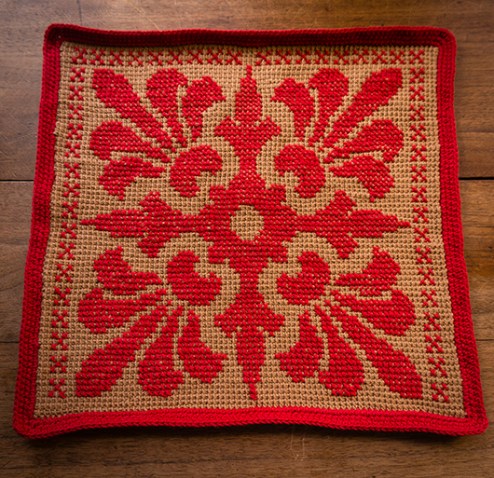
fwf-63-cushionfront

The hideous cushion is gone, replaced by something I will enjoy looking at; and that I can expect to last for a long, long time.

fwf-63-finished-front-shot

fwf-63-closeup-angle

fwf-63-newsletter

It’s an investment in the comfort of my home, plus I’ve had the pleasure of making it.

Now, of course, I’m looking at every other run-of-the-mill throw pillow around here with a crazy gleam in my eye.

Coming Up…

I’m not sure. Because while I’ve been playing with cushion cover and the Five-Hour Baby Jacket, I’ve had two other projects on the go as well.

One is crochet: a lap blanket using this intriguing gradient yarn, HiKoo Concentric. I’m giggly with anticipation to see how this is going to turn out.

fwf-63-hikoo-concentric
The other is knitting: a pair of socks in dear old Zitron Trekking XXL Sport, to be embellished after the knitting is complete. I really want to finish these so I can wear them.

IMG_20180314_064940_259
Knitting merrily on the train from Rome to Naples.

So, which? Come back in two weeks, and I guess we’ll all find out.

Tools and Materials Appearing in This Issue
HiKoo CoBaSi Plus (55% Cotton, 16% Bamboo, 8% Silk, 21% Elastic Nylon; 220 yards per 50 gram hank). Shown in Color 063 (Amber Waves) and Color 047 (Really Red).

Size D (3.25mm) Color Coded Crochet Hook by addi.

Enamel “Elegant Flowers” Buttons by Skacel Buttons in Black, size 22mm.

Clover Small Locking Ring Stitch Markers 353

HiKoo Concentric (100% Baby Alpaca; 437 yards per 200 gram cake). Shown in Color 1027 (Trixie).

Zitron Trekking XXL Sport Sock Yarn (75% Superwash Merino Wool, 25% Nylon. 459 yards per 100 gram skein.) Shown in Color 1407.

About Franklin

Designer, teacher, author and illustrator Franklin Habit is the author of It Itches: A Stash of Knitting Cartoons (Interweave Press, 2008). His newest book, I Dream of Yarn: A Knit and Crochet Coloring Book was brought out by Soho Publishing in May 2016 and is in its second printing.

He travels constantly to teach knitters at shops and guilds across the country and internationally; and has been a popular member of the faculties of such festivals as Vogue Knitting Live!, STITCHES Events, the Maryland Sheep and Wool Festival, Squam Arts Workshops, the Taos Wool Festival, Sock Summit, and the Madrona Fiber Arts Winter Retreat.

Franklin’s varied experience in the fiber world includes contributions of writing and design to Vogue KnittingYarn Market News, Interweave KnitsInterweave CrochetPieceWorkTwist Collective; and a regular columns and cartoons for Mason-Dixon Knitting, PLY Magazine, Lion Brand Yarns, and Skacel Collection/Makers’ Mercantile. Many of his independently published designs are available via Ravelry.com.

He is the longtime proprietor of The Panopticon, one of the most popular knitting blogs on the Internet (presently on hiatus).

Franklin lives in Chicago, Illinois, cohabiting shamelessly with 15,000 books, a Schacht spinning wheel, four looms, and a colony of yarn that multiplies whenever his back is turned.

Follow Franklin online via Twitter (@franklinhabit), Instagram (@franklin.habit), his Web site (franklinhabit.com) or his Facebook page.

Fridays with Franklin: Fluff My Cushions, Part Three

fwf-logo-columnsize

For an introduction to what does on in this column, click here.

For the first part of this series, click here.

With Upstairs Baby nicely clad in his Five Hour Baby Jacket, I returned to the crochet cushion cover.

I’d hoped this edition would show it to you completed, but I’ve been very much on the run for weeks and weeks. February and March are busy months for those of us who teach at shows and shops and festivals, and the cushion had to be fit in between flights and classes and banquets and chatting with students and readers at the Madrona Fiber Arts Winter Retreat and Stitches West, not to mention a lovely dinner with fellow makers at Makers’ Mercantile itself.

That being said, I’ve made considerable progress and I’m excited about how the project is shaping up.

I finished the cross stitching over the Tunisian crochet front panel on my flight home from Stitches West.

28336985_10215683213537968_1175092489739333512_o
Cross stitch at 35,000 feet.

There was more cross stitching than I had intended, because I failed to follow my own advice. I told you to take the time to carefully baste in your thread guidelines before starting the embroidery, right? And told you I’d done it every ten squares, right?

I did. But what I couldn’t admit to you until now is that I’d begun with only the horizontal and vertical center guidelines basted–the bare minimum. My excuse, my feeble excuse, is that I did it in a rush just before leaving for a trip to London; and I persuaded myself that just those two lines would be fine.

I was wrong. I miscounted, you see, and ended up placing the horizontal guideline several squares off the true center. Only after ripping out a major mistake, and putting it my proper grid of guidelines to avoid more such mistakes, did I discover this monumental goof. Well more than half of the center motif had been stitched.

If I’d put in the proper number of guidelines, I’d have found the error right away. Rushing never saves time in the end, does it?

I had a choice. Rip out all the cross stitch, and start over. Or keep going, and hope for a way to fudge things later on.

No matter how virtuous a needleworker you are, this is going to happen from time to time.

So the completed motif had gaps–significant gaps–on three sides. On four sides, it would have been a border. On three sides, it just looked weird.

I decided to go for broke and fill in the gaps with a simple motif, and move on with my life.

cushion-cover-chart-bordered
Testing the border motif on the chart, to make sure it not only looked well, but also fit into the space available.
cushion-bordershot
The border was inspired by a filling motif from the same Edwardian filet crochet book that gave me the main motif.

Those of you who must have absolute symmetry at all times will grind your teeth. But I like it–I often enjoy asymmetry–and I’m keeping it.

cushion-aerialshot-fridayswithfranklin-crochet-tunisian

With the stitching on the front complete, I subjected the fabric to a wet block. As usual, I’m happy that I did.

cushion-soakblock
Crochet soup.

A wet block truly settles the stitches and gives the work a more professional, finished appearance–quite aside from cleaning the yarns, which will have acquired a shocking amount of grime during the transformation from fiber to skein to fabric.

blocked-corner-closeup

cushion-cover-crochet-lowangle-tunisian

On the Flip Side

I thought I’d use double crochet, but even at a firm gauge it just didn’t work for me–too loose, too likely to allow the pillow form (which is white) to show through the gaps.

So I swatched a bit of single crochet

singleanddoubleswatch

and felt better about that. It’s strikingly handsome, especially when worked in the stripes with some of the leftover Color 063 (Amber Waves) that was used for the front.

Both sides look nice, but I decided this side

cushion-backpanel-rightside-crochet

was preferable to this side

cushion-cover-crochet-stripes-wrongside

because it’s slightly neater–no color blips at all where the yarns change. I also like the jazzy zigzag effect.

The fabric curls at the left and right selvedges, but as those will be sewn down in the finished cover that’s not an issue.

cushion-cover-back-panel

You can do an envelope back on a cushion cover without buttons, but I think they give you a neater closure. Plus it’s an excuse to play with buttons. I chose these Skacel buttons from their enamel line.

cushion-buttons-skacel-enamel

I think the style carries some of the florid beauty of the front over to the back.

This means I that I’ll be able to try crochet buttonholes for the first time when I work the top flap. Quite exciting, really. Who could ever be bored, when there’s yarn in the world?

See you in two weeks.

Tools and Materials Appearing in This Issue
HiKoo CoBaSi Plus (55% Cotton, 16% Bamboo, 8% Silk, 21% Elastic Nylon; 220 yards per 50 gram hank). Shown in Color 063 (Amber Waves) and Color 047 (Really Red).

Size D (3.25mm) Color Coded Crochet Hook by addi.

Enamel “Elegant Flowers” Buttons by Skacel Buttons in Black, size 22mm.

About Franklin

Designer, teacher, author and illustrator Franklin Habit is the author of It Itches: A Stash of Knitting Cartoons (Interweave Press, 2008). His newest book, I Dream of Yarn: A Knit and Crochet Coloring Book was brought out by Soho Publishing in May 2016 and is in its second printing.

He travels constantly to teach knitters at shops and guilds across the country and internationally; and has been a popular member of the faculties of such festivals as Vogue Knitting Live!, STITCHES Events, the Maryland Sheep and Wool Festival, Squam Arts Workshops, the Taos Wool Festival, Sock Summit, and the Madrona Fiber Arts Winter Retreat.

Franklin’s varied experience in the fiber world includes contributions of writing and design to Vogue Knitting, Yarn Market News, Interweave Knits, Interweave Crochet, PieceWork, Twist Collective; and a regular columns and cartoons for Mason-Dixon Knitting, PLY Magazine, Lion Brand Yarns, and Skacel Collection/Makers’ Mercantile. Many of his independently published designs are available via Ravelry.com.

He is the longtime proprietor of The Panopticon, one of the most popular knitting blogs on the Internet (presently on hiatus).

Franklin lives in Chicago, Illinois, cohabiting shamelessly with 15,000 books, a Schacht spinning wheel, four looms, and a colony of yarn that multiplies whenever his back is turned.

Follow Franklin online via Twitter (@franklinhabit), Instagram (@franklin.habit), his Web site (franklinhabit.com) or his Facebook page.

Fridays with Franklin: Fluff My Cushions, Part Two

fwf-logo-columnsizeFor an introduction to what goes on in this column, click here.

For the first part of this series, click here.

Somebody call the Vatican, because we’ve had a miracle.

Before I set out to make this pillow cover I measured the pillow. Of course.

My trusty tape measure said (and still says) it is 16 inches square. Measure twice, crochet once.

I worked the Tunisian crochet bit of it to be a bit smaller than that, so I could add a contrasting border in single crochet. That made for a fun change, and was quite simple.

fwf-59-edging-chart

I’m very pleased with the effect. Crochet borders are, as the kids on my lawn say, da bomb.

fwf-59-edge-corner
The finished dimensions of the front panel after wet blocking were almost identical to finished dimensions of the pillow itself, because what I like in pillow cover is zero ease. I want the cover to fit snugly. A loose cover, to me, resembles a sagging diaper or ill-fitting skirt.

Then something extraordinary happened. The moment I began the next stage–cross stitch embroidery of the center panel–the work expanded to cover 400 square miles.

fwf-59-relative-sizes
It’s all fun and games until your crochet blots out the sun.

Or so it has felt at times.

Cross Stitch Over Tunisian Crochet

There are so many excellent guides to cross stitch readily available that I will forbear for the moment to write one here. I do want to talk a bit about what I’ve encountered working cross stitch over a foundation Tunisian crochet.

What makes this crochet fabric so ideal for cross stitch are the nearly perfect little squares that are its hallmark.

If you have only worked cross stitch before on even-weave fabrics like Aida canvas, it can seem confusing at first as to where exactly you ought to take your stitches. There’s some wiggle room here; but you do want to make sure that once you establish your choice with the first stitches, you stick with it throughout

Here’s where I chose to make my stitches–in and out of the four orange dots. The orange cross to the right of them shows the size and shape of the typical resulting stitch.
fwf-59-stitching-holes

Since this is a crocheted fabric, the grain of it is not perfectly square like a true even-weave. The individual cross stitches will show variation.

To keep them as consistent as possible, I’ve worked with the fabric always oriented in the same direction (that is, the same edge always at the bottom while I stitched).

The Importance of Guidelines

When I teach cross stitch, I hammer home the importance of first laying out your guidelines with running stitches in thread. Don’t skimp on your guidelines! The larger your design, the more guidelines you put in.

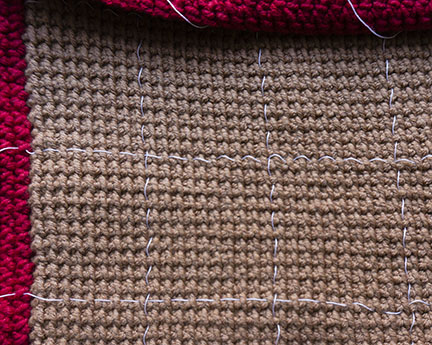
This is the chart I’m using. My guidelines are marked with dashed lines. You’ll note they’re every tenth stitch, in both directions.
fwf-59-cushion-cover-chart

Why so many? Why not just the customary two, to pinpoint the center?

Because in large designs–especially large abstract (non-representational) designs like this, it can be too easy to make a mistake and not realize you’ve done so. The design looks fine, at a glance. You move along, and count from a bit of finished work to establish your next row of stitching–and then, only after doing a bunch more work, you realize your error.

Nobody enjoys ripping out. Put in a bunch of guidelines; and when you count, count from them first. Use stitches you know to be correct as a secondary reference point.

fwf-59-fabric-guidelines
To mark my guidelines, I used regular old sewing thread.

These guidelines also allowed me to look at the design as manageable blocks instead of a large and potentially confusing whole. So I could focus on working one 11×11 square, like this.

fwf-59-cushion-chart-excerpt
That’s  harder to goof up and, frankly, less daunting psychologically.

Keeping Your Twist

I got a very alarmed e-mail from a reader who told me you cannot, simply cannot, embroider with yarns designed for knitting and crochet.

I beg to differ, seeing as I and many others have done so for years. In fact, the booklet I referenced last time, from the early 20th century, was quite gung-ho about it. If it were impossible, someone would have twigged it by now.

I will say that any yarn or thread you choose for embroidery must be strong enough to withstand the repeated abrasion that comes from being pulled through the fabric. Most lightly spun and all unspun yarns are unsuitable–they will fall apart as you work.

Yarns with lots of texture (like coils) won’t pull readily through the small hole made by your needle, nor will yarns with additives like sequins. Beaded yarns may work, if the beads are quite small, but beaded embroidery is a topic I’ll leave for another time.

fwf-58-hikoo-cobasi-plus
HiKoo CoBaSi Plus

HiKoo CoBaSi Plus has worked very well, with one caveat. Like any embroidery strand made from fibers that do not stick together (this includes purpose-made embroidery cottons with multiple plies), the yarn will tend to untwist as you work.

Just pause every so often and twiddle the needle to put the twist back in. That’s all.

Some Now, Some Later

I began working the central motif as I’ve always worked cross stitch: row by row, laying in the first part of the cross from left to right, then completing the row by working back from right to left.

Then, after realizing how much of this piece would be done on the road while teaching or in company when I was liable to mis-read my chart, I decided to take a different tack.

When I’ve been in a situation that allowed me to focus–at home, in my workroom, or alone in a hotel room–I’ve worked only the first part of each cross stitch, filling out the design.

fwf-59-embroidery-progress-shot

Then, when I’ve been in distracting situations like airplanes and airport lounges and cafés, I’ve worked over those established stitches–in other words, that’s when I’ve done the mindless work that requires no counting.

Where Am I?

It’s gone well, though I have not as I hoped finished all the embroidery yet. As I said at the beginning of this installment, what began as a cover for a tiny little pillow keeps growing larger, and larger and larger. Still–I’m pleased. The entire first layer is in, so now I merely fill in the second layer. (I may add borders in the blank areas to the right and left, but I’m not sure yet.)

fwf-59-firstlayer

We’re going to have to pause this project for a bit, anyhow–because a newborn baby in the apartment upstairs needs a warm sweater, quickly, and I have just the thing waiting to be knit up: Zitron Gesa & Flo, with a dash of Schoppel-Wolle Edition 6 Light Fingering.

fwf-59-newballs

I’ll show you in two weeks.

Tools and Materials Appearing in This Issue
HiKoo CoBaSi Plus (55% Cotton, 16% Bamboo, 8% Silk, 21% Elastic Nylon; 220 yards per 50 gram hank)
Zitron Gesa & Flo (100% Ultra Fine Merino. 98 yards per 25 gram ball; shown in Color 8: Lavender)
Schoppel-Wolle Edition 6 (100% Merino Extrafine Superwash Wool. 328 yards per 50 gram ball; shown in Color 2296: English Garden)
Addi HeartStopper
Addi Click Crochet Hook Interchangeable Set

About Franklin

Designer, teacher, author and illustrator Franklin Habit is the author of It Itches: A Stash of Knitting Cartoons (Interweave Press, 2008). His newest book, I Dream of Yarn: A Knit and Crochet Coloring Book was brought out by Soho Publishing in May 2016 and is in its second printing.

He travels constantly to teach knitters at shops and guilds across the country and internationally; and has been a popular member of the faculties of such festivals as Vogue Knitting Live!, STITCHES Events, the Maryland Sheep and Wool Festival, Squam Arts Workshops, the Taos Wool Festival, Sock Summit, and the Madrona Fiber Arts Winter Retreat.

Franklin’s varied experience in the fiber world includes contributions of writing and design to Vogue KnittingYarn Market News, Interweave KnitsInterweave CrochetPieceWorkTwist Collective; and a regular columns and cartoons for Mason-Dixon Knitting, PLY Magazine, Lion Brand Yarns, and Skacel Collection/Makers’ Mercantile. Many of his independently published designs are available via Ravelry.com.

He is the longtime proprietor of The Panopticon, one of the most popular knitting blogs on the Internet (presently on hiatus).

Franklin lives in Chicago, Illinois, cohabiting shamelessly with 15,000 books, a Schacht spinning wheel, four looms, and a colony of yarn that multiplies whenever his back is turned.

Follow Franklin online via Twitter (@franklinhabit), Instagram (@franklin.habit), his Web site (franklinhabit.com) or his Facebook page.

Fridays with Franklin: Fluff My Cushions

fwf-logo-columnsizeFor an introduction to what goes on in this column, click here.

If you ask me, you can tell a civilization is in decline when it stops caring about good throw pillows.

Most of us, if we are lucky, spend quite a bit of time with our throw pillows, and they do so much for us. They hide that coffee stain on the sofa from visitors, they add a certain quelque chose to the bed on days when we make the bed, they support our backs as we knit in a favorite chair, they cradle our heads while we fall blissfully asleep during a weekend binge of The Crown or America’s Next Top Cake Hero.

Yet how much thought do we put into the selection of these small but essential elements of the well-appointed home? Judging from the pillows I’ve seen lately (including on my own sofa), shamefully little.

roz-and-pillow.jpg
Rosamund doesn’t like it, either.

I’ve taken a hard look at the soft furnishings of our nest this winter, in part because for a couple of weeks I couldn’t leave the nest or the Chicago weather would have killed me. And I feel the need of an upgrade.

I don’t even know where that green sofa pillow and its twin came from. They mystify me, because I don’t like that depressing olive green and I don’t like that clammy fabric.

I suspect they came home because I was out at some discount store, remembered that we needed new pillows, and grabbed the least offensive pair off the shelf because they were a) cheap and b) meh, good enough.

Is that any way for a man who claims to be a fancier of fine textiles to act? No, it is not.

Out of the Past

A few years ago I was visiting a friend’s great-aunt, and the friend told her that I knit and crochet. The great-aunt said languidly that the afghan over the back of the couch upon which we were sitting was her own work, circa 1950; and it was the first and last thing she’d ever made because needlework was boring as all hell.

It was quite a showpiece, fashioned entirely from wool, weighing in at about three hundred and forty thousand pounds. Most fascinating to me were five square panels set into the center and corners, each embroidered with florals in cross stitch.

I asked if I could photograph it. She thought that was a weird request, and said no. She changed the subject to the voracious and seismic lovemaking of the newlywed couple in the apartment above. They, on cue, went into action at that very moment and we scrambled to keep the tea service from bouncing off the table. The afghan was forgotten.

Months and months later, I came into possession of a 1916 book of knitting and crochet patterns that included an afghan with cross-stitched panels.

fwf-58-bookpage
I strained my rudimentary crochet skills to understand the method, which the book called “afghan stitch,” and realized it was what I had seen demonstrated at a couple of fiber shows as “Tunisian crochet,” and had read about in a few Victorian books as “tricot crochet” or “tricot stitch.” (And yes, “tricot” is French for “knitting.” Foreshadowing!)

Ever since, I’ve been looking around for a chance to play with the technique, and at last hit me–why not do up a pretty sofa pillow/cushion cover in Tunisian crochet, and embroider it to suit?


The Apparatus

Now, the world of Tunisian crochet is large and varied. This is not the only stitch, but it’s the one called for in all old manuals for cross-stitched panels.

First, a note about the tools for working it.

Tunisian crochet is usually not made with typical crochet hooks, but specialized hooks intended for the purpose. Maker’s Mercantile sells them, and they are usually either double-ended, like these, or have a hook at one end and a stop at the other, like these.

But they also sell a set-up that interested me particularly because of the size of the panel I wanted to make. It looks like this.

fwf-58-hooksetup
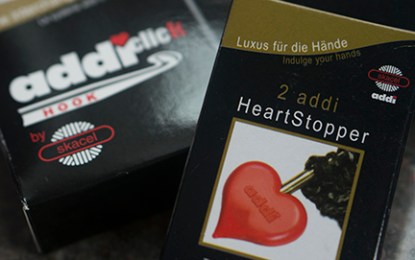
An Addi Click Interchangeable Hook at one end, a cute little Addi Heartstopper at the other.

That’s a hook from the Addi Click Crochet Hook Interchangeable Set, with an interchangeable cable and, to keep the work from sliding off the end, an Addi HeartStopper. A long panel can be heavy, and using a hook on a cable means the weight of the growing fabric slides down the cable to rest, and won’t wreak havoc on your wrists as it might with a traditional hook–one of the same reasons circular knitting needles have become so popular, even for flat knitting.

Also, I knew I’d be working on this project on a lot of airplanes–and a short hook with a short cable is less cumbersome in an airplane seat and less attention-getting at security than a long metal hook.

The Tunisian Crochet or Afghan Stitch, Part I: The Set-Up

You may have noticed that those Tunisian hooks with an end stop look like knitting needles. That’s no coincidence, because this odd form of crochet acts a whole lot like knitting. (Hence the nineteenth century moniker “tricot crochet.”)

In fact, if you are a knitter and think you can’t possibly do this, let me give you all the fundamentals of the basic Tunisian stitch in two steps:

*1. Pick up and knit stitches into your fabric. Don’t turn the work.
2. Now bind off all but one of the stitches you just picked up. Repeat from *.

I’m not kidding. You pick up stitches and you bind them off. You can do that, right?

Let me show you how.

I’ll demonstrate some of the gold HiKoo Simpliworsted left from Rosamund’s superhero sweater. (If you want to crochet a washable afghan that incorporates this sort of fabric, Simpliworsted is a great choice.)

We have to start somewhere, and that somewhere is with a crochet chain. It’s no different than the standard chain you’d use to start a regular piece of crochet.

The chain has two sides to it. The front shows you little Vs.

chainvs

The back shows you little bumps.

chainbumps

We will work the next stage, the “forward” row of picked-up stitches, into the bumps.

Set-Up, Forward Row

Insert the hook into bump nearest the hook,

firstpickup

and pull through a loop of the working yarn. Now–and herein lies a great difference between Tunisian crochet and other sorts–we slip this new loop onto the shaft of the crochet hook. That’s right–just as we keep our knitting stitches on the shafts of our needles.

Continue to pick up a loop through every one of the bumps on the back of your chain, keeping all the newly-created stitches on the hook.

middle-of-setup-forward
In the midst of the set-up forward row.

Do not turn the work. That’s right–don’t turn the work. In fact, never turn the work.

Instead, we will now work a “reverse” row and bind off all these new stitches.

Set-Up, Reverse Row

Yarn over the hook, and pull a new loop through the stitch at the left end of the row.

setup-reverse-01
Yarn over hook, pull a loop through last stitch you made in your forward row.

Yarn over the hook, and pull a loop through the first two stitches on the hook.

set-reverse-02
Yarn over the hook, pull a loop through the first two stitches on the hook.

**Yarn over the hook, and pull a loop through the next two stitches on the hook.

Repeat from ** until you have only one stitch left on the hook.

setup-complete
The forward and reverse rows of the set-up are complete. One stitch remains on the hook. You’re ready to work the rest of the fabric.

Your set-up is now complete. The next section will tell you how to work the remainder of the fabric.

The Tunisian Crochet or Afghan Stitch, Part Two: All the Other Rows

You’ll continue to work your fabric in much the same way–with forward rows (right to left) in which you make new stitches; and backward rows (left to right) in which you bind off all but one of them.

Forward Row

Look at the fabric you’ve created in the set up. You will see a series of vertical “bars.” I’ve marked them here to make them obvious.

verticalbars

Each bar you see has a mate on the back side of the work. We will work only into the bars on the front until the last bar of the forward row.

Put the hook under the second bar in from the right selvedge of the work. Yarn over the hook and pull up a loop.

forward-01
Slide the new loop onto the shaft of the hook.

Repeat into the next bar, and all remaining bars until you reach the final bar–the one at the left selvedge.

forward-02
Working a forward row, making a stitch under each vertical bar at the front of the fabric.

Create the stitch at the left selvedge by sliding the hook under both the front and back bars, yarn over the hook, and pull up a loop.

forward-03
The left selvedge stitch is picked up under both the front and back vertical bars (outlined in orange).

This little change gives you a neat left selvedge that matches the right selvedge.

DO NOT TURN THE WORK.

Reverse Row

Note: This is pretty much identical the reverse row in the set-up!

Yarn over the hook and pull a loop through the first stitch on the hook only.

***Yarn over the hook and pull up a loop through the first two stitches on the hook.

Repeat from *** until one stitch remains on hook.

DO NOT TURN WORK.

first-row-completed
First complete row of fabric (made from one forward and one reverse row) completed.

Begin the next Forward Row, as above.

Bind off as you would any flat piece of crochet.

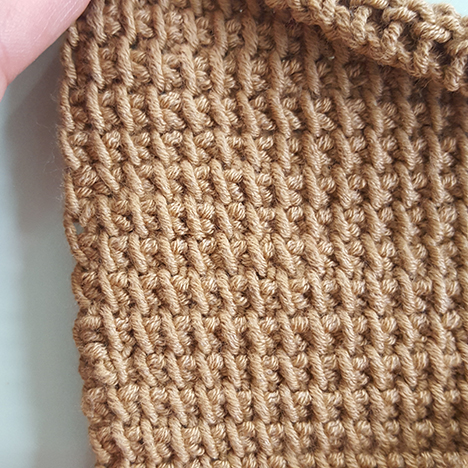
The fabric this stitch creates is intriguing: dense, cushy, and with a surface texture that reminds me of the little square cells in a waffle.

DSC05149

Destination: Throw Pillow 

For my pillow cover, I settled on HiKoo CoBaSi Plus. It’s a worsted weight–unlike the original CoBaSi, which is a fingering weight, and fabulous for wool-free socks and summer shawls.

fwf-58-hikoo-cobasi-plus
Yes, please.

CoBaSi Plus (a mix of cotton, bamboo, and silk–get it?) is strong, soft, durable, springy, lustrous, washable, and feels nice against your face–all important in a cushion you’d like to be beautiful and useful.

In setting about making my fabric, I learned a few things very quickly.

First, when guides to Tunisian crochet tell you to use a hook size that seems large for the weight of your yarn, they mean it. This fabric is tight. Use a hook that would be reasonable for, say, a granny square, you may find very that your fabric is impossible to work without damaging your fingers.

How do you figure out which hook to use? SWATCH. No way around it.

cobasi-swatch
I tried three sizes of hook. The smallest (at the bottom of the photo above) made a fabric so dense that was nearly impenetrable on forward rows. The largest (at the top) made a fabric loose enough for the fabric of the pillow form to show through…tacky. The hook in between (in the middle), a 5mm, was just right. You can barely see the difference in the photograph–but it’s there.

Also, Tunisian crochet has a reputation for being tough on the hands and wrists. I won’t disagree with that–it can be. Using the loosest suitable tension (therefore, the largest suitable hook) will help, as will avoiding yarns (like pure cottons) that don’t like to stretch.

I also found it was far easier on my hands and wrists when I grasped my hook knife-style (in the palm of the hand, rather than resting pencil-style on the thumb), and held it nearer the lower end of the hook, where it joined the cable.

Coming Up…

The making of the fabric was quite pleasant, if occasionally monotonous. But what I was really looking forward to was turning it into a big, bold piece of cross stitch.

fwf-58-newsletter-promo
For that more on that, see you in two weeks.

Tools and Materials Appearing in This Issue
HiKoo CoBaSi Plus (55% Cotton, 16% Bamboo, 8% Silk, 21% Elastic Nylon; 220 yards per 50 gram hank)
HiKoo Simpliworsted (55% Merino Wool, 25% Acrylic, 17% Nylon. 140 yards per 100 gram hank)
Addi HeartStopper
Addi Click Crochet Hook Interchangeable Set

About Franklin

Designer, teacher, author and illustrator Franklin Habit is the author of It Itches: A Stash of Knitting Cartoons (Interweave Press, 2008). His newest book, I Dream of Yarn: A Knit and Crochet Coloring Book was brought out by Soho Publishing in May 2016 and is in its second printing.

He travels constantly to teach knitters at shops and guilds across the country and internationally; and has been a popular member of the faculties of such festivals as Vogue Knitting Live!, STITCHES Events, the Maryland Sheep and Wool Festival, Squam Arts Workshops, the Taos Wool Festival, Sock Summit, and the Madrona Fiber Arts Winter Retreat.

Franklin’s varied experience in the fiber world includes contributions of writing and design to Vogue KnittingYarn Market News, Interweave KnitsInterweave CrochetPieceWorkTwist Collective; and a regular columns and cartoons for Mason-Dixon Knitting, PLY Magazine, Lion Brand Yarns, and Skacel Collection/Makers’ Mercantile. Many of his independently published designs are available via Ravelry.com.

He is the longtime proprietor of The Panopticon, one of the most popular knitting blogs on the Internet (presently on hiatus).

Franklin lives in Chicago, Illinois, cohabiting shamelessly with 15,000 books, a Schacht spinning wheel, four looms, and a colony of yarn that multiplies whenever his back is turned.

Follow Franklin online via Twitter (@franklinhabit), Instagram (@franklin.habit), his Web site (franklinhabit.com) or his Facebook page.


This Is Not Going to Be Pretty, Part III: Actually Kind of Pretty

fwf-logo-columnsizeFor an introduction to what goes on in this column, click here.

For the beginning of this project, click here.

I knew if I hesitated before setting the uneven warp to rights, I’d never finish this piece of weaving. I had to take the tide of madness at the flood.

The bunny who represents my Better Judgment had given up on me for the time being and was posting Instagram selfies from various scenic locations in central Ohio.

fwf-58-bunny-selfie
After a fitful night’s sleep, I carried the loom back down to the cellar, clamped it to the table, and set about unrolling the warp. In anticipation, had already cut a long strip of freezer paper to the proper width, carefully, using a rotary cutter and self-healing mat.

In theory I would unwind the warp and re-wind it with proper separation (the freezer paper) between the layers. This isn’t a fun thing to do, but it can be done.

I got about three feet of yarn free of the loom. Then it refused to budge. Refused.

I investigated and found my previous sloppiness had allowed about forty strands at the left edge to slide so far off course that they were now tangled around the warp beam, around the cords that hold the bar to the warp beam, around the bar itself, and around each other.

This meant I couldn’t unroll the warp. I’d need to untangle it–one strand at a time. Then tie the untangled ends to the warp beam. Then re-sley the reed. Then re-wind the warp.

Now ensued a dark, dark moment of the soul in which I considered ripping it all to shreds. Not just the warp. Also the loom. And then setting the house on fire, and changing my name, and moving to Mexico, and beginning life anew as one of those people who sells decorated coconuts outside Señor Frog’s in Cozumel.

If you think I’m kidding, you’ve never stood and contemplated how long it will take you to separate two hundred sticky alpaca warp threads, enmeshed together more tightly than an entire subdivision of suburban swingers throwing themselves into the last orgy before school lets out.

I would show you photographs, but I haven’t any. I was so utterly demoralized I couldn’t pick up the camera.

The only thing that got me through the dark moment was you, dear reader. Also you, and you, and those other readers over there.

It turns out the fear of total failure in front of thousands of people is, for me, motivational.

It took me two days to get the warp back on the loom.

Then I had to weave the damn thing.

fwf-58-rewound

Gettin’ Sticky With It

The re-wound warp was evenly tensioned, but still sticky as an entire subdivision of suburban swingers who have just finished throwing themselves into the last orgy before school lets out.

Baby llama likes to cling to itself. It may become stickier still if you paint it.

This extra-sticky yarn will be even more inclined to stick if you sley it close together. That’s what I had done by putting the Delilah Undyed DK Yarn into in the 12-dent reed that would normally hold fingering or lace weight yarns.

Why do this? Because when you want a warp-dominant fabric–which was my original goal–you will tend to pack the warp threads closer together.

The result of all this stickiness? My sheds wouldn’t open. I’d move my reed up or down, and the warp would just kinda sit there and laugh.

I was able to take care of the worse of the two sheds–the down shed–with a pick-up stick. I put the reed into the down position, then carefully opened the shed with the stick. Once it was open, I put the stick into the shed behind the heddle and kept it there.

fwf-58-stickplacement
When it was time for a down shed, I brought it forward to just behind the reed and pressed it downward. Ta-daaa, open shed. It was an extra step, but it was still faster than having to open the down shed bit by bit.

When it was time for an up shed, I slid the stick to the back of the loom.

Unfortunately, I couldn’t insert a corresponding pick-up stick for the up shed. The two sticks wouldn’t slide past each other behind the heddle as they went into and out of service.

The up sheds took a long time to open. The fabric was creeping along.

I was having renewed visions of selling souvenir coconuts when one of the finest weaving teachers I know–Susan, the owner of Yarnorama in Paige, Texas–stepped in with some advice:

1) Crank up the tension on the warp. Crank it as high as it will go without snapping threads.

2) Spray the warp, as it comes off the warp beam, with a bit of hair spray.

The latter suggestion sounded a little Out There, frankly; but at this point I was desperate. If she had told me to dip the entire loom in honey mustard I would have tried it.

6a00d83451ccbc69e20134852ba7f2970c-600wi

It worked. The sheds began to separate. Not always perfectly, but near enough to make me happy.

fwf-58-weavingitoff

Reader, I Finished It

How to describe the feeling of pulling the woven fabric off the loom? My thesaurus fails me. A fizzy cocktail of relief, joy, pride, excitement.

fwf-58-offdaloom
I secured the ends with hemstitching (which is discussed at length in our previous undertaking, The Warp with Two Brains). Because both the warp and weft (HiKoo Alpaca Lace Light) yarns were–have I mentioned this?–sticky, I worked the hemstitching with pure cotton sewing thread in a pale ecru that matched the warp.

fwf-58-newsletter-shot
A wet finish was essential. There are different ways of doing it. Here’s what I did for this project:

1) I tossed the fabric into hot water with some Soak,

2) smacked the heck out of it with a couple of hefty wooden spoons for a good fifteen minutes (therapeutic),

3) plunged it into cold water, then

4) threw it into my washing machine’s normal spin cycle to remove the excess moisture.

Some folks iron their damp woven fabrics dry at that point. I had other things to do, so I laid mine flat in a space where I was reasonably confident it would be left alone. I took care to make sure it was flat, because there is a danger at this point that wrinkles you leave in place may, in fact, become permanent.

When it was dry, I trimmed the ends

fwf-58-edgetrim

and then brushed them with a hairbrush to make them a little looser and bushier. Not a complete frizz, mind you. And that was purely a design choice. I just thought it looked nicer that way.

fwf-58-fringe

Warp a Lot, Weave a Little

I planned a large wrap with a painted lotus pattern. I put on nine feet of warp.

In the end, I created a scarf 13 inches wide and five feet long. The painted warp is dominant and clearly visible, but the lotus pattern is just a shadowy memory.

During the final spin, some of the twist in the warp let go, so and created interesting little passages of looser, fluffier fabric.

fwf-58-untwist
The fabric is buttery soft. The drape is FAB. U. LOUS.

fwf-58-finished-wrap

This is, without question, the most luxurious and interesting textile I have yet woven. I learned a lot, most of it the hard way. I am excited to try a painted, patterned warp again–knowing what I know now.

I’m glad I did it. Even the Bunny admits that, in the end, the destination was worth the journey. Right? Right?

fwf-58-bun-tired
Next Time…

I cannot wait to show you what I’ve been doing to these skeins of HiKoo CoBaSi Plus

fwf-58-hikoo-cobasi-plus
with these things…

fwf-58-addi-hook-addi-heartstopper

Tools and Materials Appearing in This Issue

Schacht Cricket Rigid Heddle Loom (15-inch version shown)
Schacht Cricket 12-Dent Reed (for 15-inch loom)
Schacht Cricket 15-inch Pick-Up Stick (also available in 10-inch length)
Delilah Undyed DK Yarn (100% Baby Llama, De-Haired)
HiKoo Alpaca Lace Light (shown in 1006 Smoke, 100% Baby Alpaca, 1540 yards per 100 gram hank)
HiKoo CoBaSi Plus (55% Cotton, 16% Bamboo, 8% Silk, 21% Elastic Nylon; 220 yards per 50 gram hank)
Addi HeartStopper
Addi Click Crochet Hook Interchangeable Set
Createx Acrylics Fabric Paint

About Franklin

Designer, teacher, author and illustrator Franklin Habit is the author of It Itches: A Stash of Knitting Cartoons (Interweave Press, 2008). His newest book, I Dream of Yarn: A Knit and Crochet Coloring Book was brought out by Soho Publishing in May 2016 and is in its second printing.

He travels constantly to teach knitters at shops and guilds across the country and internationally; and has been a popular member of the faculties of such festivals as Vogue Knitting Live!, STITCHES Events, the Maryland Sheep and Wool Festival, Squam Arts Workshops, the Taos Wool Festival, Sock Summit, and the Madrona Fiber Arts Winter Retreat.

Franklin’s varied experience in the fiber world includes contributions of writing and design to Vogue KnittingYarn Market News, Interweave KnitsInterweave CrochetPieceWorkTwist Collective; and a regular columns and cartoons for Mason-Dixon Knitting, PLY Magazine, Lion Brand Yarns, and Skacel Collection/Makers’ Mercantile. Many of his independently published designs are available via Ravelry.com.

He is the longtime proprietor of The Panopticon, one of the most popular knitting blogs on the Internet (presently on hiatus).

Franklin lives in Chicago, Illinois, cohabiting shamelessly with 15,000 books, a Schacht spinning wheel, four looms, and a colony of yarn that multiplies whenever his back is turned.

Follow Franklin online via Twitter (@franklinhabit), Instagram (@franklin.habit), his Web site (franklinhabit.com) or his Facebook page.